
Highway 22 connects Castlegar with Trail, B.C., and passes a small residential community of Oasis. A pond is situate between the Highway and Oasis and is the subject of this blog.
There is no intent to discredit the educated human Professional Engineers and Nature’s animal, the Beaver, who continue to apply natural instinct to dam rivers, streams and in this instance, a pond. The Reader needs to smile when reading this story and understand the satire as well as the respect that a retired Professional Engineer has for both.
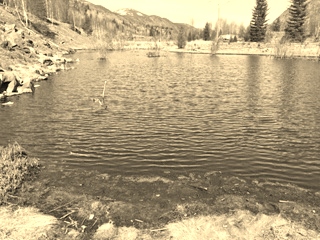
Figure 1 Oasis Pond
The writer suggests that the pond is likely fed by underground drainage from the mountains West of Oasis as it has water in it all year round. The pond has a natural beauty and is used by ducks of all variety, Canada Geese and the Beavers and of course, all the natural organisms that are enjoyed by fowl.
Perhaps a “Scouting Party” of Beavers placed this pond on their short list of potential sites as the Columbia River beside was too swift, too wide and too deep for dam construction.
The Writer grew up in Saskatchewan near Swan River and spent many curious boyhood years watching the Beavers construct a dam on that river which was slow moving, about three (3) feet deep and about 20 feet wide. An abundance of Aspen (White Poplar) trees near the proposed location, is most important as they are relatively easy to gnaw down and the branches and leaves are the preferential food of the Beaver.
It is important to note that Beavers have an advantage over the Hydro Engineers as there never is any need for Public Consultation regarding Rural Farm Lands. It is suspected that the Oasis Pond remains in the Agricultural Land Reserve (ALR) today. The Writer is not aware of any advertised Public Hearings to permit flooding of agricultural lands. The Beaver then, must have special legislative permission that even the Indigenous citizens of Canada do not possess.
The pointed end of the bough is floated downstream and at the precise moment it is depressed on the downstream side with the momentum of tree and beaver used to drive the bough into the stream bottom. In ponds, it is assumed that some physical force is used to embed the bough into the soft bed.
The Writer noted then, as in the pond now, the narrowest width in the stream or pond is selected for the Dam to conserve effort and materials.
This the lower Beaver Dam which separates the original pond into three (3) pools. Figure 2 is the most Southerly pool .
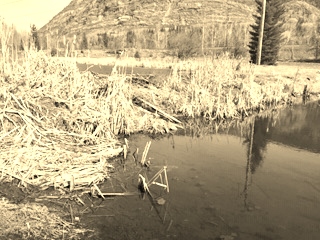
Figure 2 Separation of Southern Pool from top two Pools
A man built a fill area which was available as a starting point on the East side to reduce the width of the Dam. The fill area may have been used by the West Kootenay Power & Light Co. Ld., the original utility that serviced Cominco Smelter in Trail, B.C.
It is interesting to note that pool difference in elevation is about nine (9) feet so that the Beaver engineering instincts needed to consider that the water pressure at the bottom edge of the dam would be approximately 562 pounds per square foot. They were able to widen the bottom to allow for this natural challenge and chink mud, reeds and grass in between the boughs to counteract this challenge. The cross section of the Dam would be about 3 to 4 feet on top with a 60 degree front face and about 8 feet at the base.
Present day Hydro Engineers would need to analyze the available soils to ensure that their earth filled design was relatively impervious to water seepage as they selectively placed the layers of design materials. Obviously the Beavers kept working with the available materials and were just as successful as the Arrow Dam (a bit of satire here of course) but both dams are servicing their purpose.
Universities train their Engineers to design with available materials after researching their strengths. Beavers naturally apply their instincts to achieve the same results. The Writer is sure that the Beaver Project Beaver Engineer would have his Material Testing Beavers search the ponds for the most suitable material sources.
It is not known if the Construction Unions have ever attempted to organize the Beaver Workers or the label the Project “Union Only” as was experienced on the recent Site C Dam on the Peace River. Certainly the Trail Times has not recorded any labour disputes nor work stoppages during construction.
The Writer suggests that this labour peace amongst Beavers is something BC Hydro Constructors would like to research and perfect in their future Projects.
The completed Beaver Dam is shown in Figure 3:
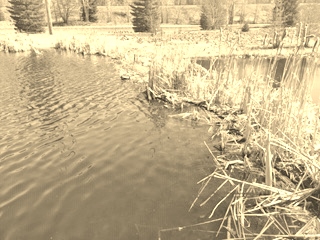
Figure 3 Middle and Southern Pond Separation
The Hoover Dam US Corps of Engineers built with the Convex side into the upstream to have the natural strength of the design to assist in the structural stability. The Beaver Engineers must have had difficulty with the water pressure that caused the dam under construction to shift with their progressive construction. Nonetheless, the final design is a uniform parabolic shape and pleasing to observe.
The Reader must realize that all this effort is to have sufficient water depth to store their food of tree boughs, branches and their leaves so that should winter ice cover the pond, food would always be available to the pond Dwellers who would dive into the pools from their houses to safely retrieve their preserved food.
The Beaver Engineers and Builders, then decided that they needed to extend the flooded areas of Oasis Ponds and constructed a dam to partition the upper Northerly pond into two parts as shown in Figures 4 and 5:
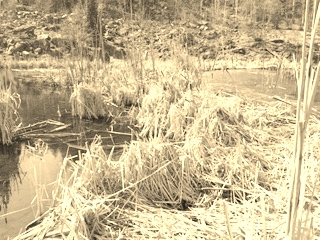
Figure 4 Separation of Most Northerly Pond From Middle Pond
This upper dam is the narrower than the southern dam and has a water level differential of about seven (7) feet. An existing fill area constructed from the East side was again likely by West Kootenay Power & Light Co. Ltd., which the Beaver Dam Constructors utilized to reduce materials required for construction. It can be estimated that the pressure at the deep side of the Dam would be about 450 pounds per square foot. The lateral alignment was essential straight which maybe due to the reduced water pressure as that at the South Dam
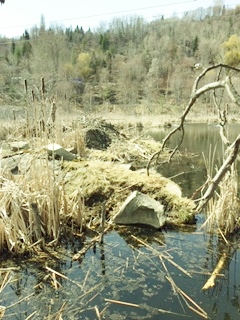
Figure 5 Beaver Condominium 101
The Beaver Housing has this smaller one on the highest elevated pool but adjacent to the Dam. Typically the interior would all be above water level with a full open chamber and likely all as one room. there would be an opening in the middle allowing the occupants access to water without having to expose their cover to predators.
Again residential construction has been permitted in this mixed “zoning” by the authorities. A search of the records of the Regional District of Kootenay Boundary would not uncover construction drawings or a Building / Occupancy Permit issue. Again Beavers have special privileges not afforded the taxpayers. The Writer is sure that BC Assessment has never appraised this building nor is there any taxes collected.
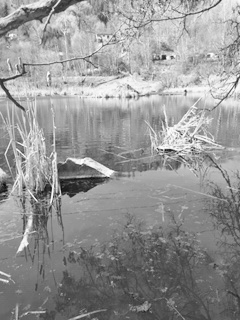 Figure 6 Condominium 201
This second condominium is much larger and further back from the upper Dam. We can philosophy that somehow the Beaver Community was able to make the decision who would occupy each building. It is unknown whether the local School District imposes a requirement to attend school like the rest of the populace.
There is noted evidence that recent construction has taken place on both condominiums. It would be interesting to determine whether this was reinforcing the existing construction or perhaps “raising the roof” to enlarge the living chamber inside.
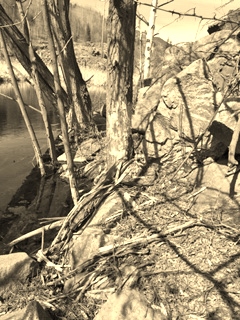
Figure 7 Fresh Beaver Food Gathering
This fresh gnawing of bark appears may be a Beaver food gathering exercise as there is no attempt to gnaw into the tree itself.
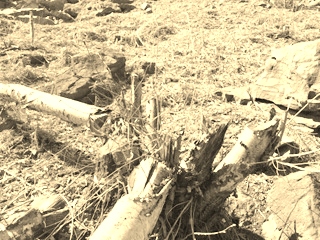 Figure 9 Beaver Tree Gnawing and Falling
This grove of trees were all fallen and the limbs were harvested for food as the trunk has not been “bucked” into sections.
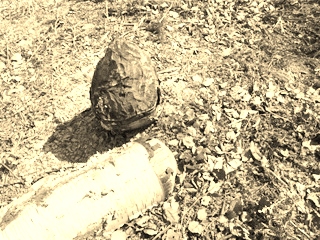
Figure 10 Another Tree Gnawing and Falling Effort
On closer inspection, the Writer notes that the tree is usually gnawed deeper on the side where it is intended to fall and usually directly into the pond or water. Then the gnawing continues on the opposite side to facilitate the tree to topple much the same as a professional human Tree Faller. Very interesting. Unfortunately the wind or the shape of the tree may cause gravity to direct its final trajectory, much to the disappointment to humans and animal alike.
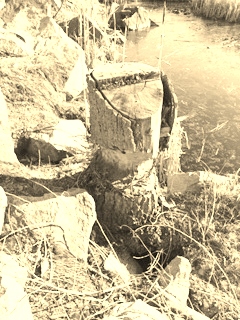
Figure 11 Assistance of Humans to Beavers
This is an interesting stump and the Writer philosophies that the Beavers had started to fall this tree but the Ministry of Transportation and Highways decided to fall the tree away from Highway 22 as a precaution and safety of the motorists using the roadway. The tree trunk was then sawn into bolts but the Beavers abandoned the tree entirely which suggests that it may have been intended by the Beavers to fall the tree in line with the upper Dam to use it as part of a Dam extension.
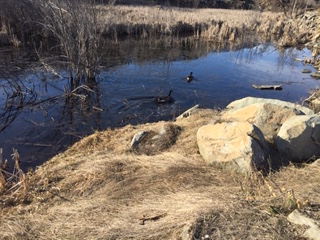
Figure 12 Canada Geese Enjoying Oasis Pond
Nature is in harmony with Canada Geese using this pond as their nesting area. All is as it could and should be.
The Writer has enjoyed writing this story and he wishes that the Readers have appreciated the bit of satire in comparison of Engineers to Beavers.
Written April 09, 2020 by EWV
 Elmer Verigin
Elmer: I finally am getting back to one of my favorite animals from the wild and not so wild areas in the Canadian wilderness. Trecking across the Canadian Shield for more than 50 years, I have encountered these rodents with their specific skill of building dams. I will describe one of the highest dams, that I encountered.
This was prior to GPS days and a walk across the hinterland was with the use of aerial photos and pace-compass traversing. These traverses were planed to encounter the max. of exposed rock surfaces. So when one had to cross an area of swamp/creek, you would pick an area with a beaver dam. This was the situation in the Sioux lookout area in the 1980’s. When I approached the dam-pond conjunction, I could hear no water spill, and on further approach, no pond. I studied the ex-pond area and concluded that it was drained about 4-6 years ago. I had to study the mystery of the dam, so I wandered over. It was almost completely gone. I stood at the base of the missing dam , looked to my left to the top remenants and calculated that the top spillway was a minimum of my hightx4=22 feet. This was an extraordinary feat. I turned to the right to examine the other end of the dam, an there was nothing but a glacial polished rock. Not only that, but I noticed that the angle was such the it expanded, on the down steam side. The original length of the dam would have been 25 feet and the top about 50 feet.
How many additions through the years, only the beaver family history books will tell. The head of water that this 22 foot high dike held would have been astonishing.
No satire needed here,
I wlil add another story in a day or two.
Cheers for now
Tony
Tony
That is astonishing as a 22 foot height would equate to 22 x 62.4 = 1,372.8 pounds per foot at the upstream side bottom of the dam
Wow!
Elmer
Beaver Dam #2
Working in the Precambrian Shield, south of Dryden, Ontario, sometimes in the 1980’s, again I used aerial photos to plan my cross-country traverses. The photos showed an area flooded by beavers, so I chose one at which I would cross over. Arriving at this site, there was no pond, no sound of running water. I arrived at the site where the dam should have been and all was intact; dam 3-5 feet high, no brakes-damages, etc. The new growth was but several years old, so the mystery demanded a further inspection.
On the upstream/pond side, was a stretch of boulders, stripped of all organics. On closer inspection, I could hear the water from the creek flowing between the rocks. The water levels at this time were low ; ie drought. In the Glacial time, this valley was a river and the till was sorted so that only the boulders remained.
When the the beavers chose this site for their dam, the stripped the up stream side of the organic/composte material for their dam, The more they stripped, the more poros the site became. A dry spell finally made them move onto another site or become wolf bate.
Tony
(In love with Nature
Tony:
Your profession took you into the hinterland where you loved to be in your youth. Obviously we share a passion for the outdoors and nature. like you explained to me that you can observe a rock and provide a history of its life span. So it is with nature as it is alive all around us.
The Beavers were very intelligent and predators had a difficult time depending on them to be their dinner.
Elmer