FRIENDSHIPS CAN BE DISCOVERED EVERYWHERE
23 Monday Jan 2023
Posted in Uncategorized

23 Monday Jan 2023
Posted in Uncategorized
26 Monday Dec 2022
Posted in Uncategorized
THE WRITER’S PROJECTS (that he can remember)
A) Design only
There were many instances where the services of Elmer Verigin were required on a design basis only. There were many design for beams, concrete elevated slabs and such like. These included designs of houses, additions and related projects. In these instances, I have not listed the extensive list of clients, The following projects were some that are large enough to list
B) Design-Build
Elmer Verigin was engaged in the design of the development that required a Contractor to complete construction. In some instances Verigin Industries Ltd was the Contractor in many other, independent firms were selected from a public tender process.
In some instances the process involved a search for land, zoning and subdivision with an ultimate design and construction.
C) Tender and Build
Clients would make contact with either Elmer Verigin or Verigin Industries Ltd in Trail and later with Marbella Pacific Construction Ltd or Verigin Construction Ltd in Vancouver. Projects being advertised for tender would be selected for tender. A tendering process would take place and usually the lowest tender would be accepted.
In some instances, selection was made as a second bidder above the lowest as in two (2) of the Expo ’86 contracts and the Nelson House School.
D) Project Management
In this section, Elmer Verigin was engaged as a Professional Engineer to arrange:
The process would include formal reporting on a regular basis to the client in each instance. Recommendations would be suggested to the client with final decisions made by the client. The resulting actions would be taken by the Consultant to completion. In all instances, the client would finance make payments upon inspection for completion to that stage of construction.
E) Professional Investigations and Reports
In these instances, Elmer Verigin was engaged as a Professional Engineer to conduct studies to provide fundamental evidence to enable each client to assess potential liability. In other instances, the purpose was to establish the viability of a potential project. Some events were resolved by negotiation and some projects were “shelved” for reasons out of the control of the Consultant. In several instances, the case was heard before a judge and resolved in favor of the client.
F) Organizations, Societies and Companies
This list comprises of the association that Elmer Verigin may have had in this list along with offices held:
22 Thursday Dec 2022
Posted in Uncategorized
21 Wednesday Dec 2022
Posted in Uncategorized
The International News Story today (December 21, 2022) covers the visit of the Ukrainian President Zelensky to meet with United States Politicians.
This speech, delivered by our Canadian Prime Minister at the time of Ukraine Independence from the Soviet Union, has many references to our Canadian Ukrainian friends. I grew up in Pelly when our neighbors were almost equally Ukrainian and Doukhobor. Our spoken second and third languages were Ukrainian and Russian and we used this to communicate out of preference.
Early in the 1800s Doukhobors were banished to the Ukraine area around Milky Waters. They lived very peacefully and cooperatively until the Russian Government of 1842 banished them again to the Georgia area.
It was deja vu to find Ukrainians and Doukhobors become neighbors again in Saskatchewan.
All politics aside, this speech delivered by our Prime Minister has congratulatory as well as historical content.
Let us pray for a peaceful resolution to this current conflict in Ukraine.
26 October 2010
Lviv, Ukraine
Prime Minister Stephen Harper today made the following remarks at the Ukrainian Catholic University in Lviv, Ukraine:
“Well, thank you very much, everybody, for that really warm welcome. Thank you, Father Gudziak, for allowing me to come and be here today. It’s a pleasure to be with all of you here.
“I would also like to just begin by recognizing some of my parliamentary friends and colleagues who have come from Canada to be with us today. First of all, Senator Raynell Andreychuck, who led an observer mission in the last Ukrainian election. The Chairman of the Canada-Ukraine Parliamentary Friendship Group and Member of Parliament Mark Warawa, and Secretary of the same group, Member of Parliament James Bezan.
“Now as Father Gudziak mentioned, there are strong people-people links between our two countries.
“Ukrainians have been emigrating to Canada for more than 100 years and one and a quarter million Canadians have Ukrainian roots. That’s about 4 per cent of the total population. And that percentage is much higher on the Canadian prairies where I reside. It’s a part of Canada that looks like parts of Ukraine and where you would recognize many of the surnames, as you would for members of the distinguished Ukrainian delegation that is travelling with me here.
“So this is like a homecoming for them. And of course everywhere we go, we are seeing that wonderful hospitality for which Ukrainians are rightly famous.
“Now we’ve had some productive talks with your government. I will come to one part of those discussions that may be of particular interest to you a little later. But before that, I’m really here to speak to you about some other things, deeply important things, values and principles that Canada and Ukraine share.
“When Ukraine first declared independence in 1991, the first western country to recognize your status as a sovereign independent country was Canada. And you might ask why were we so quick to do that? What was the hurry? For we didn’t wait very long. You affirmed your independence on December 1st. On December 2nd, we recognized your government and your statehood. Even before, in fact, the Soviet Union had officially ceased to exist.
“Why? Now, some of you here certainly won’t remember the Cold War. But I can tell you, certainly tell those of us who do, we heaved an enormous sigh of relief when Soviet communism was finally and irrefutably discredited. The communist ideology had purported to be the cure for all that ails humanity. It had just one problem. Before it could work its miracles, it had to jail or kill every living soul who disagreed. And so millions were murdered and millions more were starved. It is a past that must not be forgotten, that must never be swept under the carpet.
“Yesterday, I visited the Holodomor memorial.
“Holodomor was of course officially recognized as a genocide by Canada’s parliament two years ago, largely thanks to the work of my caucus colleagues, in particular James Bezan, who in fact introduced the legislation. Now as you know, almost as many or as you may know almost as many Ukrainians died in the Holodomor during the 1930s as there were Canadians alive at that time. To contemplate an act of malevolence on that scale truly focuses one’s mind on the nature of this evil. So much for communism’s supposed ideals.
“Of course through it all for years, for decades, thousands of Ukrainian Canadians demonstrated at every reasonable opportunity to raise awareness in the west of Soviet oppression. They did so because they knew all too well that their brethren back in Ukraine had no such freedom. And among the leaders of this Ukrainian Canadian vanguard was a parliamentarian from Toronto, named Yuri Shimko, a descendant of Ivan Franko who I know is revered in this city and throughout western Ukraine.
“So, yes, Canadians did rejoice when we saw that ideology of Soviet communism consigned to history’s scrap heap. And when Ukraine reclaimed its freedom, we were more than ready to reach out to those who had lived under communism for all those horrible years.
“Besides the bonds of kinship that exist between Canada and Ukraine, there are important values and principles to promote. As Canadians, we believe that a government must work in the interests of its people, not the other way around. We believe that countries which respect the rights of their own people are more likely to respect the rights of other nations and to be good world citizens.
“And we believe that countries where citizens know what their governments are doing and can hold them accountable are less likely to make war on their neighbours than those were power is the possession of an exclusive ruling class responsible to nobody. There are exceptions. There have been exceptions. There always will be. But the exceptions of anything prove the general rule. If peace is your goal, then a free and democratic society is the way to go.
“Therefore, the cornerstone of Canada’s foreign policy is the promotion of such values: freedom, democracy, human rights and the rule of law, and all the institutions that come with them: property rights, an impartial judiciary, and above all, freedom of expression and a free press. The freedom for which Gongadze became a hero.
“In fact, we do not believe that you can have any one of these things: freedom, democracy, human rights and the rule of law, without the others. But the first is freedom. So that when Ukraine rejoined the brotherhood of the free, we in Canada were among the first to cheer.
“And we have tried to be more than mere spectators. As a friend of Ukraine, we have done a few things intended to widen your road to democratic reform. These have been both done at the governmental level and informally through community and trade organizations. First was the establishment of embassies and consulates immediately after Ukrainian independence. It tells you something about your Canadian cousins, that when the Ukrainian embassy opened in Ottawa, the cost of it was largely covered by the Ukrainian-Canadian community, a great example of how active that community is.
“Since then there have been high-level delegations travelling back and forth, visits to Ukraine by three of our governors general, and twice to Canada by your own presidents.
“And I am proud to point out that Canadians have repeatedly participated as observers in Ukrainian elections in 2004, 2006, 2007 and again this year.
“Canadians are happy to assist with elections because it is in the choosing of the government by the governed that freedom becomes more than just a word.
“There have been many government contacts at an operational level and the Canadian International Development Agency has assisted with programs to encourage small business. In fact today we are announcing six more projects to foster growth and boost grain exports. And of historic importance, we are now working with your government towards a Canada-Ukraine free-trade agreement. Our economies complement each other in several ways and it should be possible to lever our historic and linguistic ties to stimulate trade investment and job creation.
“Trade builds prosperity for everyone and it presents particularly great opportunities for young people such as yourselves who have a global perspective. I said earlier there was something in the current rounds of talks with your government that should be of particular interest to this audience. For many years, our two countries have had a program through which as many as 50 Ukrainian university students a year come to Canada to work as interns in our parliament to see how our parliament works. I’m happy to tell you that yesterday, we took that idea much further and way beyond the confines of government.
“Yesterday, our government signed a youth mobility agreement so that young Canadians and young Ukrainians will find it easier to travel between our two countries and work in each other’s. Obviously as Canadians we want to keep strong and vital the close relationship that we have with the Ukraine. We would love to see lots of you come to Canada, both for work and to have some fun. All we ask is that while you are in Canada, to teach us more about your Ukraine and make sure you share your Canadian experiences with your friends. Tweet about what you see, post the best of your photos of Canada on Facebook. You can help all of us to become better friends.
“Now, ladies and gentlemen, I just want to conclude with this. Your country has been in transition for 20 years. Just as nobody could have predicted the past two decades, no one can say what the future holds. But it is a great time to be alive.
“In fact, as I look about me, I am reminded of a fragment of poetry. Bliss was it in that dawn to be alive, but to be young was very heaven. For ultimately what your country becomes, how it responds to the turns of future history and how you live as citizens, all this will be up to you and your generation. You have great things ahead of you, great things to decide. A whole destiny to shape.
“I would therefore say this not only to you but to all the fine young people of Ukraine.
“As you set about your life’s work, remember that in Canada, you have friends. Friends who respect and admire Ukraine’s heart for freedom, its spirit of national self-determination, and the courage of its people, a courage that has never deserted you, even in the darkest nights of your long history.
“As Shevchenko wrote, and I quote: ‘Strive and you will triumph for God is on your side. The rewards are glory, truth, and that most sacred of things, freedom.’
“I look forward to meeting all of you and I wish all of you good luck in your future. Slava Ukraini! Slava Canada!”
15 Thursday Dec 2022
Posted in Uncategorized
13 Tuesday Dec 2022
Posted in Uncategorized
With all the current concerns of “Global Warming”, I just wanted to share some of my reading materials,
Great Briton has already started the Engineering process to create a Fusion Electric Generator that they plan to be in operation by 2050. That is an ambitious objective considering that this energy is what fuels our Sun and Stars.
Ben Harack Ben Harack’s Blog, Fusion Power
Nuclear fusion power creates very fast-moving electrically charged particles. This post is about the two major methods for converting the kinetic energy of these particles into useful electrical energy.
One of them, heat engines, is a well-proven technology with well-understood operating guidelines and some limitations.
The other, direct conversion, is an very new technology that has not yet had an opportunity to be employed in an industrial setting.
Heat engines are well understood. Almost everyone in the modern world has probably heard of the steam engine, which is an example of a heat engine. Heat engines are a way to convert intense heat into mechanical power.
For electric power production, the steam-driven mechanical power is then transformed into electricity. This is very well understood because we have literally built millions of heat engines. About eighty percent of the world’s electricity comes from steam turbines.
Converting fusion power to electricity through this path requires several energy conversion steps.
All together, we can see that the biggest losses are made during the thermal to mechanical step. Continual efforts are being made to improve heat engines, but there are some fundamental limits they must obey as per the second law of thermodynamics.
Direct conversion is a method by which we can convert fast-moving charged particles directly into electrical current. This is very different from the concept of using the fast-moving particles to cause heat that we then use in heat engines such as steam turbines.
Images for this section drawn from Direct Energy Conversion in Fusion Reactors, by Ralph W. Moir, Lawrence Livermore Laboratories, Livermore, CA.
In order to understand why direct conversion works, you need to understand electric potentials. I will attempt to provide an illustrative explanation here in case the reader is not familiar with the physics of this concept.
First of all, what is potential energy? The classic example is a boulder sitting on top of a hill. The boulder isn’t moving, so it has no kinetic energy (which is the energy of motion). However, since it is on top of a hill, a tiny nudge can send it careening down the hill. This means that is has potential energy. In this case it has gravitational potential energy.
As the boulder rolls down the hill, its potential energy is transformed into kinetic energy. Eventually the boulder will come to a rest some distance from the hill since it will lose its kinetic energy as it rolls (to friction and other energy loss forces).
The key concept here is that potential energy can be transformed into kinetic energy. The opposite is also possible. Imagine that you are driving a car on a smooth road towards a hill. Just as you are nearing the bottom of the hill, you turn off the engine and coast up the hill. You lose speed rapidly as you climb. If you were lucky, you will have exactly enough kinetic energy to reach the top of the hill and stop at the top (balancing precariously like the boulder was originally in our first example).
Now, electric potentials are similar, but we do have to deal with some additional complexities. For instance, there are both hills (positive potentials, created by positive charges) and valleys (negative potentials, created by negative charges).
If we look at the simplistic example of a positively charged particle approaching a positive potential, we can use the hill analogy. So if the positive particle is going fast enough, it can climb all the way to the top of the positive potential ‘hill’. The positive potential resists the attempts by the positive particle to climb, since as we all know, positive charges repel each other.
Things get a bit more complicated when we are dealing with a potential and a charge that are of different signs. In these interactions, we can always regard the potential as a conceptual ‘valley’ as far as what the charge sees. That is, a negative charge will be attracted to a positive potential, causing it to go towards the point of greatest positive potential.
If we are analyzing the motion of a negatively charged particle, we can consider all of the hills and valleys to be reversed, since the force on a negative particle is equal to, but in the opposite direction of, the force on a positive particle.
So, now that we have the concepts of electric potentials under our belts, how do we convert the kinetic energy of a charged particle into an electric potential?
It is important to note that the positively charged particles (the ions) are thousands of times as heavy as the negatively charged electrons, but carry practically equivalent charge. An ion might be carrying +2 charge (lacking two electrons around it), while an electron by itself carries -1 charge. This means that the electron has a much larger charge to mass ratio than ions. This means that electrons accelerate much more quickly than ions when affected electric fields (and potentials). This asymmetry allows us to effectively ‘sort’ these particles onto different electrodes.
First we will look at a relatively simple single-stage direct conversion system. There is a detailed image below that shows what we are talking about. In the image below, particles are propagating from the left to the right. The big circle shows a zoomed-in image of the area delineated by the smaller circled area.
The kinetic energy of the positive particles is transformed into potential energy as they climb the potential hill that is created by the Ion Collector (which is at a very high potential of 100 kilo-volts). Ions strike the Ion Collector and ‘steal’ electrons from it. This has the effect of removing electrons from the target plate, thus increasing its positive potential. Remember that electric potential is created by collections of charge. In this case we have added positive charge to an already positively charged plate, increasing its potential.
On the other hand, since electrons are relatively light, we can reflect them away with a grid of electrodes at a relatively small negative potential. In the image below these are labelled as the “Electron Reflector Grid”, which is at a negative potential of -10 kilovolts. The electrons are thus reflected towards the Electron Collector Grid, which is a different collection surface than the positively charged ions. The negative potential will attract the positive ions, but since it is just a grid (not a barrier), and they are moving with great momentum, they pretty much ignore the electron reflector grid as they fly right past and strike the Ion Collectors.
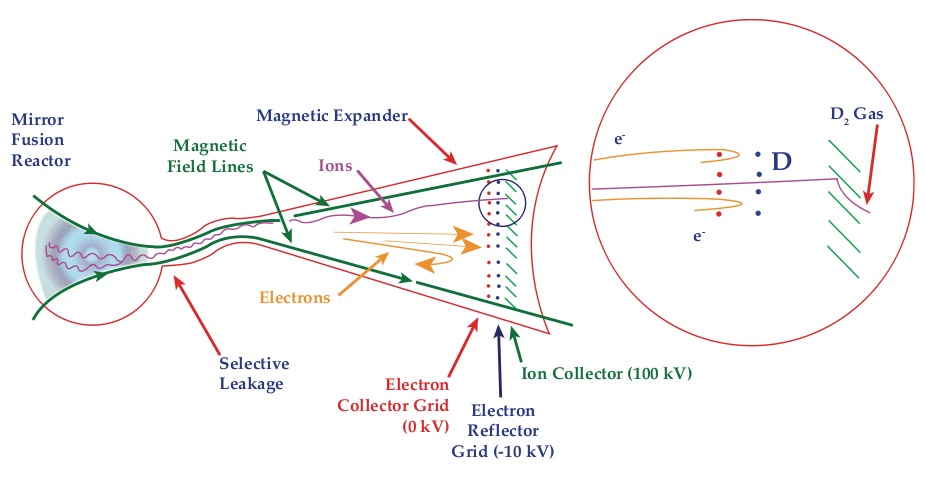
We have thus effectively sorted the incoming particles onto separate collectors according to their charge. We have widened the potential gap between the Ion Collector and the Electron Collector Grid because we have positive current flowing onto the Ion Collector and negative current flowing onto the Electron Collector Grid. This current flow becomes the electric power that we are producing.
This example system has an efficiency limit of about 50% because it is only able to provide one potential for the ions to strike. However, we can expand the concept by creating a potential ‘stairway’. The more energetic a particle is, the further it can go to the right in the image below.
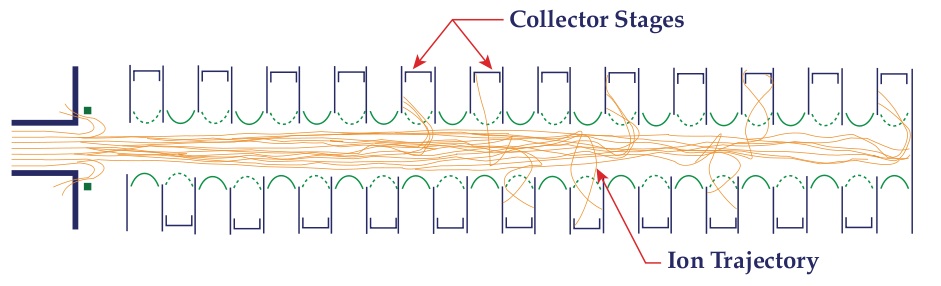
We use a series of positive potential ‘steps’ to slow down the positively charged particles. One can imagine this as a series of steps up the side of a big hill. The more kinetic energy that the positive ion has, the further up the hill it can make it before it runs out of speed/momentum. Again, in the image above, the potential is lowest on the left side and highest on the right side.
In this image, there are 22 ion collectors at progressively higher potentials as you progress to the right. Electrons, as before are reflected by low potential grids (the little dotted half circles) and collected seperately from the ions. The ions end up being sucked in towards the sides slightly by the electron grids and then strike the positive potential plates at each stage.
This 22 stage tester was created in a lab and tested. The test yielded a result wherein 86.5% of the kinetic energy was converted into electricity. This is a much higher efficiency than we can reach using heat engines such as steam engines, which currently max out before 50% efficiency. In the future it may be possible to push the thermal engine efficiency up a few percent, but they are not expected even in coming decades to get anywhere near the efficiencies boasted by the direct conversion method.
That said, we must keep in mind that while this system has been tested on a small scale in a lab, and relies on solid physical principles, we cannot guarantee that it will be able to deliver these efficiencies for a full-sized 1-3 GW fusion power plant. There are certainly some engineering difficulties to be analyzed and overcome before we can claim that this is a fully proven technology like the steam engine is.
Posted December 13, 2022 at 1010 hours by EWV
09 Friday Dec 2022
Posted in Uncategorized
Scientists have successfully ‘reprogrammed’ ear cells to make them grow the hairs which allow humans and animals to hear sounds.
The astonishing discovery brings us ‘a step closer to developing treatments that regrow the missing cells that cause hearing loss’, although applying the treatment to our species is still a long way off.
A team from Harvard University ‘reprogrammed’ the inner ear cells of mice and made them regrow hairs.
‘This paper is the first to show that, by reprogramming, mature mammalian inner ear cells can be induced to divide and become hair cells, which are needed for hearing,’ said senior study author Zheng-Yi Chen, DPhil, an associate professor of otolaryngology-head and neck surgery at Harvard Medical School.
‘These findings of renewed proliferation and hair cell generation in a fully mature inner ear lay the foundation for the application of reprogramming and hair cell regeneration.’
Hearing loss affects 11 million people in the UK and 37 million in the US.
The inner ear cells of humans and other mammals lack the capacity to divide or regenerate, which means that damage is irreversible.
They worked by turning vibrations in the air into electrical signals which are relayed to the brain, but are easily destroyed by exposure to loud sounds and aging.
There are currently no pharmaceutical treatments available for hearing loss.
Previous research has showed cells can be made to regenerate hairs, but not in ‘fully mature’ ears.
Dr Chen said “it is essential to demonstrate that cell division and hair cell regeneration can be achieved in a mature mammalian inner ear’ if we are to cure hearing problems.
They reprogrammed cells by activating two ‘molecular signals’ which made the cells divide, with some of the cells taking on the properties of hair cells.
‘Our work revealed that reprogramming is achieved by re-activation of early inner ear developmental genes so that the mature inner ear regains neonatal properties, which enables them to re-divide and regenerate,’ Dr Chen explained.
‘The most significant aspect of the current study is the fact that fully mature mammalian inner ear still retains the capacity to divide and regenerate if it is sufficiently reprogrammed, which removes a fundamental barrier that has prevented the inner ear regeneration necessary for hearing restoration.’
The team is now working to make drugs which can stimulate the process of regrowing ear hairs.
‘We hope that our research can serve as a model for regeneration of other tissues with similar properties that are unable to regrow cells, such as in the retina and the central nervous system,’ Dr Chen added.
09 Friday Dec 2022
Posted in Uncategorized
Along with difficulty communicating, people with hearing loss are at risk for a number of associated medical problems if they do not take steps to seek treatment. The correlation between hearing loss and a number of physical, social and psychological conditions is well-established; one of the most common is depression.

Approximately 48 million Americans experience hearing loss. New patients experience a variety of emotions including stress, anxiety, fatigue and social isolation, all of which are factors that can lead to depression. A study by the National Institute on Deafness and Other Communication Disorders (NIDCD) showed that 11.4 percent of individuals with hearing loss suffered from depression, a significantly higher percentage than those with good (7.1 percent) or excellent (4.9 percent) hearing. Those aged 18 to 69 were determined to most likely experience depression.
People with hearing loss are also more likely to withdraw from social activities. This increases their risk as social isolation worsens depression.
The key is recognizing the symptoms of depression early. Depression can manifest itself with feelings of sadness and hopelessness, and while these are the most common outward signs, they aren’t the only ones. Less obvious symptoms include:
It often takes a close friend or family member to notice these types of behavioral changes.
The earlier you receive treatment for hearing loss, the less likely you are to experience depression. The following signs, established by the American Speech-Language-Hearing Association, are useful in determining the possibility of hearing loss:
Any of these signs should prompt you to schedule a hearing evaluation with Dr. Jill Davis as soon as possible.
If hearing loss is causing depression, treatment might be as simple as turning on your hearing aids. Researchers at the Archives of Gerontology and Geriatrics found that every patient they studied who wore hearing aids showed a significant decline in negative psychosocial and cognitive conditions within 90 days. To reduce your risk of depression, be sure to wear your hearing aids regularly. Depression is a widespread ailment with serious consequences; avoiding it will only lead to worse health long-term.
05 Monday Dec 2022
Posted in Uncategorized
16 Wednesday Nov 2022
Posted in Uncategorized

