• About

Elmer Verigin

~ My Journey through life Just stories and writings of Elmer Verigin

Elmer Verigin

Monthly Archives: February 2020

THRESHING GANG

17 Monday Feb 2020

Posted by everigin in Uncategorized

≈ 6 Comments

There are many different gangs in this world but this is about a “Threshing Gang”, a dated and unique farmer’s experience, recounted here by someone who was there: with threshing machines, rack and horses along with the people who needed to cooperate in order to be able to harvest their crops.

Historically crops were first cut down with a scythe, allowed to dry and then gathered into a central spot where the threshing would take place with a flail (essentially a whip of different sorts that would release the grain from the husks), The straw would be removed and the precious grain gathered to be ground into meal and flour. A slow process that met the requirements of the time.

During the Industrial Revolution and the advent of machinery, larger tracts of land could be farmed and thus the evolution of Binders to cut and bundle the grains followed by threshing with large sophisticated machines sometimes referred to simply as “Threshers”. This story could take place between 1903 through the mid 1950s prior until the development of moving threshers, or combines, where a farmer may be able to be essentially independent as is the practice in current times in 2020.

So my blog entry is about the dated Threshing Machines and the men who operated them.

Woman leading the convoy of binders

This photo is dated about 1904 and illustrates the machines replacing the historic scythe that reaped the standing grain. The Binder was so named as it would cut the crop and bind it with twine, into sheaves. Although each farmer would require a binder and team of horses, this photo has an early cooperative (Christian Communities Of Universal Brotherhood (CCUB)) working together to harvest. Later Binders were larger and required a team of four (4) horses. Much later, small tractors replaced the horses.

A foot operated lever would drop an accumulation of four (4) to five (5) sheaves into rows.

Bountiful crops were prevalent on the prairie fields

The sheaves (bundles) would then be “stooked” as in the photo. Usually a minimum of six (6) sheaves would form a stook that would be stable to withstand the prairies winds. Care by the “Stooker” who professionally erected the first two sheaves in a stable angle so that it formed the core. The next two sheaves were carefully placed, leaning into this core from each side. If the yield was large, often a sheave was placed from each end to use eight (8) sheaves. There were stooks with 10 sheaves with one placed on each end.

The purpose of the stook was to keep the grain from being in contact with the ground in the advent that a rain and a lengthy inclement weather, could cause the grain to sprout but with the stook, would quickly dry when the Sun came out again.

Care was taken to build the rows so that the teamster and rack could follow the row easily. Usually the horses became accustomed to following the rows on their own, adjusting enough clearance for the “Pitcher” to use a three (3) prong fork to load the sheaves. It is interesting to note that there never was an additional person to sort the sheaves on the rack. The Pitcher became an expert of aiming the sheaf to a location in order that the load would be balanced and not shift on the way to the threshing machine. The sheaves would be stacked about ten (10) horizontal rows, tapering to the top so that the total load was stable. It was amazing to watch these men perform load after load without incident. At age thirteen (13) I had my first “rig” and team of horses which were a “matched” pair of sisters (Molly and Jessie) from a mother mare, Queen. The teams would understand the commands from the Teamster which was interesting to watch.

It was the usual practice, that each farmer, desiring his crops be harvested,  would supply a team of horses, a rig, his fork and bedroll, There would be eight (8) farmers to efficiently, supply sheaves to the threshing machine which was owned by one farmer. This would allow four (4) rigs to each side of the threshing machine feeder. Each farmer usually farmed one quarter section (160 acres) but others had two quarters or more. To mitigate costs, the eight farmers would try to equalize their contribution but the crops were not uniform and so a record of time on each farm needed to be recorded and the agreed cost of each rig would be paid in cash for any additional time. The Owner of the threshing machine and tractor also had a weighted share and the farmers with rigs would try to “work off” their share. It was not that complicated and cooperation and need to help each other usually overcame any deficiencies.

In order to speed up the process (i.e. the threshing machine may be at a distance from the stooks), Field Pitchers were brought in to assist the teamsters to load their rigs. This person moved from one rig to the other. These were usually hired men whose cost was shared by the threshing unit.

Once the rack was loaded, the teamster would climb on top and drive his rig to the threshing machine and take his turn to unload into the Threshing Machine Feeder. Sometimes a friendly game was played in that some Teamsters were able to bring their load in faster than his regular spot in the line. Friendly “ribbing” took place so that the proud farmer did not want to ‘lose face’ amongst his peers.
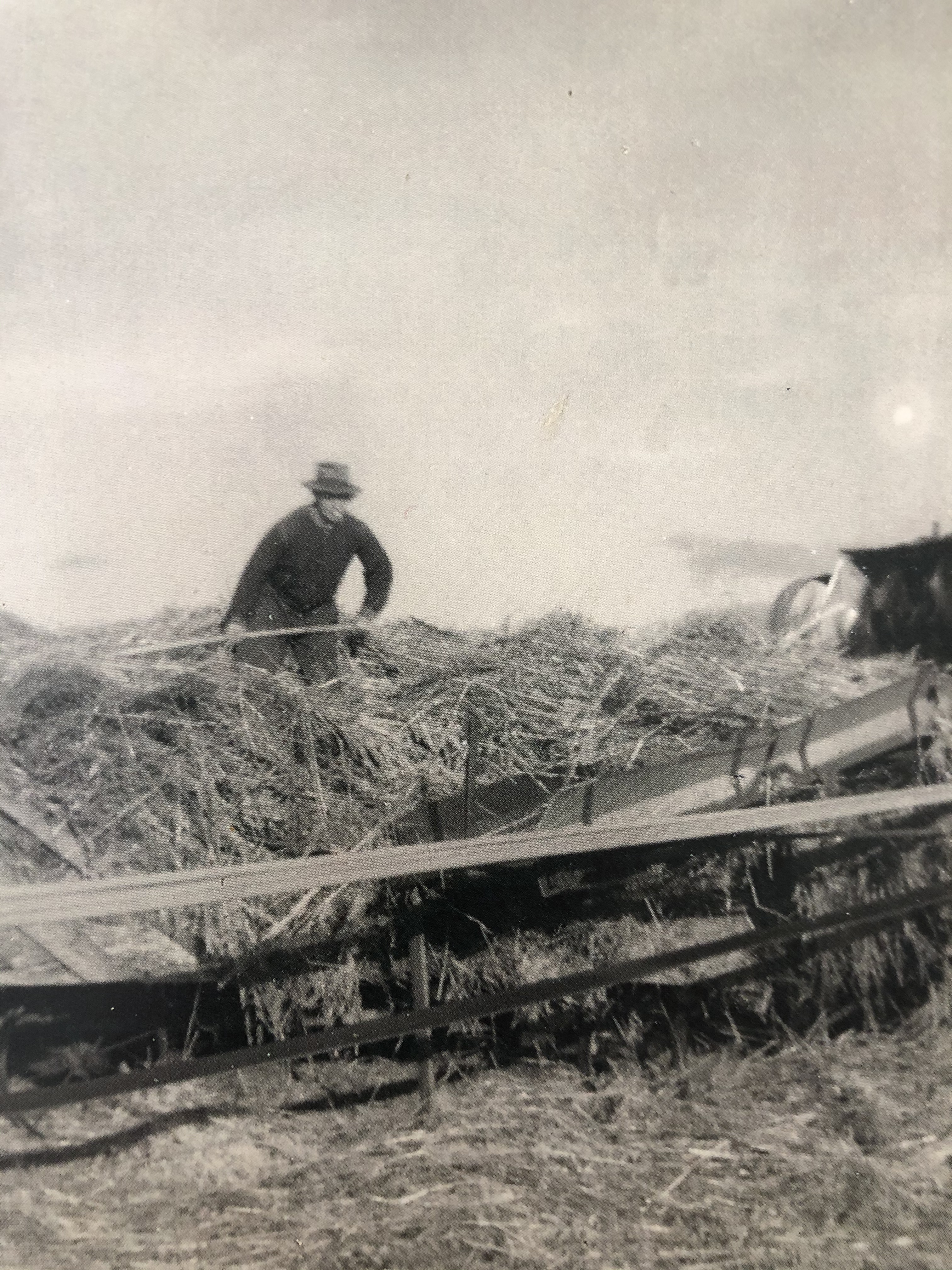
Each farmer cooperated with his neighbours by supplying a “rig”

This photo illustrates the teamster unloading sheaves into the feeder of the threshing machine. This machine, in this photo, is a smaller thresher that could only accept sheaves in one row. The machine in the next photo shows teamsters feeding from both sides .

The horses would be adjacent to moving belts and the dust of the threshing machine but soon become adjusted over time. In my experience, Molly and Jessie seemed to sense when the rack was almost empty and would start to “back up” (to clear the rack from extended moving parts of the threshing machine) so that I had to hurry to throw the last few sheaves as the horses were in a hurry to get away from the dust of and noise of the machine, and they would be at a gallop toward the row of stooks where we had left off. One needed to be quick to get control of the team.

Very interesting how animals have this intelligence!
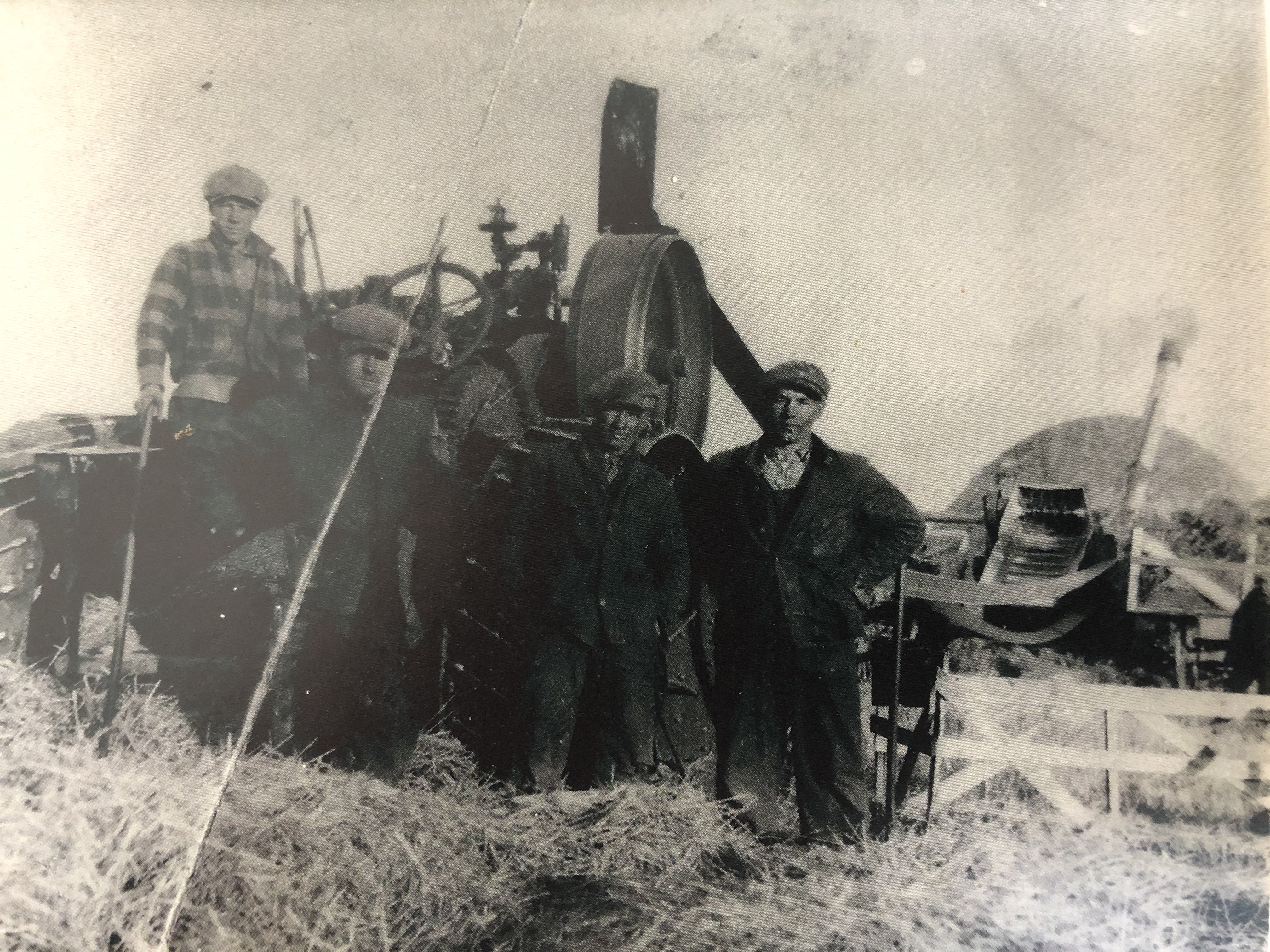
My father (Wasyl) started his farming together with his three (3) brothers (John on extreme left, Wasyl, brother George and Sam on the right) as a cooperative. All families lived together. They were able to purchase a steam engine and a large threshing machine that is depicted in the above photo.

Straw was burned in the chamber that would heat water into steam and propel the piston that moved the engine as well as the pulley that drove the threshing machine. Everyone had a function and together the operation was a success.

Wasyl could neither read nor write but was provided with a Steam Engineer 3rd Class by the Saskatchewan Government.

Later a decision was made to have each family move to independent farms but they still threshed together into the late 1940s.
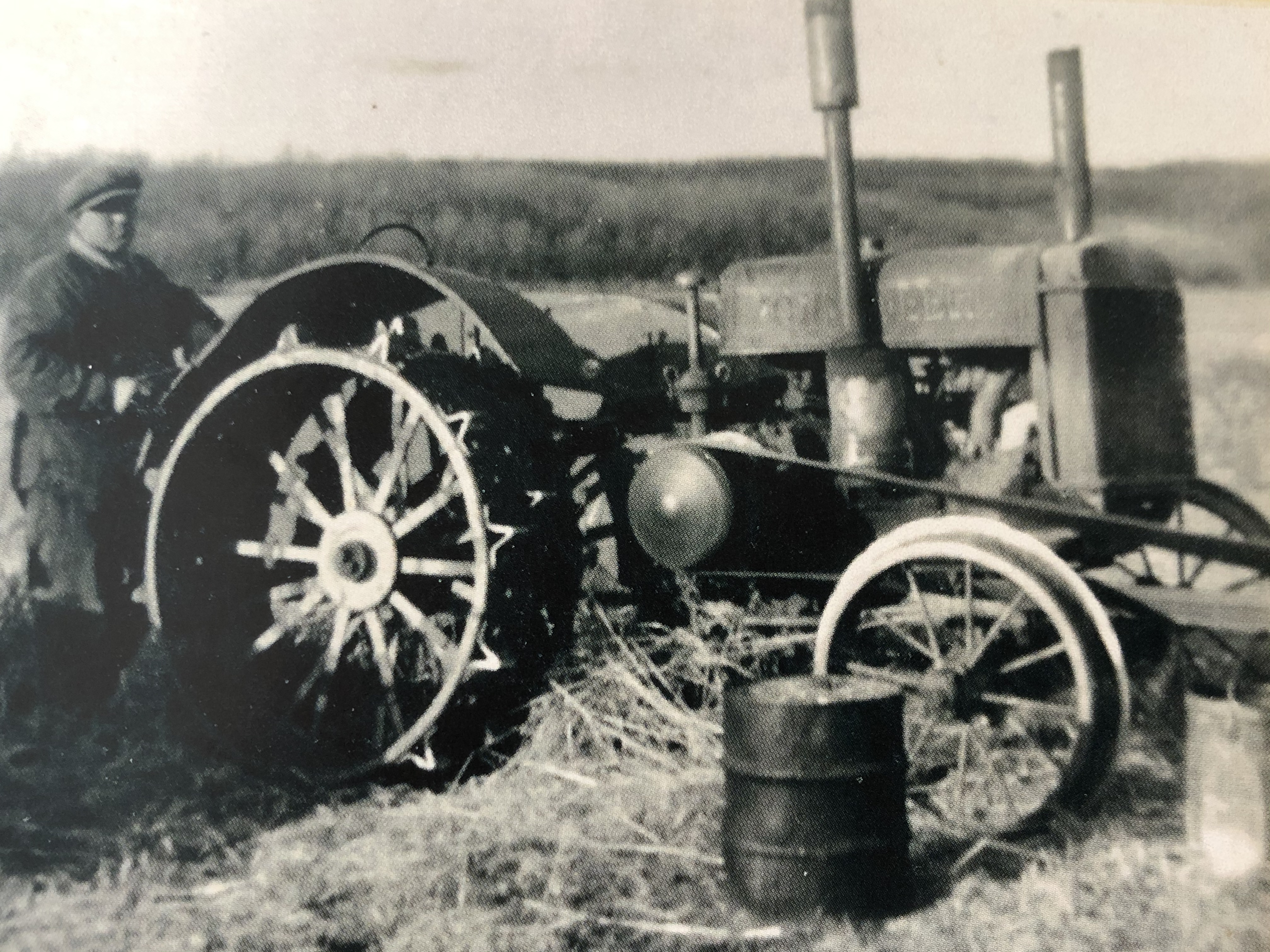
In the 1930s through to laye 1950s a gasoline tractor replaced the steam engine

Gasoline Tractors replaced Steam Engines

When the Verigins separated, Wasyl was given the share of equipment which included the threshing machine and tractor which had replaced the steam engine. Our family moved some twenty-five (25) miles from the Verigin brothers (left near Veregin) and moving the machines became impractical and so Wasyl threshed with farmers surrounding his farm in Pelly.

Threshing together, had a social function for all those involved and became an anticipated pleasure that was looked forward to by many of the individuals.

Firstly, the purpose was of course to harvest the grains which would have been impractical at that time to achieve individually. By working together, they also visited and would share farming methods that assisted those that used the experience to learn from each farmer. The friendships that can be achieved through cooperation far outweighed the negative factors. It seemed that the “bad apples” of the previous year would be “weeded out” so that the new group could function together better in the ensuing year. The “grouping” would start in July, well ahead of harvest as each farmer was anxious to get included in the “gang”.

For the women on each farm, it was the responsibility to ensure that the workers were well fed. Competition by each farmer’s wife was to demonstrate their cooking skills and that they did:

  1. Breakfast was very early and just after the teamsters fed their horses which the morning was well before dawn. Usually the menu was all from farm produce and included pan-fried potatoes and eggs (fried and boiled to preference of the teamsters). Cut up tomatoes mixed with onions and plenty of coffee
  2. Dinner (all teamsters came back to the farmhouse to feed their horses as well as to eat) would include boiled chicken and or a stew. Again cut up vegetables and home baked bread was plentiful. Usually tea was the beverage of choice. Of course there were pieces of cake and cookies.
  3. The mid afternoon Lunch was a treat. A large container (usually the basin that bread dough was mixed in (12 to 14 loaves at a time) was filled with sandwiches. A lot of butter on the bread and baloney filler. Gallon jugs of coffee, that was laced with “too much” cream and sugar, was the beverage. This was carried out to the threshing machine site and the teamsters ate as they came in and before they went out to the field. As a youth, my sister Mary and I had the responsibility of carrying all this to the crews and it was a heavy task as can be appreciated. We always had to wait until all the crews had their fill before we could partake in the feast. I remember the crew would see the saliva dripping from my mouth and they would pass a sandwich to me. There never was any coffee nor sandwiches left no matter how much was delivered to the hungry men.
  4. Supper was usually at least two pots of Borsch, boiled potatoes and roast beef or pork (chicken, turkey, duck or goose) depending what the farmer’s wife wanted to do. Pickles and cut up vegetables were always present. Desserts would include puddings, cookies, etc. There was few left overs if any.
  5. What was most interesting are the stories that floated around the large table that was always set out so that everyone could sit together. The “taller the tale” the greater the laughter. A great deal of “ribbing” took place at something that may have happened out in the field. Of course, the last rig would come to the farm in darkness and not everyone was properly orientated and so there were times that someone got lost and had to be looked for and the laughing that took place afterwards.
  6. Usually a 1/2 section would take a maximum of two (2) days so each house wife needed to prepare accordingly. Obviously she wanted to impress these men so that they would go home and tell their wives what a good cook she was. Yes, competition was vey much in vogue in those days. The men looked forward to the farms where the “best cook” lived.
  7. The teamsters had their own sweat laced bed rolls and would tend to find a corner in the house to stretch out very soon after they tended to the horses.

This blog is about the era of the small farmer and draft horses with 160 to 480 acre farms. The railways were all anxious to provide freight service and organized communities about every ten (10) miles or so along their railway right of way. Grain companies built elevators to receive grain from the farmers and transport same to market. So it was acceptable that the farmer used his horses to deliver his grain to these elevators

.
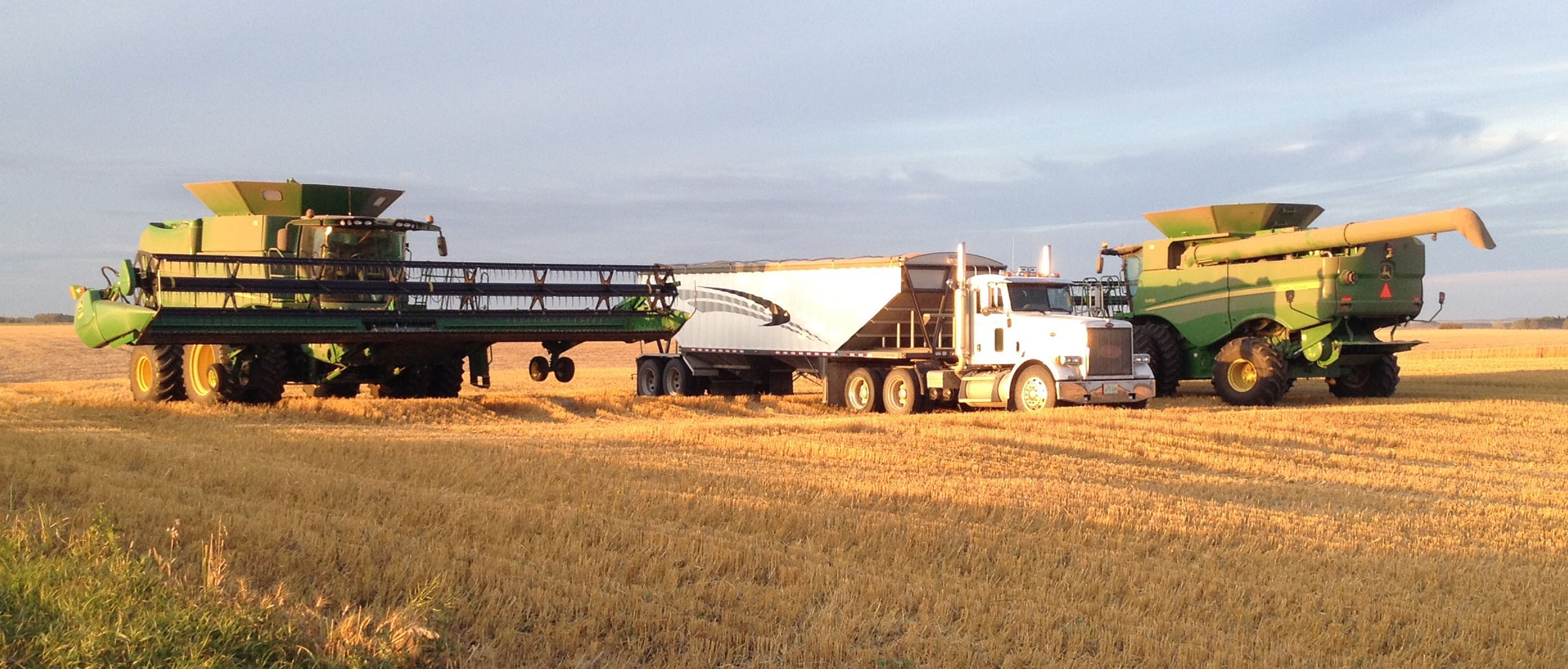
With the move to larger machinery and the combines, farms are now a minimum of 7,000 acres. Large grain tractor trailers are able to move grain a larger distance so that the five (5) elevator villages were replaced with modern computerized grain handling facilities that service about five or more of the original villages with one facility. This had the social economic effect on rural population. Small farmers do not raise any farm animals and thus farming practices have changed dramatically .

I am saddened as I recall five (5) neighbours to our farm where today there are not any at all. The five (5) elevators that rose in the skyline in each community do not exist anymore.

Under construction by Elmer Verigin February 21, 2020, 1145 hours
Vulnerability of Work by Nona Kucher

15 Saturday Feb 2020

Posted by everigin in Uncategorized

≈ Leave a comment

Vulnerability at work………… #itstartswithme!

Written by: Nona Kucher


Shhhhhhhhhh!

That’s right…hide. I can hide in my office, hide in my car, hide in the nights alone at home and hide in my soul but I can’t hide how I feel sometimes. It  may be noticeable, but most times it’s not. For people like me, it’s easy to exist when there is busyness around, especially at work. Many do not know but I have struggled with depression since my early teens. I manage it now but it wasn’t always that way.

The details of why I didn’t want to exist anymore are irrelevant but know there were two significant times in my life where that was the case. The ages were 18 and 47. You may ask “how could this be?” I had so much going for me; a whole life to live out. It’s true… I didn’t want to live anymore but never had the guts to do anything about it, thank god! This didn’t change how I felt, however. Both times were very lonely. Months and months of laying in my bed staring at the walls. I literally gave up the will to go on.

When I look back, it seems so surreal. I have hid behind my reality all these years. Just the thought that I felt that way before scares me so bad. How could I let myself go there? When you are in that place, you don’t see beauty, you don’t see the people that care about you, you don’t see all the things that you could be doing and you don’t even see yourself as a human being. My self-talk was so negative and I made sure I didn’t forget every single bad thing I ever did or said. The more I would put myself down, the weaker I got. The pain of staying on the earth, in this life, was greater than the thought of leaving it. Read that again. The pain of staying on earth, in this life, was greater than the thought of leaving it. It is hard to imagine but these were my real feelings. There just seemed to be no way out!

With my family’s commitment to my health and time that passed, I did get the help I needed but felt so vulnerable. I used to think that vulnerable meant “weak”, “at risk”, “easily hurt” or “attacked” and so on. Vulnerability comes from the Latin word for “wound,” vulnus. Vulnerability is the state of being open to injury, or appearing as if you are.

A couple of years ago, a friend introduced me to a different meaning of vulnerability. I knew I had to change the way I looked at myself in a different way, my mindset and life around me in order to have a meaningful life, “If I don’t change…nothing will change.”

These next words describe me in my vulnerability  and by sharing these definitions I’ve gathered up over the years, in a refreshing light; I hope that it lightens the load that some of us carry for years:

Vulnerability means you fall  easily. You see the best in people. You love them over the little things  — the way their smile shines and the intensity of their stare. You get attached easily, because you give yourself the freedom to feel.

Vulnerability means you are comfortable opening up to other people. You are willing to look someone in the eyes and spill your soul. You want others to know the authentic you instead of forcing a fake smile every time you enter the real world or workplace.

It means your mood can change in an instant. Seeing one sentence on social media can cause your heart to drop. It can ruin your entire day, and cause you to re-think everything you thought you knew about a person or yourself.

You care deeply about things. You do not want to lose what you have, because you love what you have. You love your life — or at least certain pieces of it. Moreover, you are not willing to loosen your grasp on them.

You are willing to jump straight into love and give someone half your heart, possibly giving him or her the power to destroy you or rebuild you. Still working on this…

It means you are comfortable crying over the things that upset you instead of pushing away all of your emotions. You are the type of person that grabs a tissue and let the tears fall instead of replacing your sadness with anger. You admit when you are upset instead of trying to put on an act and appear strong when you are secretly crumbling. Everyone crumbles.

Vulnerability means you have nothing to hide. The people closest to you know about your dreams, your hopes, and your fears. They know who you really are. You have given them permission to dig deep inside of yourself. It is scary but so freeing.

You have a clear understanding of who you are as a person. You realize you are not indestructible. You are not superhuman. You are mortal and full of flaws — but you are still beautiful and you can still be a rock star at work!

You have empathy for people you have never met. Realizing that you are in a community with strangers across neighbourhoods, at work and in the world. That you are connected because you share common thoughts and beliefs, and because of this, you are not so alone after all. In fact, it is the opposite.

You have doubts. You think so highly of other people, of your friends and coworkers and parents, that you cannot stop comparing yourself to them. It does not mean you hate yourself — but it does mean that you see places where you can make improvements and try your hardest to do so.

You admit when you are wrong. You do not pretend to know everything. You realize that you have a lot left to learn, and that there are so many people out there that can teach you more about the universe. Vulnerability means having a huge heart. Caring about others wanting what is best for the people around you, which includes the people you work with.

Vulnerability means you are human — so don’t ever feel bad about shedding a single tear, and admitting that no, you are not fine!

To think that I spent half of my life feeling like I was a bad person because I thought I was weak, in other words, “vulnerable”.

Today, I embrace these new meanings of the word, I embrace me and I embrace the opportunity it gives me at work to check in on my co-workers with this new awareness. My story is my gift to those who are feeling the way I once did and still do sometimes. It’s okay, I am okay, and so are you! #Itstartswithme to have the courage to talk about the silence around us . The more we talk, the more we help.

Help is different for everyone, but always starts with talking to someone, could be your doctor, a counsellor, partner, a loved one, family, friends  or a co-worker like  .

[AJ1]can you expand on “It” a little? would “hiding” work here?

[AJ2]Could you say “These next words describe me in my vulnerability now” just to set up the next part?

[AJ3]Could you say “let your guard down easily” here?

[AJ4]Do you mean you love them for things that are more than meets the eye, a deeper connection?

[PRT5]Anything more to add here Nona?

[AJ6]Could you say “and not stay silent”?

[AJ7]Could this say instead “your partner, a loved one..”?

[AJ8]A very warm, expressive and open piece, Nona. You should be proud

[PRT9]Ditto that Nona!

Nona writes in the “AFTER HOURS” a Teck publication. I was very impressed with the sincerity of my daughter and I asked her for permission to reprint here in my blog.

Posted by Elmer Verigin February 15, 2020 1645

A POSSIBLE MIRACLE FOR THOSE WHO ARE HARD OF HEARING

15 Saturday Feb 2020

Posted by everigin in Uncategorized

≈ Leave a comment

This article is copied here as encouraging news for those of us who are hearing challenged like this myself.

I am praying for these Scientists to be successful in their research as my quality of life is difficult in relationships with my family, friends and public.

You can make your own opinions based on the publication as follows:

Reversing Hearing Loss (article from Harvard Medical School)

News & Research

Reversing Hearing Loss

Reprogramming enables regeneration of inner-ear cells

By RYAN JASLOW December 6, 2019 Research

LuckyStep48/iStock/Getty Images Plus via Getty Images

A team led by Harvard Medical School and Massachusetts Eye and Ear researchers may bring scientists a step closer to developing treatments that regrow the missing cells that cause hearing loss.

In a new study published online December 4 in Nature Communications, scientists report a new strategy to induce cell division in the mature inner ear. With this pathway, they were able to reprogram the inner ear’s cells to proliferate and regenerate hair cell-like cells in adult mice. This proof-of-concept study, and first of its kind, may provide an approach to the regeneration of sensory hair cells and other important inner-ear cell types in people with hearing loss.

Get more HMS news here

“This paper is the first to show that, by reprogramming, mature mammalian inner-ear cells can be induced to divide and become hair cells, which are needed for hearing,” said senior study author Zheng-Yi Chen, HMS associate professor of otolaryngology head and neck surgery and an associate scientist at the Eaton-Peabody Laboratories at Mass. Eye and Ear. “These findings of renewed proliferation and hair cell generation in a fully mature inner ear lay the foundation for the application of reprogramming and hair cell regeneration.”

Hearing loss is one of the most common forms of sensory deficits in people, affecting about 37 million Americans, according to federal statistics. Inner ear cells of humans and other mammals lack the capacity to divide or regenerate; therefore, damage to the inner ear, in particular to the hair cells, leads to permanent hearing loss. Hair cells are the specialized inner-ear cells responsible for the transduction of sound-evoked mechanical vibrations into electrical signals that are then relayed to the brain. A number of genetic and environmental factors, including overexposure to loud sounds and aging, destroys these key cells in the hearing system.

There are currently no pharmaceutical treatments available for hearing loss.

Reprogramming using transcription factors

Hearing loss can be caused by the loss of different inner-ear cell types. The ability for remaining cells to divide and repopulate the ear is one way to achieve hearing recovery.

Previous research has shown that, in the newborn mouse inner ear, cells can be induced to divide and regenerate hair cells after damage. However, in fully mature ears, the capacity for cell division is lost, and hair cell regeneration does not occur. In humans, even a newborn inner ear is fully mature. Thus, Chen and colleagues said that in order to develop new treatments for human hearing loss, “it is essential to demonstrate that cell division and hair cell regeneration can be achieved in a mature mammalian inner ear.”

In the new study, Chen’s laboratory used a reprogramming approach by activating two molecular signals, Myc and Notch, in the adult ear. They found that mature inner-ear cells can be induced to divide. Importantly, some of the new cells developed characteristics of hair cells, including the presence of the transduction channels that carry out the mechanical to electrical conversion, and the ability to form connections with auditory neurons, both of which are essential to hearing.

“Our work revealed that reprogramming is achieved by reactivation of early inner-ear developmental genes so that the mature inner ear regains neonatal properties, which enables them to redivide and regenerate,” Chen explained.

Future targets for pharmaceutical treatments

This work builds on earlier studies identifying the role of Notch in hair cell proliferation. “The most significant aspect of the current study is the fact that the fully mature mammalian inner ear still retains the capacity to divide and regenerate if it is sufficiently reprogrammed, which removes a fundamental barrier that has prevented the inner-ear regeneration necessary for hearing restoration,” Chen added.

Chen’s laboratory is working to discover additional druglike molecules to achieve cell division and hair cell regeneration in the mature inner ear and in large animal models, including pigs.

“We hope that our research can serve as a model for regeneration of other tissues with similar properties that are unable to regrow cells, such as in the retina and the central nervous system,” he added.

The study was funded by the National Institutes of Health (grant NIH R01DC006908), the U.S. Department of Defense (grant DOD W81XWH1810331, Fredrick and Ines Yeatts hair cell regeneration fellowship and the David-Shulsky Foundation (Z768).

Patent applications based on the work have been filed by Chen and some co-authors.

Adapted from a Mass. Eye and Ear news release.

Posted by Elmer Verigin February 15, 2020 1639 hours

A Visit With Nostalgia in Trail, B.C.

05 Wednesday Feb 2020

Posted by everigin in Uncategorized

≈ Leave a comment

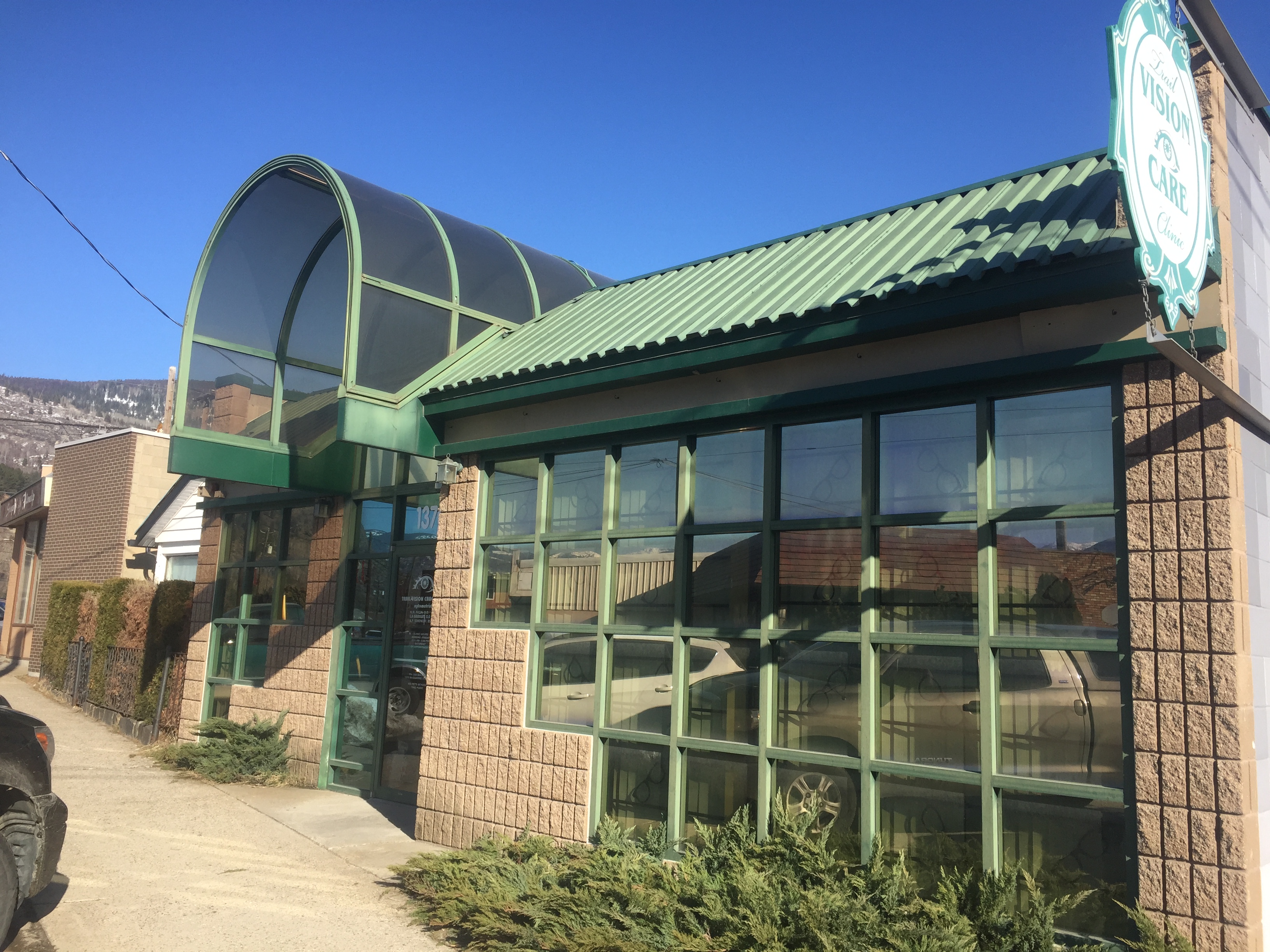
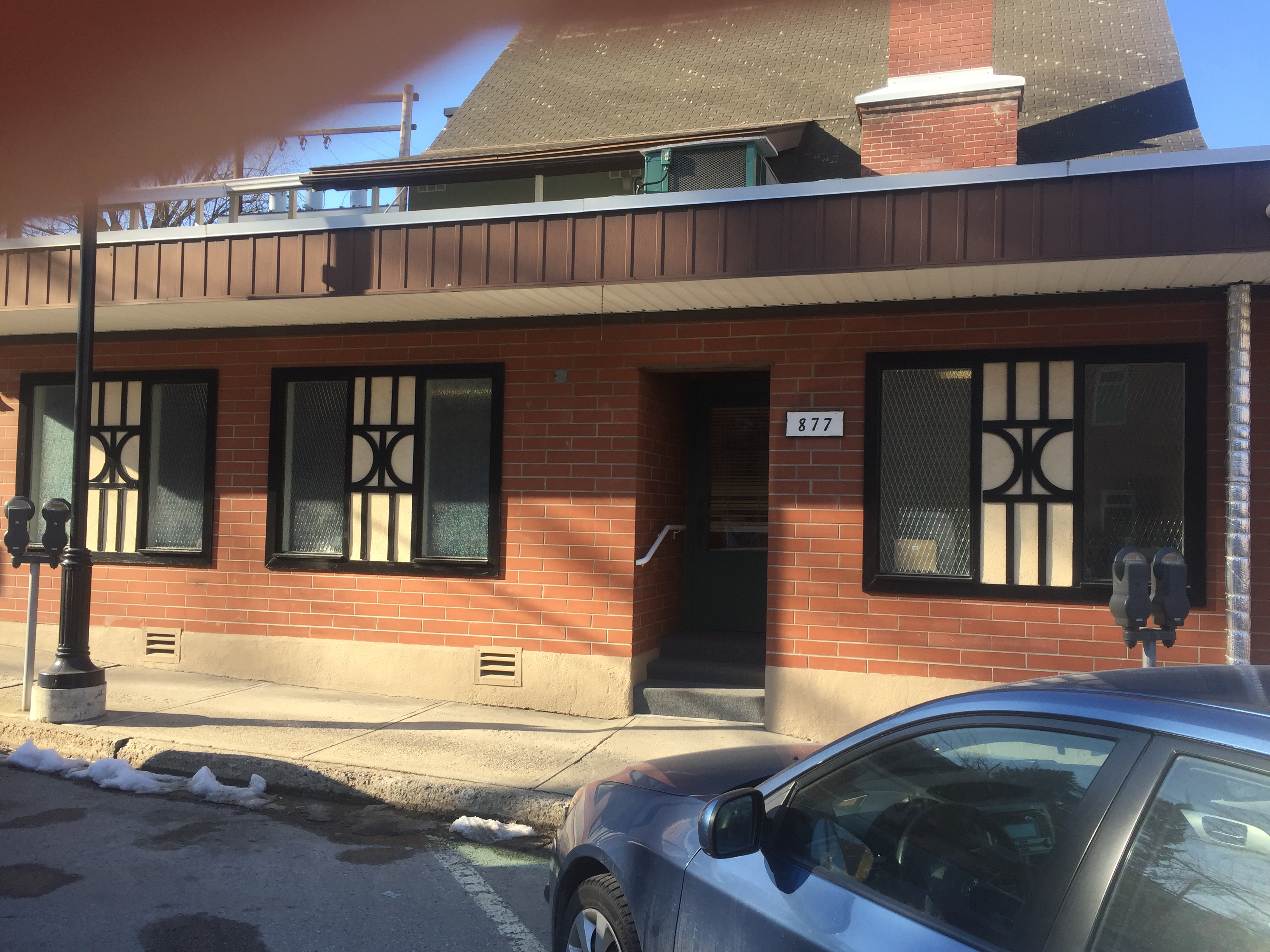
It is 1225 hours,  January 28, 2020 and I am parked in a stall adjacent to 877 Helena Street, waiting for Marilyn to complete her shopping at the Thrift Store around the corner on Bay Avenue. It is raining and generally a dull depressing day.

I look at the building again and suddenly a warm feeling comes over me as I recognize the original Jack Kenderick, Optometrist Building. Memories flood my mind as I recall travelling to Trail in the late 1950s from the family farm at Pelly Saskatchewan to work the Summers with my two (2) brothers, Lawrence and Russel. This was one of many work sites.

I am not sure how Lawrence met Jack Kenderick but that meeting resulted in the L,W. Verigin Construction Ltd being engaged in renovations of an original Trail house on that site. As I recall, Jack would accumulate some capital and invited Lawrence to renovate over several years.

Jack decided that his small Suningdale home needed renovation. A few years l later, I also worked on that renovation. Jack wanted his son David to learn about Carpentry and so David was added to the renovation crew that excavated and constructed a full basement under this house. An addition and Carport filled out the total contract.

Years later, David received an Optometry degree and took over his father’s business. David brought in partners and they decided to build a new building on ____ McQuarrie Street, designed by a special Architect to suit the Optometry business.

David called me and the project was completed with high grade Millwork manufactured in the Verigin Plant.

Marilyn returned and tat was the total flashback in time.

Posted February 05, 2020 1720 hours EWV

Recent Posts

  • SOUL ABODE IN MAN
  • SOUL ANODE IN MAN GRAPHIC VERSION
  • MY EXPERIENCE WITH HEARING LOSS
  • WORLD’S LARGEST WATER WHEEL
  • CONSTRUCTION HUMOUR

Archives

  • November 2025
  • October 2025
  • September 2025
  • August 2025
  • June 2025
  • May 2025
  • April 2025
  • March 2025
  • February 2025
  • January 2025
  • December 2024
  • November 2024
  • October 2024
  • September 2024
  • August 2024
  • July 2024
  • June 2024
  • March 2024
  • February 2024
  • January 2024
  • December 2023
  • November 2023
  • October 2023
  • September 2023
  • August 2023
  • June 2023
  • March 2023
  • February 2023
  • January 2023
  • December 2022
  • November 2022
  • October 2022
  • September 2022
  • August 2022
  • July 2022
  • June 2022
  • January 2022
  • November 2021
  • October 2021
  • May 2021
  • February 2021
  • January 2021
  • December 2020
  • November 2020
  • September 2020
  • August 2020
  • July 2020
  • May 2020
  • April 2020
  • March 2020
  • February 2020
  • January 2020
  • September 2019
  • June 2019
  • March 2019
  • February 2019
  • January 2019
  • December 2018
  • November 2018
  • October 2018
  • September 2018
  • July 2018
  • May 2018
  • April 2018
  • March 2018
  • January 2018
  • November 2017
  • October 2017
  • September 2017
  • August 2017
  • July 2017
  • June 2017
  • May 2017
  • February 2017
  • December 2016
  • November 2016
  • October 2016
  • September 2016
  • August 2016
  • July 2016
  • June 2016
  • May 2016
  • April 2016
  • March 2016
  • February 2016
  • January 2016
  • December 2015
  • October 2015
  • September 2015
  • August 2015
  • July 2015
  • June 2015
  • May 2015
  • April 2015
  • March 2015
  • February 2015
  • January 2015
  • December 2014
  • November 2014
  • October 2014
  • September 2014
  • July 2014
  • June 2014
  • May 2014
  • January 2014
  • December 2013
  • November 2013
  • October 2013
  • September 2013
  • August 2013
  • July 2013
  • June 2013
  • April 2013
  • February 2013
  • January 2013
  • December 2012
  • November 2012
  • October 2012
  • September 2012
  • August 2012
  • July 2012

Categories

  • Family
  • Friends
  • Musings
  • People
  • Uncategorized
  • Whatshan

Meta

  • Create account
  • Log in
  • Entries feed
  • Comments feed
  • WordPress.com

Blog at WordPress.com.

  • Subscribe Subscribed
    • Elmer Verigin
    • Join 40 other subscribers
    • Already have a WordPress.com account? Log in now.
    • Elmer Verigin
    • Subscribe Subscribed
    • Sign up
    • Log in
    • Report this content
    • View site in Reader
    • Manage subscriptions
    • Collapse this bar
 

Loading Comments...