• About

Elmer Verigin

~ My Journey through life Just stories and writings of Elmer Verigin

Elmer Verigin

Category Archives: Uncategorized

A Miracle at Whatshan Lake, B.C.

16 Saturday Feb 2013

Posted by everigin in Uncategorized

≈ 41 Comments

WHATSHAN LAKE RETREAT STORY

A) The beginning

It was in the spring of 1980 that a legal advertisement appeared in the Trail Times under Lawyer Dahlstrom, that an estate sale of lands located at Whatshan Lake was taking place. As was my usual routine, I read the legal ad because I was always looking for construction projects to tender in my responsibility as General Manager of Verigin Industries Limited. My perusal resulted in putting the paper aside as purchasing land for our cash strapped construction company, was not my priority at this time.

Within two months after the first series of ads, I saw the ad again and this time I wanted to know whose estate was involved. The name advertised was McAlister and I knew a visually challenged Engineer in Rossland by the name of Robert (Bob) McAllister. “Did he die?” was my first thought. So I dialed the number in the phone book, not sure whether I would get an answer. I was not interested in responding to the legal ad.

“Hello”, was the response after a few rings, “Can I help you?”

Since I knew Bob, having met him at several local Branch meetings of the Professional Engineers of British Columbia and a few social functions where his hobby of Ham Radio was the subject of some meetings and his professional expertise as an Astronomer, it was an easy response, “Do you know this McAlister that is having an Estate Sale?”

‘”Yes that is me”, he responded. “It was my late father’s estate lands at Whatshan Lake”.

“Is it possible to get drawings and an information package?”I asked.

“Of course, Elmer, come on up,” was his enthusiastic response.

That was how I first became familiar with the Whatshan property.

Bob explained how his father had been employed with West Kootenay Power & Light Co. Ltd., and had explored Whatshan Lake while fishing. The parcel of land at the South end of Whatshan Lake was ideally suited for a power project as the “Head” from the Whatshan Lake level down to the Arrow Lakes on the Columbia River, had the potential for a large hydro-electric project. As an enterprising individual he purchased this land and began his quest for development of a power project.

The firm prior to BC Hydro was also on the watch for potential power sources and this site was already on their “screen”. They approached the elder McAllister but he was convinced that this was something he needed to do himself and so the meetings did not go well. The power giant exercised its legal power and expropriated a large portion of the land surrounding the lake on the South end of Whatshan Lake. They further expropriated gravel that was needed for construction from the West end of the property. McAllister sued and continued to dispute the settlement offers even after construction started on the Whatshan Dam and the corresponding tunnel that would conduct the water directly to a power house situated on the Arrow Lake (Columbia River) to the East. As Bob further informed me, the elder McAllister was offered a meager financial amount and died fighting the Power Giant.

“As you can see, Elmer, I am blind with no means of employment so I have no recourse but to sell the remaining lands for whatever I can get for them,” he sadly advised. “The property is pristine and I know my father would be saddened with my decision but I have no choice”.

The story touched my heart and I became interested to at least inspect this site. I called my friend Jim Laktin and asked if he would want to go with me. He agreed and later suggested we take his brother Peter along.

We had to use maps to find the 203 acre property and once on site, realized that there was a considerable amount of marketable timber, a river, a small waterfall and a large pool on the river. It was well suited for development.

The second five (5) acre parcel was situated further downstream on Whatshan River after Barnes Creek combined its waters to recreate a flowing stream as the Whatshan Dam essentially had stopped all water from Whatshan Lake from flowing into the original river. Accessibility to this site was difficult as we were not aware that a former water line right of way and resulting trail was available from the Needles Cemetery. The surprise here was to find a water fall of approximately 20 meter drop and some 5 meter width at the top. Water cascaded into a pool with a spray that attracted rainbows in the sunlight.

We were mesmerized by the sight! It was like if we were at a movie or in some wonderland experience.

So we explored the large parcel a bit more, the dam, the lake and then drove north along the West side of the lake and noted the limited development as well as the public beach some three (3) km from the dam. That is where we noted the intake structure for the Whatshan Power House on the East side.

We had a beer and a light lunch that our ladies had packed us and philosophized as to what was the potential of this site. As I recall we listed the following:

  • An offer could easily be made with consideration of payment from the marketable timber cut 400 mm on the butt and larger, leaving a surplus for a profit
  • The land could then be marketed to a purchaser considering a vacation spot. This would not be a “rush sale” as the residue funds would carry maintenance until a reasonable offer could be accepted
  • The smaller property could be marketed separately and had the potential for a private retreat location that did not require a building

With all these thoughts drifting through our minds, we started counting the money that could be generated because we had young families that needed to be provided for. Just as we passed Hills, on the return journey, these thoughts came to my mind:

  • Why would we want to “rape and pillage” such a pristine property?
  • Was there some way that development could take place where perhaps under-privileged children could visit from various parts of the world and especially from the “concrete jungle”?
  • The prevailing thought was “there are children in downtown Vancouver that never have seen a creek, growing timber or to have been able to fish or take a hike in nature,”
  • Would I feel comfortable with myself after development for profit, knowing that I sacrificed an opportunity to provide the greater society with a safe haven, a paradise in nature and somewhere to enjoy what God had created for all before it all disappeared with development?

It was with these lingering thoughts that I spoke to Jim and his brother Peter and related the above list, point by point. There was silence for at least ten (10) minutes which was eventually broken by Jim.

“You know Elmer, I thought it would be too good to be true that I would end up making money with you,” he thoughtfully looked straight ahead at Highway 6. “It all makes sense what you say, but how would we achieve all that?”

I thought about that for a few minutes and I formulated my response as follows, “There are many ways, I am sure, but if we are truly going to make this a project for the people then we would need to convince people to sponsor it.”

As we continued on our journey home we developed this plan of action:

  1. We were members of the Doukobor Cultural Association (DCA) so why not ask them to sponsor this project?
  2. Would it not be better if an organization undertook this project?
  3. We could ask Water Demoskoff, a professional Logger in the DCA to survey the logging potential
  4. We would then decide what is our maximum offer to the McAllister estate
  5. Those members who felt comfortable with this would need to provide personal statement to a financial institution to see if they would be prepared to provide the funds should our offer be accepted
  6. The three of us agreed that we would be the initial members that would start this process
  7. The “selling point” to the DCA members would be that the lands would be destined for “society” in a fashion that the DCA would need to decide.

To the best of my recollection, that is how the Whatshan Story began.

B) Land Purchase Process

At the next meeting of the DCA the idea was presented and discussed thoroughly with many members expressing doubts as to the purpose and liability of such a venture.

This resulted in a volunteer committee being selected to have a look at this property. Walter Demoskoff (our member professional Logger) was one of those who went and conducted a survey of marketable timber. At a DCA Meeting held November 15, 1981 Walter gave his report. It was his report that swayed acceptance of a proposal to purchase by thirteen family members as follows:

  1. Fred / Ann Chursinoff
  2. Walter / Ann Demoskoff (both deceased)
  3. Larry / Edna Sapriken
  4. Elmer / Marilyn Verigin
  5. Jim / Katie Laktin
  6. Lorne (deceased) / Irene Tamelin
  7. Fred (deceased) / Nina Voykin
  8. Paul / Nina (deceased) Koodrin
  9. Bill / Betty Zarikoff
  10. Bill / Natalie Voykin
  11. Joe / Shirley Podovinkoff
  12. Lawrence / Mable (deceased) Verigin
  13. Peter / Olga Switlishoff (agreed later)
  14. Lawrence / Kathy Popoff (were not at the meeting)

They all agreed to purchasing the property. An offer of $140,000 for the two properties was submitted and accepted as reported at the November 29, 1981 meeting

Fred Voykin and Elmer Verigin negotiated and signed an interim agreement with Kootenay Savings Credit Union (KSCU) after the Bank of Montreal declined to fund the offer.. Personal financial statements were to be submitted by December 17, 1981.

Bob McAllister called me before accepting the offer and asked as to what would be the ultimate purpose for these lands should the offer be accepted. I reiterated the following main points:

  • Preservation  of wilderness for future generations
  • Accessibility for all people regardless of income
  • Creation of a camp or retreat for children and adults
  • Other

“My father would be very pleased,” he commented. “The land is yours!”

A Guarantee Bond and Postponement of Claim documents were executed with the KSCU on February 26, 1982 and the land became the property of the DCA in this process:

  1. The DCA was not registered as a Society at this time so the land was registered in the names of Fred Voykin and Elmer Verigin who held the land in trust for the DCA
  2. The DCA registered their Society in April 24, 1984
  3. The property became registered to DCA after that

Walter Demoskoff volunteered to log the poles for his cost of expenses and in the summer of 1982, $32,998 revenues were received. Major logging was delayed while prices remained low until the winter of 1983. Walter, then supervised the logging by the Barabanoff Brothers and marketed the timber to a sawmill in Lumby. On March 06, 1983 Walter reported that $110,000 was the yield to date which would be applied against the loan.
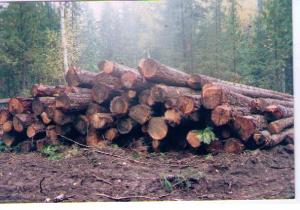
DHRS #1999 How Whatshan Lands were financed

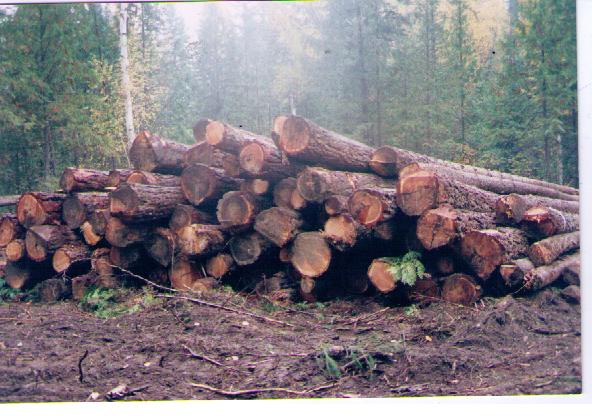
Ultimately some 70% of the available timbers stand of 200 mm “on the butt” and larger was marketed to retire the KSCU loan.

C) Initiation Process to Build the Retreat

There were many discussions amongst the DCA members as to what should be done with the property that included the following:

  • Build a Retreat as was the original concept and intent
  • The Retreat idea was challenged by some in that the property did not front onto Whatshan Lake and so had limited recreational value
  • It was too far from Castlegar and who would travel that far?
  • Others felt that the financial liability of a development was not within their scope and plans in the initial concept
  • Market the property as a fund-raiser for other needed projects
  • This resulted in a search by the enthusiastic others to find a method by which development could take place

It is within this climate that I had discussions with some of the DCA members that were relocated on the B.C. Coast and the suggestion was “why not organize a separate society to build a retreat?” That way many more interested people could become involved and it would be open to the public at large.

This idea was pursued by advertising a public meeting in Castlegar in January 27, 1996. It was at this meeting, and a few ensuing ones, where a constitution was drafted and named as the Doukhobor Heritage Retreat Society. A broader participation from all the major Doukhobor organizations was encouraged resulting in some of the following meetings:

  • A dinner meeting in Grand Forks at the home of Mike / Frances Kanigan with John J. Verigin Sr, (deceased) / Laura Verigin, Bill / Liz Pepin, welcoming Elmer / Marilyn Verigin from Tsswwassen
  • A meeting with Alex Ewashen and Alex Wishlow of the Doukhobor Society of Canada, Bill Makoroff and Steve Lapshinoff from the Krestova Doukhobors and JJ Verigin Jr. of the Union of Spiritual Communities of Christ met at the Doukhobor Village in Castlegar with Elmer Verigin
  • A dinner meeting of Peter / Gloria Fominoff, Peter / Elsie Rezansoff and Elmer / Marilyn Verigin met in White Rock, B.C.
  • Many other meetings

The overwhelming consensus was that Whatshan Lake Retreat, as the name became used, would be open to all Doukhobor organizations and people. The idea was to build a facility where everyone could come and be accepted without any reservation or prejudice.

A Board of Directors was formed from a broad spectrum of members paying a $10 fee. A constitution was registered (need date) and meetings began to find a common consensus as to a plan of action. Some of the directors were DCA members. but others came from many other groups and some from no established organization.

Discussions as to where to build the facility included these topics:

  • A Retreat should be best located adjacent to a lake. The current DCA site was about 300 meters distant with a section of BC  Hydro land in between
  • Another site may be available in the vicinity and perhaps a feasibility study needed to be undertaken to locate a better site

A committee was struck with Lawrence Popoff and Lorne Tamelin who then searched out B.C. Ministry of Lands locations for possible sites to build a Retreat. Of all the sites, a location at the South end of the largest Lake in the Whatshan chain was selected by this Committee, as the recommended site for review. An outing was arranged for as many DHRS members as possible. All travelled to this site some 16 km along the Forestry Road located on the North side of the Whatshan lake chain to a clearing about 1 km South of the site.

All viewed the site and agreed that it was a beautiful location with a glorious view of the lake. An application was made to the B.C. Ministry of Lands and after their review, the response was negative in that “the Doukhobors already had a large tract of land on the South end of the lake and that is where they should build.”

Disappointed, but undaunted, the DHRS began a search of a suitable site on the DCA lands. The current site was selected; a conceptual plan was created by Peter Rezansoff. The DCA was approached with the idea of leasing a tract of land for a Retreat. A renewable lease of $1.00 per year was negotiated for twenty acres and the documentation was prepared by Peter Fominoff, a member and a Lawyer in White Rock.

D) Building Permit Application Process

The process to obtain a building permit from the Regional District of Central Kootenay (RDCK) was in itself a separate saga of what almost appeared to be a deliberate process to discourage construction. Some of the events leading up to an application for a Building Permit included:

  1. Firstly a legal ad required posting as part of the process for a septic tank permit
  2. A neighbor some 300 meters away complained that a Retreat construction would compromise the water quality in Whatshan Lake
  3. A total development plan needed to be developed and approved by the District Planner

This was followed by a prequalification before a formal Permit application and a horrific list of prequalification needed to be processed:

  1. Proof that fire-fighting resources were available which included a water tower allegedly required by the Building Code
    1. After review of the BCBC, no such requirement was necessary
    2. Contact with the Fire Marshall’s Offices in Cranbrook, determined that no such requirement was necessary
  2. Proof that Elmer Verigin P.Eng., was actually registered with the B.C. Association of Professional Engineers  (APEBC)
    1. Although, Elmer Verigin sealed the drawings, the Building Inspector still made contact with APEBC to check
  3. Access approval by Ministry of Highways
    1. This was relatively a routine application
  4. Permission from the Agricultural Land Reserve (ALR)
    1. Although ALR had already approved a request from Elmer Verigin, the RDCK would not accept that and made a separate application to the ALR
    2. A ALR committee inspected the site and reported that the land could not sustain agriculture

It was during this time in 1994, that the DHRS felt it should establish a local (Edgewood, B.C.) understanding of the Whatshan Lake Retreat Project. In this endeavor, a local supporter(s) of the project, Bill and Penny Penner arranged an information session with three local families. After explanation of the project objectives, these families arranged a public information meeting at the Legion Hall in Edgewood, B.C., to which representatives of the DHRS were invited.

Bill / Natalie Voykin, Larry Ewashen, Elmer / Marilyn Verigin were pleasantly impressed with the large attendance of over eighty (80) people in the small Legion Hall.  The organizer(s) immediately advised us as “guests” that “the meeting was ours to chair and conduct” and that I was to chair the meeting. Once I explained the objectives of the Whatshan Lake Retreat project, our positive excitement soon changed to grave concern as the Attendants had all been told that the project objectives by the Proponents (the DHRS) was to gather young troubled youth from the urban communities and bring them to Whatshan where they would be potentially capable of becoming a local liability to do public mischief and conduct damage to their properties.

The room was “charged” with a negative atmosphere that could be best described as one in the “wild west days” where the scene was a “boiling pot of tar, with a pile of feathers standing beside a puffing locomotive on a railway track. The intent of the group was to tar and feather the group and run them out of town.”

It took us some one-half hour of patience and my entire test of chairing difficult meetings to achieve order amongst the “cat-calls” and snide remarks when I outlined the project objectives to provide a place in nature for the public to enjoy. The response was a negative “give me a break” to “who are you trying to kid” comments. Soon some in attendance stood up and asked the question of the rest “how many of you have ever been to a Summer Camp?” After some fifteen (15) hands were gingerly raised, the next question was “so was the intent of the camp to run around the area, breaking in to properties?” Many heads shook negatively. “So is this what will happen here?”

The crowd went suddenly silent while another elder lady stood and asked the question, “I have lived here all my life and I have been the victim of property damage. Unfortunately, the damage was by local kids. So I cannot see a danger with this project?” Soon the crowd settled in to a less suspicious mood, the questions ceased to be critical and insinuating and eventually they all became silent and attentive. The meeting was soon over and we went home.

That was our first experience in this neighborhood with a promise from the meeting organizer, “Elmer, I will continue to oppose your project up until you complete it. Upon completion, I will be the first to come over and share a cup of coffee with you”. True to his statement that is exactly what took place on official opening in July 1999. We have been great neighbors since.

A small group met on site in the summer of 1995 to select an actual site for the Retreat Building. This consisted of:

  • Bill / Natalie Voykin
  • Fred / Ann Chursinoff
  • Lawrence / Kathy Popoff
  • Elmer / Marilyn Verigin

We walked into the woods and formed a circle in the spot where we all felt most comfortable and sat down. A psalm was recited by Natalie as we held hands. We marked the center of our prayer circle with a stake. Today, it is in this spot that the center post is located that supports the roof trusses for the Retreat.
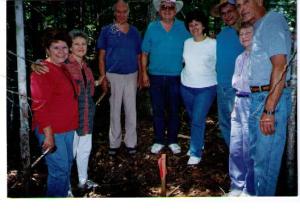
DHRS #1999 We blessed this site of the Whatshan Centre

The Building Inspector eventually advised that an application could be made for a Building Permit. The sum of $1,400 was required and there was no money in the treasury. It is important to note that the following members gathered donated $200 each as follows:

  1. L. Popoffs
  2. L. Tamelins
  3. F. Chursinoffs
  4. R. Verigins
  5. E. Verigins
  6. L. Saprikens
  7. (Elmer needs to confirm the missing other families)

E) Construction Process of Whatshan Retreat Building

The Building Permit was issued in the spring of 1995 but there was no funding available, nor grants to start construction. The terms of the Permit approval were that construction must begin within six (6) months of issue. So a desperation action plan was concocted to install footings in November 1995 as follows:

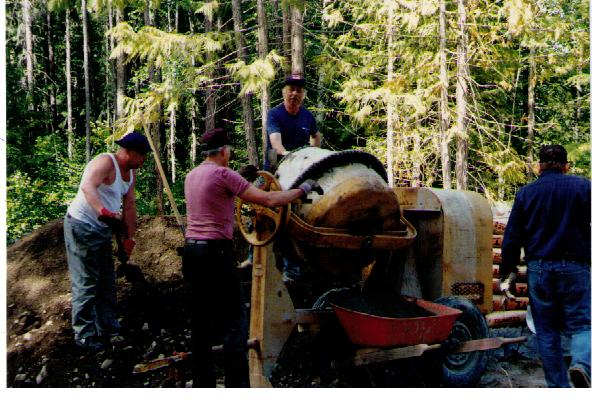
  1. The Ferraro Bros. from Korpack (Trail donated) fifty (50) sacks of cement
  2. The Chernoffs of Trowelex (Castlegar) donated a concrete mixer
  3. Kalesnikoff Lumber (Tarrys) donated the form material
  4. Marbella (Delta) donated wheelbarrows and miscellaneous tools
  5. A backhoe was hired from a local logging contractor
  6. A weekend was chosen in early November and we gathered there

A brief religious blessing took place within the excavation and the footings were formed and concrete placed in one weekend. The Building Permit could not be revoked.

These old guys did could not afford Redi-mix. The water had to be hauled by barrels from Whatshan Lake by Elmer’s Silver Cloud pickup. Walter filled the pails in the lake, Joe passed the pails up to Elmer, Elmer dumped the water into the three (3) barrels. Elmer drove carefully not to spill the water but the hill was a bit of a challenge as the water slopped and was ready to spill. Elmer paid attention to barrels and not enough on his driving as the truck choked just 1 meter short of the top of the hill. Elmer hit the barkes, the barrels hit the end gate, crashing through and rolling down the hill back to the lake where Walter groaned with an “Oh Nooooo!”.

So we filled the barrels again while Walter and Joe admonished Elmer on his lack of teamster skills. Joe said “Back up, Elmer” but Elmer knew what he had to do this time and stubbornly forged ahead, giving the Silver Cloud a bit more speed. The water splashing on the truck deck distracted Elmer to look back again and just 600 mm short of the brow of the hill, a repeat of the first time took place.

A mournful cry came from Walter as the barrels arrived in front of him. He was suffered from  and case of liquid indigestion from last night and this experience was not on his agenda at all.

This time Elmer backed up the hill and heeded the gruff instructions from the combined crew. We arrived at the mixer to a welcome of “What took you guys so long!”
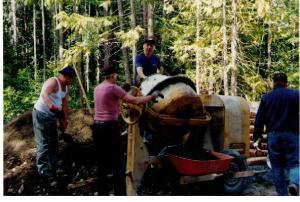
DHRS #1999 Old Guys mixing concrete the old way

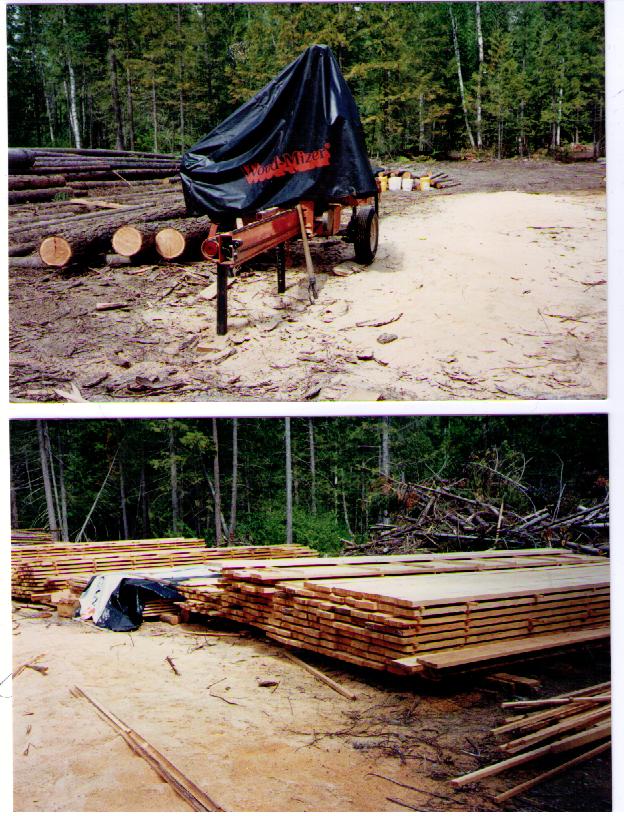
It was the winter of 1996 that some serious planning took place as to how some funds could be raised so construction could begin. Walter Demoskoff suggested that a portable sawmill could be brought in, logs on site would be used to prepare the lumber for the Retreat.

 The plan unfolded as follows:

  1. Hire a portable sawmill for an estimate cost of $6,000 to saw all the lumber for the building
  2. Walter volunteered to provide these funds prior to selling three (3) truckloads of logs which would repay this loan
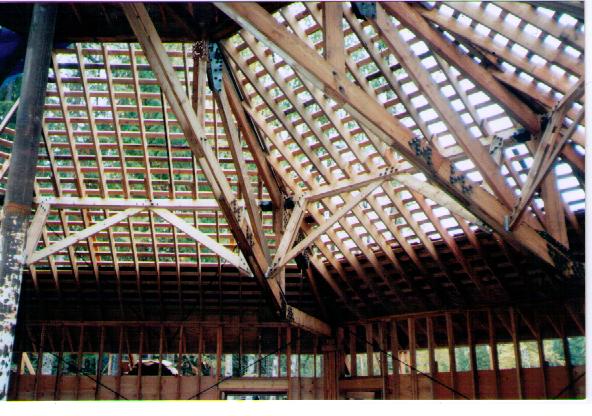
  3. It was necessary to design the trusses from lumber that would be available log sizes on site and estimate the framing lumber in advance so that sawmill operator could prepare the correct materials
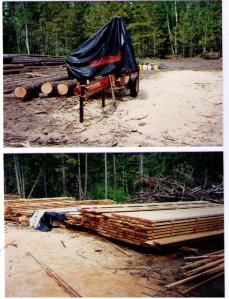
DHRS #1999 Lumber for the Whatshan Centre from timber on site 001

  • The DCA was approached and they agreed to supply logs for the lumber and the required market logsMarket logs were to be cut from the reserve stand not previously harvested on the West side
  • When the access road to the West side of the property was actually surveyed, it was found that seven (7) truckloads of marketable timber could be harvested
  • This was all harvested, including the three (3) DCA donated loads by Walter Demoskoff and Fred Chursinoff as a volunteer donation using Walter’s track machine
  • Shake bolts were available on site to be split for cedar shakes
  • Bryans Transfer (Trail) provided a flat bed to move equipment and materials to Whatshan
  • Peter Rezansoff (Vancouver) negotiated with Ocean Cement that they would supply a truckload of bagged cement to the site where concrete was mixed by hand
  • Cominco Ltd (Trail) was approached for the supply of 1,350 bolts, washers and nuts for construction of the roof trusses. These bolts were sold as salvage for $50.
  • West Kootenay Mechanical (WKM) (Trail) supplied the Journeyman Plumber, as required by Code, to install all the plumbing Rough-In.
  • WKM fabricated the steel gusset plates for the trusses and all the flashings
  • Martech Electric (Castlegar) supplied the Electrical Permit and encouraged Westco, Gullevin and Gescan Electrical Wholesalers to supply all the Electrical materials
  • Hank Tarasoff donated much of the plumbing supplies
  • Gerry Evin brought his backhoe and dug out all the stumps
  • Mickey Podovinikoff brought his Caterpillar / Loader and provided all the backfill and site grading. He was there when Nakusp Redi-Mix brought out two trucks to mix the concrete on site for the major concrete floor pour. Mickey’s loader was used to place gravel into the mixer (supplied by Nakusp Redi-mix) and lift the cement bags for easier placement.
  • Brian Verigin supplied and fabricated the steel post in the center of the building and with the assistance of Joe Podovinikoff this design. It is Mickey Podovinkoff machine that erected this post with the professional “Riggers” Larry Sapriken directing the post over the bolts and Bill Penner holding it in line. Of course, as in any project, there is the Foreman, General Foreman, Superintendent and Safety  Officer on hand.
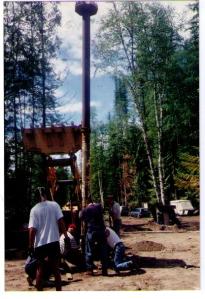
DHRS #1999 Brian Verigin's main support post is erected

  • Windows were salvaged from the renovations to Stanley Humphries High School in Castlegar, B.C.
  • Thorman Well Drilling (Nelson) drilled, tested and commissioned a water well
  • The Novakshonoff family, Mainstream Mechanical, (Grand Forks) provided the Mechanical expertise to install the pump into the well, pressure tanks, septic pump and connecting water lines along with the commissioning expertise to pressure the water system to the Retreat Building
  • Doors and panic hardware were salvaged from a seniors project renovation on the Coast
  • Inter-Tech Construction supplied all the drywall, insulation, ceramic tile, handrail and fireplace doors
  • Korpack supplied all the masonry and flue liners for the fireplace
  • 100 chairs were donated by Alex Ewashen
  • Investors Group donated $1,000
  • Toilet partitions were supplied by Shanahans when they double-shipped Marbella Pacific on a project and then denied that they had duplicated an order. We just stopped arguing.
  • The toilets and sinks were salvaged from the Terra Nova Hotel renovations in Trail, B.C.
  • Lawrence Popoff used his Mechanical training to overcome the Building Inspector challenges with the Hood over the kitchen range
  • There was much more that came from various places and it is not the intent of the writer to disregard these donations. It is just that they were so numerous that all cannot be included in this writing

So the Retreat Building construction was started with the above base and a multitude of volunteers started coming over the next three (3) years until completion in June of 1999. To mention a few names would be an injustice to those who may be missed. I tried keeping a list of names and the time spent at Whatshan and this list exists. It is much too detailed and too long for the purpose of this story. The idea of “service above self” became a motto. There are also many stories of laughter and the joys of working together.

John J. Verigin Senior travelled from Grand Forks with Pete Oglow to confirm that all the volunteers were working. Their kind words of encouragement spirited the multitude of Lower Mainland volunteers who Peter Rezansoff “sweet-talked into coming to a “paradise in the hinterland”. So how long is Lawrence Popoff’s nose?
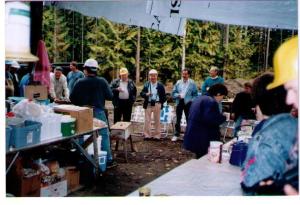
DHRS #1999 John J. Verigin Sr. and Pete Oglow and volunteers

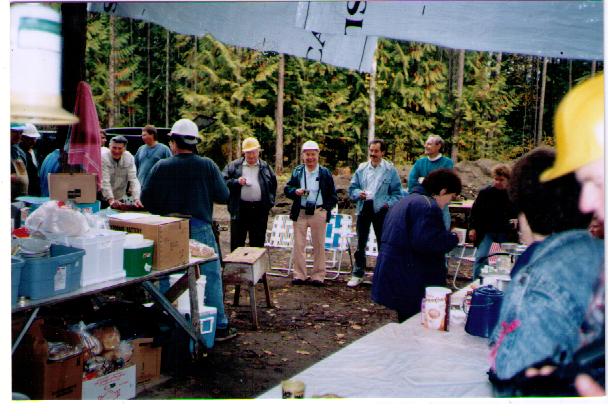
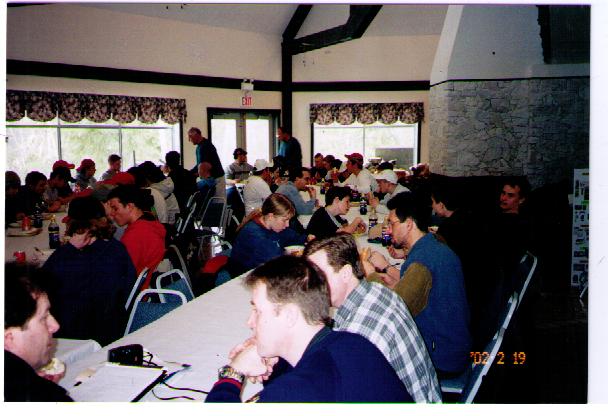
A temporary kitchen was erected and a wood stove / oven provided most of the cooking and warming of food. The ladies donated food as well as participated in the work along with the men. Whatshan became known for its big meals as sometimes the crew exceeded thirty (30) volunteers. Meals had to be set for banquets on primitive tables, benches, etc. Everyone either had a tent trailer or camper for sleeping wherever there was a level spot.

Here at some of the “foxy ladies” whose talents also included Shake-splitting, cooking, advising on construction as well as singing.
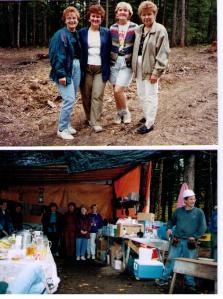
DHRS #1999 Foxy Whatshan Ladies and their kitchen

Their kitchen was primitive but the food was awesome.

Some of the following humorous stories unfolded as on any construction site.

One night a skunk decided to check out what may be a good meal as he was not invited to the banquet. He must have tipped something over as Joe Podovinikoff’s German Shepherd heard or smelled him and charged out of the pickup truck with Joe following. The skunk headed for cover under Popoff’’s Camper-Truck just as Lawrence was preparing to come to see what all the commotion was all about. Everyone was shouting for Lawrence to stay back while Joe was being dragged by his dog who was determined to get that skunk. Larry Sapriken was anxious to get out of his tent-trailer to see what was happening but could not open his door in time as his sock got caught in the lip of the door. He fell flat on his face, spraining his toe in the process. I wish that a movie camera was there that night as the moonlit scene was hilarious.

Larry Sapriken was located across an access road from the Verigins when at 2:00 A.M., a heart rendering animal shriek was heard as this cougar sauntered by. Larry shouted “what the f—k was that?’ Elmer replied with “go have a look!’ Then came a clear response from Larry: “f—k you!”

After a hard day’s work and a large evening meal, a campfire was always lit so that the progress of the day could be reviewed and philosophies exchanged. I wish that I was able to record some of these discussions but after a bit of wine everyone mellowed and singing started as there was at most times at least one guitar or accordion to get things going. One such evening a debate ensued as to whether the North Star was stationary or moving. This debate became a bit out of control when Russel Verigin decided to nail a 1 x 2 to a tree and aim it at the North Star. Every hour or so, there would be the non-believers that would check what was taking place. On one such evening, this stick was torn off the tree as it was more important to stoke the campfire at that time.

“You stupid idiot,” Larry admonished Fred Chursinoff, “that was our proof as to what was happening to the North Star”, and proceeded to replace the 1 x 2 in its original location. It was dark and Larry didn’t notice that the alignment process meant that the soot on the end of the 1 x 2 became part of his eye shadow. We could all see in the light of the campfire what Larry could not and laughter became rampant as was Larry’s curiosity for the reason.

The Whatshan Centre grew consistently over the next few years as evidenced in this construction photo. When I look at this I find it amazing that the volunteers that were able to achieve such a sophisticated construction design.
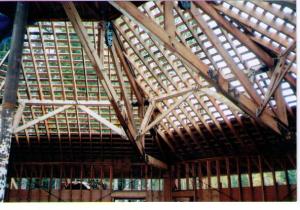
DHRS #1999 Whatshan Centre Construction

We also realized why the native word “Whatshan” was used by the Okanagan and Kootenay bands to name this area, as Whatshan is where they met to do trading. There is definitely an aura about the entire area that is very peaceful. That feeling permeates a person as they approach Whatshan and stays with them while being there. People who use the site now, comment on this feeling.

Here, a group enjoys what Whatshan is all about.
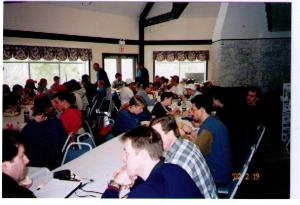
DHRS #1999 Whatshan Centre in operation

F) Achieve Charitable Status

Application were made to the CRA for a charitable tax number for the Doukhobor Heritage Retreat Society. The CRA refused the application citing that the Retreat use was not definitive and there were clauses within the constitution that did not clearly define that the facility could be used by the public at large. It appears that there are four specific uses that will permit a charitable status and those are:

  1. Sports
  2. Religion
  3. Education
  4. Health

The society was adamant that the use would be for any organization including the Retreat Society, itself, that could utilize the premises. This became too broad a definition for CRA as they were becoming more selective in their approval process with recent abuse.

Definition of specific uses and  change of society name and constitution was recently filed under Doukhobor Heritage Retreat Society #1999 (registered June 28, 1997) was presented to CRA. Later that spring of 1999, approved the amended application.

G) Property Tax Exemption

With the approval of the charitable tax exemption, attention was directed at removing the property tax status over the properties. An appeal was launched to the BC Assessment Authority and a meeting set in the Legion Hall at Nakusp.

The Appeals Board heard a submission made by Paul Moroso CGA, on belhalf of the DHRS #1999. In attendance were Larry Sapriken and Elmer Verigin. The presentation was excellent and the reasons for exemption were well stated.

The Board made the recommendation to exempt the Property Taxes which remains to this day.

H)  Major Philanthropist

Progress on the building was with limited funds and smaller donations but every donation was much appreciated. A particular donation came as a complete surprise. My Mother’s sister, Florence Markin kept asking me to explain where it was that Marilyn and I kept travelling to and occupying our weekends. She asked for a society constitution and had already heard about the struggles for funding, volunteers, etc. I heard nothing more until in the spring of 1999, when the Kootenay Mens Choir received an invitation from the Calgary Doukhobors to attend a celebration to commemorate one hundred (100) year since Doukhobors migrated to Canada. Since Marilyn and I were staying at Andrew and Florence Markin’s house at Christie Park in Calgary, Aunty warned me that I had better bring my best suit as I was to have a meeting with her oldest son, Allan, my first cousin.

I really did not know Allan as the opportunity to socialize over the years was hampered by distance as well as that Allan was a Petroleum Engineer whose initial job took him to the Southern United States for many years. I assumed that Allan would meet us at Aunty’s house but I soon learned I was to meet him at the Calgary Golf & Country Club for lunch. So off I went, not knowing what to expect.

I sat in the lobby of the Golf Club wondering what Allan would look like when this well dressed man confidently walked through the door. “Are you Elmer?” his hand outstretched. “Well then you must be Allan” I replied quickly.

“Well let’s go up and have lunch”, Allan started for the stairs to the Lounge.

The Lounge was absent of customers since this was preseason for golf in Calgary. We ordered and there was little chit-chat when Allan asked me to tell him about the project. I really did not know how much of the material I had given to Aunty, that had been digested by him so I obviously became a bit long-winded in my explanations. His next direct question(s) were:

“Is this for religious attendance only?” with my quick answer “No!’

“Is Douhobor a religion?” his questions became quick. I was to the point, “yes, but better explained as a Way of life”.

“Can you provide me more information on Doukhobors,” he kept on. I responded by “I have a Book of Life that explains it all.”

“Could you get me a copy?’ followed by my response “of course”.

We were only fifteen minutes into this meeting and lunch had just been served when he reached into his shirt pocket and pulled out what I recognized as two cheques. I thought to myself “if I was to get $2,000 or even $5,000 that would be great!” I was not prepared for what happened next.

“If I gave you $30,000 would that retire your debt at the Credit Union and provide enough to complete the remaining work?” he looked at me. I thought about the current $15,000 society debt and responded with “of course” while trying not to show my obvious surprise.

“Okay then,” and he began filling out the cheque.

“So you are planning an Investment Fund to use interest only to fund overheads”, as he started filling out another cheque. “I will provide $100,000 towards this fund. Do you have your charitable tax status yet?” he looked at me enquiringly.

“The application is in to CRA and I have verbal approval but I do not have the final paperwork at this time,” I answered.

“That’s fine then hold this cheque for awhile until you can determine if it will take place,” he paused, “let me know if it does not take place and we can do something else,” as he passed over the cheque to my surprisingly steady hands. “I will provide $100,000 each year until I have funded a total of $1 million dollars,” he added.

I was surprised at my composure when I asked, “What type of documentation do you require for this arrangement?”

“Are you going to perform as you have outlined?” he looked at me. I responded with “of course!”

“Then I do not need any paperwork”, as he looked at his watch and got up to go.

He followed me out after dealing with the tab and I found my 1980 LTD and started out to 17th Avenue when I noted his shiny sports car behind me. He was on his cell phone already and waved into my rear view mirror as he turned right on his way to his office. I carried on to 17th Avenue and turned left on my way back to Christie Park when suddenly I had the urge to confirm whether I was in a dream. I pulled the cheques out of my shirt pocket and yes, they were real. I then bit my finger and yes, there was pain. “It actually happened,” I shouted into the traffic.

As I entered the house, I was greeted by three (3) anxious people searching my face for signs of what may have happened. I just blurted out, “where is that Scotch that you said was in the bar” and I proceeded to the lower floor. “Your son just donated $1,030,000 to Whatshan!”

There was crying of joy and I poured myself TWO FINGERS of Scotch into a glass as I too was into the shock of recovery.

This funding was utilized as follows:

  1. The $30,000 did cover the society indebtedness with the balance to complete outstanding items in the Retreat Building
  2. $100,000 was invested in the Okanagan Foundation as Allan Markin Foundation
  3. $200,000 was invested in the Vancouver Foundation, also as Allan Markin  Foundation
  4. Both funds continue to invest part of the interest earned with the rest used for Overhead items
  5. The balance of the funds were used in the construction programs of 2003, 2004 and 2005, together with application for grants being facilitated by this base funding to construct:
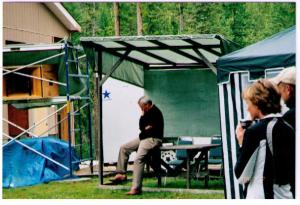
DHRS #1999 Allan Markin in a Pensive Pose

    1. Infrastructure of water and power
    2. Eight 20’ x 24’ cabins
    3. A 30’ x 40’ Concession, washroom, showers and covered patio
    4. The Cabins and Concession Building were supervised by Russel Verigin and Alex Markin, retired Carpenters and Superintendents who donated their fees.
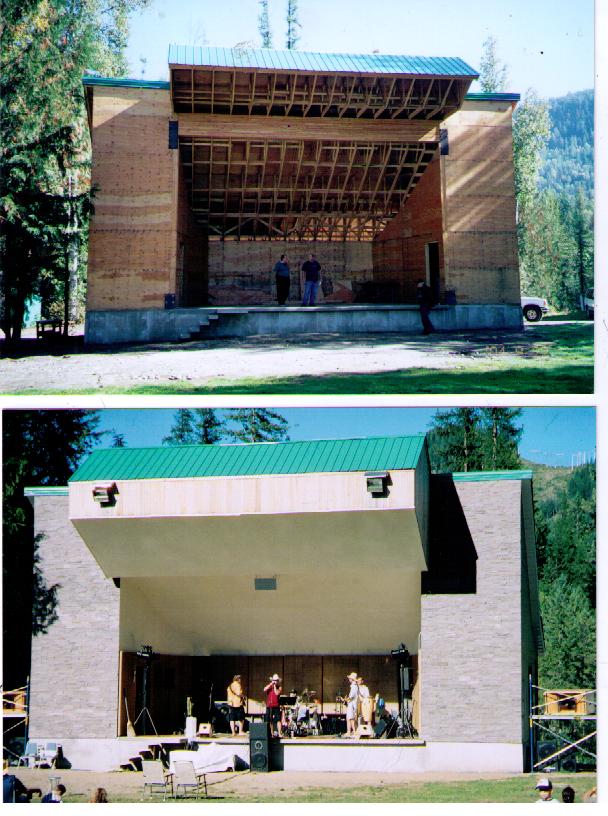
    5. An Acoustic outdoor Stage was constructed by the 2004 apprentice carpenters from J’Loyd Crowe High School in Trail, supervised by Aby __?__  and drywall, stucco and swinging acoustic panels professionally fabricated by Larry Sapriken with under the direction of Anton Neidersteiner
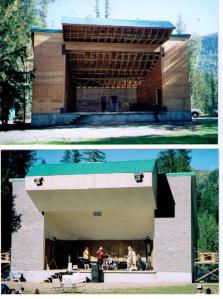
DHRS #1999 Anton's Acoustic Masterpiece

    1. An Office and Manager Residence
    2. 72 serviced RV Campsites
    3. 84 unserviced RV Campsite


I) Whatshan Lake Retreat Opening

Invitations went out inviting all to an Official Opening, July 25, 1999, at Whatshan, of the Whatshan Lake Retreat, to celebrate one hundred (100) years since Doukhobors migrated to Canada from religious persecution in Russia. Two days were selected for this occasion. Tents, trailers, campers started to arrive. Many performers of all kinds were encouraged and a fantastic program resulted. John J. Verigin Jr. was travelling with the Youth Choir in Russia but broke away, specially, for this event as it was he who had suggested that the revised constitution be registered under the name Doukhobor Heritage Retreat Society #1999, noting the 100 years since migration in 1899.

After a Doukhobor Prayer service  at this event that JJ Verigin Jr., dedicated the Whatshan Project to the “people of Canada” as a thank you from the Doukhobors who were able to find sanctity and freedom of religion in Canada. From this day forward that the project officially became non-denominational with membership open to the public for its use and enjoyment.

Many other speakers spoke at this event including the noted Writer Koozma Tarsaoff who lauded the efforts of so many volunteers and donors.

A historic moment was also achieved when the Krestova Mens Choir walked onto the stage with the Kootenay Mens Choir to meld into a Doukhobor Choir ending almost eighty (80) years of disagreement as to the definition of a Doukhobor. This choir continues to this day and demonstrates forgiveness through love.

Following this success, a few years passed and it became clear that accommodation and more services would need to be built to generate an economic use of the Whatshan Lake Retreat. The DHRS #1999 began the process of finding the funds and resources to complete the rest of the plan. A method had to be found where the reliance on volunteers and donations was not the only avenue to development.

J) Phase II Construction

 The work progressed over several years and included the following:

  1. In 2003 the first five (5) cabins and the Whispering Pines (Campground services building, Concession and Outdoor patio), electrical , water, power and roads infrastructure
  2. In 2004 the next three (3) cabins, the Stage framing, completion of campsites and Whispering Pines building
  3. In 2005 completion of the Stage and the Office / Manger’s Residence, additional two (2) wells, pump house and water distribution

Some additional funding was obtained through grants:

  1. Columbia Basin Trust
    1. $50,000 in 2004 for the first part of the Stage
    2. $40,000 in 2005 for the balance
  2. Vancouver Foundation $20,000 in 2003
  3. Union of Spiritual Communities of Christ
  4. BC Hydro $5,000 in 2003
  5. Carpenters Union $5,000
  6. Federal Government Human Resources for workers whose UIC had expired
    1. In 2003 $50,000 (need to check amount)
    2. In 2004 $30,000 (need to check amount)

Other sources of assistance came from a variety of sources:

  1. Kalesnikoff Lumber (Tarrys) donated all the sawn timber for the Whispering Pines Building
  2. Emco Engineering donated all the Electrical infrastructure designs and the upgrade to a 600 amp service
  3. Anton Neidersteiner (Kamloops) provided professional consulting on the Acoustic / Electronic Stage
  4. E. Verigin Consulting provided all the drawings, structural designs, water system and sewage system infrastructure designs
  5. Celgar (Castlegar) agreed to sell all the underground electrical cable for a extreme salvage price of $2,500 (value 10 x that)
  6. School District 20 negotiated a $1,000 salvage price for a van load of doors, windows, cabinets and many other units
  7. Joe Podovinikoff continued providing welding services for all kinds of miscellaneous metal as required
  8. Russel Verigin and Alex Markin (retired from the Carpenters Union), both Journeymen Carpenters and retired Superintendents became Mentors for the first group of Carpenter Apprentices in 2003 for a period of two (2) months. They were paid $4,000 per month but donated the entire amount to the DHRS #1999
  9. Bill Penner was the first Manager at Whatshan. Although a relatively small amount was paid to Bill for the additional workload in administrating the construction in 2003 to 2005, Bill donated most of his services to Whatshan
  10. Larry Sapriken (retired from the Carpenters Union) supervised the drywall, insulation, and stucco work. He was paid a relatively small amount for accommodation as he spent most of the summers from 2003 through 2006 at Whatshan providing his expert trades advice to the Apprentices and then to the volunteers while working in the trade as well
  11. An agreement with School District 20 to attract Carpentry Apprentices in Grade 12 curriculum in 2003. This led to the training at Whatshan of:
    1. 15 students in 2003
    2. 10 students in 2004
    3. This was not a saving but provided some exposure to the Whatshan project
  12. Independent Contractors and Businesses of British Columbia (ICBA) for indenturing the SD 20 apprentices
  13. Mainstream Mechanical donated overhead and profit to supply materials and labor
  14. Intertech Constriction / Ocean Cement supplied another truckload of cement to Nakusp Redimix who supplied the concrete on these buildings
  15. Christine Faminoff was a Curator at the Doukhobor Village in Castlegar and became very interested and supportive of Whatshan Lake Retreat although to the writer’s knowledge she had never been able to visit the site. Christine lost her battle with cancer and the Administrators of her estate dedicated a perpetual fund of $37,000 to the DHRS #1999 through an investment in the Vancouver Foundation named the Christine Fominoff Foundation.
  16. Some other Donors
    1. Thorman Well Drilling $3,344
    2. DCA $500
    3. Bill Soukoroff

                                                              i.      First donation $2,500 while alive

                                                            ii.      Second donation of $3,500 posthumously

    1. Allan Morozoff $2,000
    2. Ron Ross P.Eng., donated at least $5,000 worth of Electrical Engineering

Construction took place with purchased building materials from Building Suppliers and subcontractors for this phase of the project although there still existed a great deal of donations of volunteer labor, materials and equipment.

I need to mention the “Name-Calling Committee” which was chaired by Violet Plotnikoff (deceased) who so ably created names for all the buildings rooms and streets. A bit of humor though, Whispering Pines may have been an oversight as there are no Pines near the building.

Management at the Whatshan Lake Retreat changed from Bill and Penny Penner to Evelyn Collins then in 2010 the current Managers, Lawrence and Colleen Marshall  began to manage the facility. The Society is very thankful for the dedication of all three (3) Managers and looks forward to a continuing relationship with the Marshalls.

J) Freedom Quest

Freedom Quest Regional Youth Services is has been created as an idea, by workers working in the field of Youth Drug and Alcohol Treatment, to provide assistance to Youth struggling with addictions. See more on their website www.freedomquestonline.ca

In 2005, Freedom Quest (FQ) approached the society for sponsorship of the Youth Drug & Alcohol Program in the Kootenays. This resulted in a DHRS #1999 contract #WKBMH 07_130 dated April 01, 2006, with Interior Health Authority (IHA) and staff offices in Nelson, Kaslo, Nakusp, Grand Forks, Trail, and Fruitvale with a Head Office in Castlegar. Part of this program includes taking selected groups to Whatshan where a “Low Level Ropes Course” has been created in a wilderness section of the property. This course trains people leadership skills as well as confidence and trust in “Team Building”. The course was built with direct funding from Allan Markin. This is now in the development stage as one of the attractions at Whatshan Lake Retreat to an extended public. Renovation of the Head Offices in Castlegar has also been funded by Allan Markin.

The DHRS #1999 is very pleased with being able to assist Freedom Quest in all its endeavours

(Please note that the FQ Program is a confidential arrangement between participant and FQ. This confidentiality is strictly maintained throughout the eight week routine. As a result of this program no other function can be operated at Whatshan when the premises are being used by FQ). Those of you who may feel interested to contact them directly at (250) 304 2676 or visit them at the Head Office at 349 Columbia Avenue, Castlegar, B.C. V1N 1G6

K) Current Programming at Whatshan Lake Retreat

The current level of programs projected for 2013 are as follows:

  1. Continuing DHRS #1999 programs through FQ
  2. DHRS #199 sponsorship of Wellness Clinics funded by Allan Marking in the S’ynergy Foundation
  3. Two weddings
  4. Christadelphians Bible Camps
  5. Russian Church Bible Camp
  6. Adoptive Family Camps
  7. German Russian Church Bible Camp
  8. Institute of Higher Learning Seminar
  9. Music Festival
  10. Quilters seminars
  11. IHA Seminar

Other programs are in the formulative stage of planning. Operating the “Low Level Ropes Course” is part of the objective plans. It is interesting to note that none of the above programs involve the Doukhobor community and perhaps the dedication ceremony in 1999 where the project was a “gift” from the Doukhobor community was prophetic?

The Ministry of Children and Families augment the FQ funding by IHA for specific programs within their scope. The FQ homeless program has had substantial yearly contributions from Allan Markin.

L) Phase III Development

Development plans are underway in 2013 with partial funding of $500,000 from Allan Markin to complete development of infrastructure and services by construction of:

  1. Telephone land line
  2. Reconstruction of the existing wood deck on the Retreat Building to an extended patio
  3. Replacement of single glazed windows on the Retreat Building with factory sealed windows
  4. Construction of an accommodation / office building for FQ
  5. Installation of another water well
  6. Provision of a fire pump and fire reservoir
  7. Provision of a propane emergency generator
  8. Fire hydrants and a fire suppression system
  9. Related other improvements
  10. Playground Equipment donation of $17,000 from Florence Markin
  11. Park Benches and Tables donation of $4,000 by the DCA

M) The DCA Donation

Perhaps the largest single donation occurred in January 23,  2013. The DCA donated the entire two (2) parcels of land to the DHRS #1999 for the nominal sum of $1.00. It is an unbelievable gift which exemplifies the DCA commitment to “service above self”. The aging members of the DCA felt that this gift would be the best tribute to their 45 years of continuous association.

N) Other Major Donations

There was need for contingency funding for the General Expenses for a new Management Plan initiated in 2010. Funding was received from:

  1. Allan Markin $25,000
  2. Florence Markin $20,000
  3. Peter Rezansoff $10,000
  4. Ed and Myrtle Remple $200
  5. Ehard and Irene Dallman $500


O) Writer’s Comments

In writing this story, I need to advise that neither organization nor individual asked me to do this task. I just felt that such an achievement by such a small group(s) as the DCA and later by DHRS #1999 deserved being recorded somewhere as  a testament to their genuine commitment to serve and make this world a better place as a result. That mission was conducted not that someone would praise them. The smiling faces of the Users were enough testaments for the Founders of the Whatshan Lake Retreat in the end analysis.

If I have missed acknowledging any person or firm for their assistance with this project, please accept my apology because it was difficult to record all this and most of this came from the Writer’s memory. Neither office staff nor established office was available in the beginning.

Should you have any additional information that will enhance this story, feel free to comment on my blog and I am sure the readers will appreciate same along with the original Writer. I feel very privileged to have worked alongside with so many great people and accepted the financial and material contributions from so many more.

The majority of these contributions were recorded on charitable tax receipts once the Doukhobor Heritage Retreat Society #1999 received its charitable tax status in 1999. Prior to that the names had been recorded and are within the files in the records office at Whatshan Retreat Offices. Thank you all!

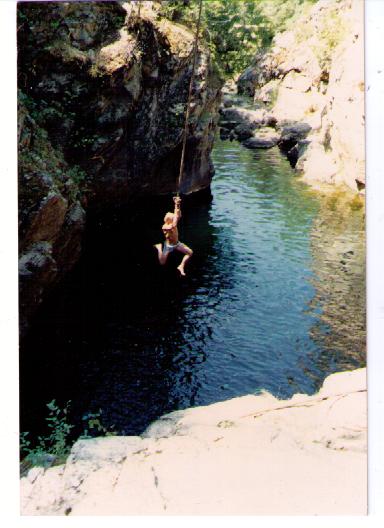
Come see us for a dip in the Hippy Hole where many people dived from the cliff edge including Allan Markin.
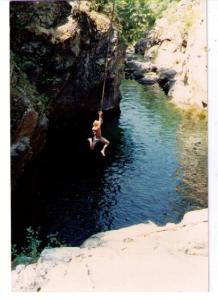
DHRS #1999 Hippy Hole Whatshan Attraction 001

Should anyone reading this blog feel motivated to make a donation to a particular function, Freedom Quest or a Foundation in your name, you may send in your intent to my address at #145 – 4200 Grandview Drive, Castlegar, B.C. V1N 4X  or contact me by phone at (250) 304 26801 or by email at EMVerigin@shaw.ca. You may also contact the Treasurer, Lawrence Popoff, directly by mail at 714 – 10th Street, Castlegar, B.C. V1N 2H8, by phone at (250) 365 7729 or by email at lkpopoff@telus.net

Elmer Verigin

++++++++++++++++++++++++++END ++++++++++++++++++++++++++ 

Writing started February 03, 2013 as recollected by Elmer VeriginMost recent revision February 15, 2013

More information on the Whatshan Project may accessed at www.whatshan.com.

Permission to include donors names received from

  1. Allan Markin
  2. Florence Markin
  3. Peter Rezansoff

References were taken from:

  1. DCA Minute Book
  2. DCA Constitution
  3. DHRS #1999 Constitution
  4. DHRS #1999 extensive records at Whatshan Offices
  5. Lawrence and Kathy Popoff extensive files on Whatshan and their continuing contribution to content
  6. Marilyn Verigin in support and editing
  7. Lori Woodhouse in support and editing
  8. Ed Dergousoff in corrections

Appeal to all Readers out There

02 Saturday Feb 2013

Posted by everigin in Uncategorized

≈ 6 Comments

Dear Blog Readers:

I understand that there may be Readers of my blog, that have not bothered to advise me as to what their interest may be. Thanks to my friend Tony for your comments as well as my daughter Nona who got me started on this. Some of you have not identified yourself and I respect your wishes.

I have posted some 40 articles that include:

1. Chronicles
2. Poetry
3. Diary Notes
4. Book Appreciations

to mention a few.

I have some three (3) hundred articles in my possession, all of which are actual happenings that I have personally been associated with.

Tell me what has interested you in what you have read, thus far, and it may influence me to post some of that.

Thank you those that have silently enjoyed my work because you too, become part of the equation.

I am not a professional Writer, but I enjoy writing.

Peace, as I love you all!

Elmer

The Sentinel in the Foothills

17 Thursday Jan 2013

Posted by everigin in Uncategorized

≈ 66 Comments

THE SENTINEL IN THE FOOTHILLS


As soon as I am on Highway 3 heading east from British Columbia, I am already preparing myself for a “treat”. I make sure that my gas tank has just enough gas to reach Brocket, Alberta. I can already envision the weathered gas station on the left side of highway on the far side of Brocket. All signs advise “Red Feather” is ahead. One would anticipate an exciting adventure in a trading post as we are on First Nations lands.

I already know not to get too excited with gas prices at Crows Nest at some 10 to 15 cents per liter cheaper than British Columbia. The extra sixty (60) kilometers may receive rewards for additional 5 to 7 cents at Red Feather.

The gas pumps are dated and the parking lot has its pot holes with no pavement. The false front on the dated building does not indicate any life and so one assumes this must be a “self serve” station and you automatically check the meter reading for the price as the other hand takes the spout out of its holder.  The numbers are worn and hardly discernible but the trust remains and the spout enters the waiting gas inlet.

Out of nowhere, it seems, this tall handsome man comes forth and takes the spout out of my hand with “fill it up?”His questioning face is not smiling but friendly.

“Yes, of course,” is my response. It is almost as if I am on familiar turf as this experience is repeated at least twice a year. I am leaning to the west while trying to be in a nonchalant discussion in this strong wind. There is a reason why the few trees in this part of Canada all are bent eastward. “The wind is a bit strong today, isn’t it?” trying to start up a conversation.

“Yes, it calmed down a lot today,” he opined as he continued with his work, oblivious to the tattered flags trying desperately to hang on to the cord that secured them to the building face.

My eyes surveyed the scene around:

  • Aging buildings in the town site
  • Lonely Band housing units dotting the prairie
  • Derelict care bodies parked around this housing where they their motors ceased to start again
  • Horses grazing on the sparse vegetation
  • Prairie on the eastern horizon
  • Snow –capped mountains to the west
  • Rolling hills to the north and south

The flick of the lever on the gas pump and the clang of the gas spout entering its holder indicated that the operation was over. Upon entering the single door to the station, the first sign reads “washrooms not in operation”. I recall that was the same sign that was there a few years ago. There was a time when some renovations were undertaken and the washrooms did operate. There must be a story in this washroom challenge as no matter what the Operator did, something would happen and the sign would go up again.

The lady behind the counter was tall, pretty and her red features displayed a natural beauty that indicated a partnership with the Owner. Again there is friendliness but without a false smile that is usual in other filling stations. There is something very genuine that I always feel at Red Feather but I sense that the business has not resulted in financial wealth. The temporary RV and vehicles parked may be the only residence or perhaps used as a shelter during operating hours.

Shopping is limited to confections and not artifacts as one would assume might be on the merchandise inventory. Perhaps a story may be there.

There is a history that I am sure could be told if and when I would take the time to chat. I wonder if my sincere interest will be reciprocated with any information that I should receive. How is life in the First Nations? Does this family lease from the Band? Do they operate for the Band?

When I drive away, my thoughts continue for the next hour with those questions as I wonder how they feel towards my white face. Are we all Canadians? Are we all equal?

How can I explain to them that I am proud of what they are doing to make a living just like every other Canadian?

One of these times, I will pause to visit more, next time.

+++++++++++++++++++++++++++++++End++++++++++++++++++++++++++++

Written January 17, 2013, 1125 hours

Handicapped People and Bullying

07 Monday Jan 2013

Posted by everigin in Uncategorized

≈ 7 Comments

ALL ABOUT HANDICAPPED PEOPLE AND BULLYING

One of my objectives for 2013 is to put my opinion forward on this subject. I have experienced bullying since a small child as it was playfully administered by my older siblings and maliciously directed by students in the school I attended. I also wondered about my family members who lived with enormous handicaps and I always wondered how they were able to accept all that in their lives.

This is a chronicle that will outline one point of view.

I used to watch a new brood of chicks on the farm and noted a yearly occurrence where some baby chicks were just not able to cope with the challenges when one hundred (100) of them competed for food, space and shelter. Sooner or later one or two would become “sickly”. It amazed me, as a child, that the other chicks would “pick away” at these poor hapless chick(s). Soon they would just give up and end up pecked away as dead carcasses. Is this a natural trait in all animals!

There was excitement when a brood sow gave birth to a litter of eight (8) to twelve (12) piglets; almost always there would be a runt in that brood. The next day the runt would be missing, which resulted in a question to my parents “there is one missing!” 

“Yes”, was the answer, “the sow ate it!” How disgusting! How could a mother eat her own offspring?

The eagle, raven, tern: all seem to have a natural characteristic when a runt chick would result in the nest. Either the other chicks or the parent bird would eat it.

In the instance of my pet cats, a mother would eventually move her litter to another location leaving the runt to die.

I have mentioned just some of the natural incidents that seem to underline the saying “the strong will survive and the weak will perish’!

Wolf and similar animal litters will enjoy “rough play” in their growing process to learn to survive.

My older sister and two brothers, used to enjoy teasing me and taunting me. Although it was playful, as a youngster, it was difficult to understand that it was just “sibling love play”? Perhaps it is a natural instinct that takes place while the growing and maturing is in process in humans as well.

So when children find themselves in a group, it seems that this type of “community association” takes place with the tougher kids picking on the timid and weaker children. Yes, I know it is bullying but it is a natural process amongst animals. As a child I was brought up as a “Consciencus Objector”. This meant that fighting back was not an option. I withstood all types of teasing and was often called “chicken”. It wasn’t until I was in grade six (6) when at noon on a cold winter’s day; I reacted to a Bully who had just brushed my cold nose with his leather mitt. My automatic response was a “haymaker” to his chin, knocking him over. The fellow lay there in disbelief that I had hit him. I am sure he thought, “Was that really Elmer?”He was one of my respected class mates from that day on through to graduation. Is that the way society needs to function? It worked in my instance.

It is my opinion that humans that have handicaps are also “picked on” or bullied mainly because the “bully” can get away with it easier as that seems to be the underlying temptation. I had an uncle that was very hearing handicapped and a granduncle that was visually handicapped. In both instances, although there would be a female member of the family that would be compassionate and caring in each instance, the rest of the family mostly ignored them. I cannot really suggest a reason other than they just had “no time” for them.

I am sure that most of us become impatient with a person with a cane that is preventing us from moving faster in a crowd or that wheelchair crowding into an elevator. It is only in later years that we realize that we too, could become handicapped and only then do we permit ourselves to assist these people when the opportunity should arise.

Nature is now taking away my hearing sense and as the condition continues to deteriorate, my dependability on technology to augment my senses becomes more acute with the years. What I notice more is the inability of friends and relatives to understand that the former self has changed dramatically and cannot participate in normal group discussion. No matter how many times I remind people that I need slower discussion with more enunciation, it is soon forgotten in the next conversation.  This is normal in group dynamics as the whole is not prepared to slow down for one part.

I used to watch my mother-in-law who had lost her hearing, in part, due to a slight stroke. She would sit there, smiling, while her family excitedly chatting around her. Soon she would take out her box of recipes and begin sorting them. It would take the group a short time to notice her in this action, only to realize that she was not even understanding their concern as she could not hear them. This is so with my situation now.

One needs to learn the process of participation without making an impact on the rest. This is difficult as one has a tendency to retreat into himself, rather than trying to cope with the situation. More technical development in hearing aids is making the situation bearable but there is no question, one realizes the limitations in the world of most handicapped or challenged people.

On the positive side of this is that during this process of understanding your handicap, one becomes more apt to notice and assist other handicapped people whenever the situation arises. It does provide an opportunity to make one a better person and improve society as a whole.

So the people around me can be interpreted to be bullies in the same manner as I previously described the children and siblings around me. Perhaps they are just being normal living beings in the natural sense.

+++++++++++++++++++++++++++++++End++++++++++++++++++++++++++++

Written January 02, 2013, 1325 hours

Quote

Interesting Article on Crop Circles

19 Wednesday Dec 2012

Posted by everigin in Uncategorized

≈ 3 Comments

Excerpts from “Secrets in the Fields” by Freddy Silva circa 2002

Excerpt 1

Page 119

“….So, just as Colin Andrews once received a dramatic reply to his cry for an answer to the riddle, mine came to thought “Smell the plants, you idiot”.

I reached down and cut the base of stems, in the fresh crop glyph. They exuded a malty fragrance, as if the water within the plants had been heated and cooked them from inside. The lower parts of the stems were superficially charred, too…..

……Canadian researcher Chad Deetken noticed…..said that 60 percent of crop circles appear during rainy nights (Deetken 1993)…..

…..in 50 percent of crop circles visited, the soil was noticeably drier compared to the tackier texture farther away from the center…..

Page 120

….Historically, crop circles have strategically referenced aquifers, ponds, wells, or underground tanks (Andrews and Delgado 1991). There is also a disproportionately large number of incidences in which circles appear where the groundwater is close to the surface, primarily in southern England where the chalk aquifer, the deepest in the world, provides an excellent moisture trap.

Historian Brian Grist has made a detailed analysis of the positioning of crop circle events and shows how the majority prefer aquiferous ground…..

…..Similar conclusions were independently reached and reinforced by Steve Page and Glen Broughton ten year later when they found 78.7 percent of recorded crop circles appeared over chalk and greensand (a mixture of sandstone and green earth). When the placement of aquifers is taken into consideration, the figures rise to 87.2 percent (Page and Broughton 1999).

So there appears to be a connection between water and the formative energy of crop circles, and given the effect on the plants and soil, it appears to generate some form of intense heat….

Page 121

…..Pure water in itself is not a conductor of electrical current. To be so, water requires a significant amount of dissolved minerals as part of its chemical makeup, and it just so happens that the water in the southern English aquifer is saturated with alkaline chalk. Chalk is a piezoelectric substance (it builds a static charge under pressure) composed of small prehistoric sea creatures, all containing tiny amounts of magnetite that once enabled them to orientate to Earth’s magnetic field. The net effect of billions of pieces of magnetite locked together and pressurized, together with energized groundwater, is the creation of the creation of a low magnetic field. This is especially so if the chalk is spread over a substantial geographic area, which the southern English chalk beds are. The combination makes this part of the world one of the largest natural conductors of electrical energy…..

Page 122

…..When you’ve got a lot of water in an underground aquifer or water table, fluctuating through porous chalk, a lot of electrical ground current is created. We were able to measure that in numerous ways in 1993. Such currents are taking place in the ground and creating significant magnetic fields. We measured the actual electrical current with electrodes in the fields and sites that are getting the most and the largest crop circle activity. Around Silbury Hill, in two days following a thunderstorm, as the water settled into this surface chalk aquifer, it created these electrical currents. We did a magnetic survey in the field and detected wide variations in magnetic fields there. Four days later it received a major formation. Four days after that we resurveyed that field and the variation shad evened out (Burke 1996)…..”

Excerpt 2

Page 124

“…..The Universe is an expansion of visible and invisible frequencies of light. When this light energy interacts with gravity the rate of spin of its molecules slows down, the myriad frequencies express themselves as matter, and the form and color of every organism and every object is there-by determined. Light is both particle and wave, and it transfers its energy by means of rapidly alternating electromagnetic field in the form of two waves; one electrical, the other magnetic which lags one step behind. Electromagnetic waves are transverse; that is, their two components move in tandem, perpendicular to the direction of travel. The transverse wave carries information vital to the cells of every organism, particularly the DNA in the human body.

The number of times a wave occurs in one second (the wave length) determines its frequency, which is also called vibration or oscillation; this frequency is measured in hertz (Hz). Consequently, one wave equals one vibration per second or 1 Hz (1000 Hz = 1kHz; I million Hz or 10 to the 6th power Hz = 1 MHz; I billion Hz or 10 the ninth power Hz = 1 GHz.

Excerpt 3

Page 160

“…..Mathematically, twenty-seven is three cubed, just as twenty-seven points is required to geometrically define a hypersphere (a 4-S sphere) in our three dimensional space (ibid.). And speaking of spheres, the period of revolution of the Moon around the Earth is 27.2 days.

In Old Testament gematria, twenty-seven is number of light, just as in Hebrew, it is the number of illumination (Gaunt 1995)….The number twenty-seven is also the difference between the notes F and G. Arithmetically this is split into two parts, the lesser of thirteen units and the greater of fourteen units. The miniscule region between these parts is called the “Pythagorean comma”, and it is marked by the note F-sharp (Levin 1994).

F-sharp is regarded with great respect by ancient Chinese as Hu, the tone of the Earth. Native American flute makers to this day tune their instruments to serenade Mother Earth to this note. It appears to have significant influence among the pyramid builders of ancient Egypt. After he conducted a series of experiments inside the King Chamber of the Great Pyramid, acoustic engineer Tom Danley identified four resonant frequencies, or notes, that are influenced by dimensional and materials used in its construction. The notes form an F-sharp chord which according to ancient Egyptian texts, was the harmonic of our planet. Moreover, Danley’s tests show that these frequencies are present in the King’s Chamber even when no sounds are being produced. So we see yet more connection with our Egyptian ancestors…..”

Excerpt 4

Page 167

“….the pioneering work of Dr. Chiang Kanshen (a formerly imprisoned Chinese scientist who escaped to Russia), who researches bioenergetic communication, Dr. Kanzhen’s work demonstrates how DNA is a passive data storage device comprising active material carriers in the form of bioelectromagnetic signals. These photons possessing corpuscular and wave properties capable of transmitting energy and information.

These photons operate at the extreme ends of the electromagnetic spectrum, namely, at very low frequencies (which excite the photons) and very high frequencies (the bandwidth capable of transmitting large amounts of information). Any excitation of the bioelectromagnetic field is therefore transmitted to the DNA, and in laboratory experiments genetic information has already been successfully transmitted from one organism to another (Kanxhen 1993).

For more than a decade, Irish molecular biologist and immunologist Colm Kelleher has also researched the structure and properties of the 97 per cent of our genetic material that does not code to protein, and discovered that more than a million sequences in human DNA have the property of being able to “jump” from chromosome to chromosome. When activated to jump, these sequences, or “transposoms,” are capable of large-scale genetic change in a very short time.

Kelleher proposes that the activation of the transposoms is done through intense spiritual energy experienced in altered states such as shamanic initiations, near-death experiences……….

Excerpt 5

Page 172

“….Sacred or canonical geometry is not some obscure invention of the human mind,” wrote Paul Devereux, one of the world’s leading writers on Earth mysteries, “but an extrapolation by it of implied patterns in nature that frame the entry of energy into our space-time dimension. The formation of matter and the natural motions of the Universe, from molecular vibration through the growth of organic forms to the spin and motion of planets. stars and galaxies, are all governed by geometrical configurations of force. One can dissect a plant or a planet and not find the Maker’s blueprint anywhere in site, of course; it is inherent” (Devereux 1992).

Sacred geometry is a mirror of the Universe, and as such, it is timeless. It is also a form of communication that can be accessed at ancient places. As Devereux says, “It is the ultimate systems language.”…..Let us briefly examine sacred geometry and its place in the greater scheme of things.

Our experience of and reaction to all things beautiful is made possible by our ability to distinguish order from chaos. When we recognize the perfection inherent in a Greek temple or a painting by da Vinci, we are subconsciously responding to proportions bound by the universal laws of geometry. To quote the geometer Robert Lawlor. “The practice of geometry was an approach to the way in which the Universe is ordered and sustained. Geometric diagrams can be contemplated as still moments revealing a continuous, timeless, universal action generally hidden from our sensory perception. Thus a seemingly common mathematical activity can become a discipline for intellectual and spiritual insight” (Lawlor 1982). A substantial body of evidence for this is found in the unlikeliest of sources, Religion.

As stated in Islam (particularly Sufi, its mystical half) – and echoed in Jewish and Hindu religions – sacred geometry enables humanity to see the archetypal world of God. At its heart, the Arabic faith still-contains an unadulterated snapshot of this primordial truth, in the geometric figures adorning its mosques and art forms. Consequently, Islam has served as curator and preserver, maintaining the purity of the philosophy of geometry, “akin to the Pythagorean-Platonic tradition of antiquity but in a totally sacred universe free of the nationalism which finally stifled and destroyed esoteric traditions of Greek intellectuality,” to quote the eminent Arabic historian S.H. Nasr (Critchlow 1976).

It’s not certain from where the terrestrial origin of this knowledge stems, since the forms of scared geometry are just as evident in Celtic, Tibetan, and Buddhist art-even in native North American sand paintings. In other words, sacred geometry is a universal principle shared by cultures that seemingly had little or no contact with each other.

One of the earliest known practitioners of scared geometry were the Egyptians. Its proportions were embedded in the ground plans of their temples, their frescoes, and in the Great Pyramid at Gitzeh, whose structure contains many mathematical laws since attributed to Pythagoras. But although enlightened Egyptians used geometry for all manner of terrestrial applications – hence geo-metry, “measure if the earth” – their aim was metaphysical. Egyptologist John Anthony West postulates: “The whole of Egyptian civilization was based upon a complete understanding of Universal laws. And this proud understanding manifested itself in a consistent, coherent and inter-related system that fused science, art and religion into a single organic Unity (West 1993).

The symbolic language of Egypt, together with its texts on medicine, mathematics, and science, demonstrates the Egyptians knew how the world works, and they did so without the advantages of computers or electron microscopes. proving that one does not need advanced technology to access and understand the finer realms of life. And because the Egyptians recognized sacred geometry as the mechanisms of the heavens, they applied it liberally across the landscape for millennia as a way to bestow Universal order on Earth, a concept encapsulated in the Hermetic maxim, “As Above, So Below.”

Such obvious benefits did not go unnoticed by other enlightened groups, and permanent expressions of this knowledge were subsequently erected for posterity throughout Europe, in the form of the Parthenon, the Temple of Delphi, Aachen cathederal (whose chapel bears identical ground-plan measurements to Stonehenge), and Chartes cathederal, one of the most impressive hymns to sacred geometry. The knowledge made its way north to the British Isles, for it is immortalized in Stonehenge. In fact, the “Pythagorean” geometric  tradition was already well in use throughout Britain some 3,000 years before the Greek mathematic, as evidenced by the formulae adopted for the construction of stone circles (Strachan 1998; Thom 1967).

Obviously the principles of sacred geometry were important enough for scholars and architects to go to enormous lengths to preserve for future generations. Well, that was the idea. These practices were abolished as a form of study by order of Emperor Theodosius in 399 A.D., the net effect being the rise of the Middle Ages. Slowly and corrosively, codes for a life in harmony with the Universe gave way to a predilection for violence, intolerance, terror, and persecution. The last great works based on sacred geometry – namely the Gothic and early Renaissance – were kept alive via Plat, the works of Vitruvius, and whatever Hermetic and Quabbalist writings and philosophies survived suppression by the emerging Catholic Inquisition. With the move toward an analytical view of the world, connections to holistic and metaphysical practices were severed, and by the time Newton and the scientific secularism of the seventeenth century prevailed, rational logic had gained such dominance that all esoteric knowledge was condemned as occult.

By the twentieth century, this masculine, left-brained worldview had reached a nadir. Man placed Nature over a barrel, harnessing its power, taming its ways, and desecrating its resources to fuel “progress”. The dubious high point of this culture has given us the nuclear age and saddled us with a few by-products; global urbanization, depletion of resources, and toxification of the Earth which, social scientists point out, has fueled a meteoric rise in human alienation and criminal behavior. Not surprisingly, worship at our ancient temples is today rarely done for its purpose of enlightenment, but a snapshot and a souvenir. As these temples become relegated to mere curiosities from an age gone by, so our wonder of the unseen and our connection to the sacred disappears.

And so the pattern emerges. The more disconnected we become from the Universal order, the more dysfunctional we become as a society. And the longer our umbilical connection remains severed, the more we rely on rationalism to explain our reason for being and the further we stray from spirituality. The vicious circle is compounded by Western language being a separatist language. As Lawlor explains: “Modern thought has difficult access to concept of the archetypal because European languages require that verbs or action words be associated with nouns. We therefore have no linguistic forms with which to imagine a process or activity that has no material carrier” (Lawlor 1982). Yet in the Eastern languages, subject and object are one. Japanese lovers do not declare to one another “I love you,” they declare aishiteru, “loving.” Subject and object are merged into wholeness, and such a linguistic foundation is probably what enables peoples of the East to accept mystical side of life more readily than their Western counterparts.

Thankfully the Universe moves in waves, and cycle of darkness is inevitably moving once again into enlightenment. For one thing, science is discovering the geometry within nature. During a demonstration of an electron microscope before the American Association for the Advancement of Science in 1037, it was discovered that the crystalline structure of tungsten is composed of nine atoms geometrically arranged like a cube. Since then, science has further discovered that the physical structure of elements is governed by geometric arrays surrounding a central point. So the general assumption that the nature of matter is fundamentally composed of solid particles has given way to quantum physics, which shows that at a subatomic level, matter is empty, and at the heart lie patterns of energy. The irony here is that acknowledging geometry as the fundamental basis of matter, science has adopted the stance taken by ancient cultures, elevating those supposed “stone-wielding, loin-cloth primitives” to the highest ranks.

Little wonder, then, that these harmonic laws were so important to temple builders: they are the laws behind the Universe. And since the Universe was created by God, they reasoned that to embed the harmonic ratios governing temporal movement of the heavens into these physical structures, the power and knowledge of the firmament could be bestowed upon the Earth. So, temples became doorways into the mechanics of the physical world and the inner world of consciousness, and the interface would enable anyone to connect with finer levels of awareness.

Today, as alienation from all forms of spiritual and Universal wonder reaches epidemic proportions, expressions of sacred geometry and symbols bearing the hallmarks of ancient philosophy of harmony are manifesting in our fields. Even skeptics will admit that a crop circle designs exhibit a harmony pleasing to the eye much like an ancient temple or classical painting…..”

Excerpt 6

Page 186

“….Energy coming to Earth enters anticlockwise then upwells clockwise. You can find this instruction carved on the stones of Neolithic chambers throughout the world, although science had to wait 8,000 years before Russian physicists discovered that natural anticlockwise rotating systems add energy, and clockwise rotations release it (Kozyrev 1968)…”

Naturally occurring examples (Elmer Verigin comments):

  1. The electromagnetic field that surrounds a wire that is carrying electricity can be depicted by surrounding fingers around an electric wire with the thumb pointing to direction of the current travel, the fingers illustrate the magnetic field action which is always counter clockwise
  2. All races are run on tracks in a counter clockwise direction
  3. Baseball base running is counter clockwise
  4. The Earth rotates anticlockwise
  5. Earth and the Solar System Planets spin around the sun counter clockwise

****************************End*************************

Excerpted by Elmer Verigin December 2012

Where is Yerevan Armenia, anyway?

05 Wednesday Dec 2012

Posted by everigin in Uncategorized

≈ 3 Comments

NOTATION LOG DATED: May 19, 2008

LOCATION:  Yerevan, Armenia Marriot Hotel

“…….I am sitting at a table outside the Hotel looking at the “Square”. It is 0850 hours and raining

The bus is to pick us up at 0930 hours and we have an outing to Lake ___?___ where we are to enjoy a highland experience along with a meal.

Later, we are to dress formally for a farewell Dinner. It has been a great experience all around:

  • The eight (8) family members
  • The eight (8) American friends
  • Paul our Tour Manager
  • Sventlana, our Armenian Tour Guide 

This “Square” is utterly amazing. The Town Planners need to be commended for their pursuit of excellence in Architectural adventure in presenting both Armenian culture and Architecture in this place:

  • The museum across the public area from
  • The Marriott Hotel
  • Three (3) other major  public building surrounding
  • About five (5) acres of public space

In front of the Museum is the water feature that is a pond with programmed water jets that are synchronized to classical music.

In the evening, for about three (3) hours, this display of water jets, lights and music all come together with an awesome character that leaves the Beholder in silent wonderment.

Spell bound!

The ever present crowd stands around or slowly walks arm-in-arm (if couples) and enjoy this public presentation.

Then there is the angled street that emanates from the “Square” and plunges across all the streets and avenues. New development along this pedestrian only avenue, is spell catching. It is definitely an “open market”

This is a good idea for the safety of the public as the Drivers in Georgia, Armenia and Azerbaijan, just aim their cars than drive.

Pedestrians have no right of way but somehow are spared the right to die. ……….”

****************************** END ****************************

Video

The Winding Trails From Trail Lead Back to Trail

30 Friday Nov 2012

Posted by everigin in Uncategorized

≈ 13 Comments

THE WINDING TRAILS FROM TRAIL LEAD BACK TO TRAIL

“Well, that leaves me no choice but to “Chopper” the boys, I need to get into the Plant, behind the picket line,” Roger Watson uttered this terse management statement to his counterpart at the bargaining table in the basement of the Union Hotel  as the picket lines continued to present a problem in maintenance basics for the strike bound Cominco Smelter at Trail. B.C., in 1990.

“There are some members within the United Steelworkers of America, who have a fetish with high-powered rifles and have become very proficient with them,” responded Doug Swanson from the union side. “I am deeply concerned, that no one will be able to control these people and something may happen that neither one of us would ever be able to forgive ourselves for the rest of our lives” Doug added. “Do we want to take that chance?”

“But Cominco must bring in Specialists into the Plant or there may not be a Plant to start again after the strike,” countered Roger. “We just have to get these people there now!”

“Okay, let’s see how we can get them through the line,” responded Doug, thoughtfully, while planning how he was going to convince his frustrated membership that this was a necessity and good bargaining practice.

So it did take place and respect grew for the two men representing two strong and opposite points of view, initiating a relationship which later was to become the significant factor that saved this fundamental source of employment in Greater Trail.

Roger Watson was born in Trail, B.C., the son of a Painting Contractor and Owner of a Paint Store. Roger graduated from the Trail school system and became a University of British Columbia graduate in Metallurgical Engineering. He was able to get summer jobs at the Trail Smelter and later became a Project Engineer in the Cominco Engineering pool. He rose through the ranks after conducting many feasibility studies for mining and potential plants at various sites throughout the world where Cominco Ltd owned properties.

One such feasibility study involved an exploratory process to refine lead rich ores using a patented Kivcet process designed by Russian Engineers. Roger sent samples of Cominco ore from the Red Dog Mine, an Alaskan Cominco property to a pilot plant in Kazakhstan so that they could be processed under the watchful eyes of the most knowledgeable Metallurgist in the world at that time, Vladmir Efremoe, President of Techicon in Genoa, Italy.

Roger was part of the Cominco Team that travelled to Kazakhstan during all the pilot plant testing and became intricately knowledgeable of the metallurgical, economic and operational challenges of the Kivcet process. Roger and his team were convinced that the Kivcet technology was the correct choice for the new Lead side Smelter.

Doug Swanson was born in Vermillion, AB where his father was employed as a Shoemaker because his Stone Masonry Trade was not in demand and a living had to be made. His education was grade 13 at Notre Dame in Nelson.  Then followed Normal School where he achieved a Teaching Certificate. He eventually received a Physical Education Degree from Notre Dame in Nelson and Notre Dame near Wilcox, Sask, where sports was part of its curriculum.

Doug spent summers working for his father’s Roofing Company, McIntyre-Swanson, in Trail and learned quickly, the work ethic, in order to survive.

Doug responded to an opportunity to gain employment at Consolidated Mining and Smelting Ltd (precursor to Comino Ltd) and chose Instrumentation Mechanics as his trade.  Doug and Lorne White explained how the CMS Ltd was the pioneer company in establishing a high level apprenticeship program that became the basis of the provincial apprenticeship program in later years. Doug and Lorne reminisced that Cominco Ltd treated them fairly and the company was a good employer that considered safety and top performance in their trades as its policy.

All employees were represented by a union which later became the Union of Steelworkers of America (USWA). Doug served his union in various capacities until he became President in 1987. Doug was President at the time period of this chronicle.

Doug recalls an interesting incident during his time (late seventies) in his active leadership in the union when a meeting was called at back of a pickup truck at the plant, in response to employees concerns over safety. A staff member from Personnel stood beside Doug on the pickup truck. Personnel was responding to an eleven (11) point list of safety concerns at the plant.  At least two (2) employees had lost their lives and some were physically hurt.

“The situation is not as bad as it appears”, the representative from Personnel started, “Cominco has a good safety record”

One of the employees raised his gnarled hand in the air and waved it at the speaker, “Here is the evidence!” All eleven (11) points were acted upon. Doug and Lorne recall that this was part of a sequence of events that established the ability of the union to have meaningful meetings with management. Safety became paramount in Cominco policy.

Despite the recommendations of Cominco Engineering and Roger Watson… Senior Management, with authority over Trail Management, became attracted to a QSL metallurgical process which was developed and patented by German Engineering. This Technology was offered with a substantial financial investment in Cominco Ltd. The Writer is not fully aware of all the reasons for this action and, therefore; this is not part of this chronicle except that the QSL process became the metallurgical process that was selected for the Lead side Smelter renovations of the dated original Lead Smelter at Trail, B.C., It became part of the final Engineering designs and construction at the Trail Plant during the latter part of the 1980s. This senior management selection over turned the local Engineering recommendation that favored the Kivcet Technology.

The writer’s information is provided here only to illustrate a likely series of events that gave rise to the eventual crisis in 1991 through 1992, that is the subject of this chronicle.

  1. QSL process was installed with a multi-million dollar expense and eventually placed on line in early 1990
  2. The newly updated Zinc Plant produces a“Slime” that was rich in many lesser metals including Lead and many precious metals that needed to be further processed by the Lead Smelter
  3. The QSL process operating equipment could not satisfactorily process this “Slime” rendering the Lead Smelter uneconomic and inefficient to continue operating in this manner.
  4. A decision was reached by the collective management, that some serious corrections were needed in the process to prevent economic disaster.
  5. The original Kivcet process technology had been proven capable of dealing with this “Slime” effectively
  6. A decision was made to renovate the QSL operation with the Kivcet technology while the Smelter would operate, albeit uneconomically during the process.
  7. This was all in conjunction with a serious drop in world metal prices and consequent demand
  8. At this time, the financial loans and support entered into a crisis mode with the Financiers dictating a cash action plan as to how to recover the failed QSL costs
  9. Roger became the Leader during this difficult time in Cominco Ltd history.

The Financiers were adamant that Cominco Ltd take immediate steps to rectify the losing proposition at the Trail Plant and so issued an ultimatum and a time frame within which a substantial change would take place that would result in financing recovery.

This chronicle will not deal with the process that Cominco Ltd used in initiating this Plan of Action to secure its position with its Financiers as this is outside the scope and expertise of this writer.

What is known is that the following was some of what was included in that Plan of Action:

  1. Market some of the Cominco Ltd properties to raise cash
    1. Sale of Brilliant Dam near Castlegar, B.C.
    2. Sale of West Kootenay Power & Light Co. Ltd
  2. Meet with USWA and discuss ways in which wages and labor costs could be controlled. This was where Doug Swanson became involved as the USWA President
  3. Meet with local municipalities that were the Cominco Ltd municipal tax base and reduce the actual tax as well as control the rise in tax levy. This was where Doug became involved from his position as Chair of the Regional District of Kootenay Boundary (RDKB)
  4. Meet with Cominco Suppliers and reduce the cost of purchases. This was spear headed by the Job Protection Commissioner (JPC) appointed by the provincial government as some of his contributions to this Plan
  5. Obtain special grants from:
    1. Federal Government
    2. Provincial Government
  6. There were likely other items on the list that is outside the scope of this chronicle.

A A Team was assembled to deal with all this Plan of Action which consisted primarily of:

  1. Cominco Ltd:
    1. Roger Watson
    2. Others that assisted Roger
  2. Regional District of Kootenay Boundary
    1. Doug Swanson, Chair
    2. Larry Robinson, Administrator
    3. Elaine Kumar, Administrative Assistant
  3. B.C. Provincial Government
    1. Job Protection Commissioner (William (Bill) Sleeman, as researched by Carol Vanelli Worosz)
  4. Union of Steelworkers of America
    1. Doug Swanson, President Local 480
    2. Ron Schmidt, Business Agent
    3. Jim Saare, President of Staff Union 9740

Developing the Plan of Action was a fundamental start to the monumental task of implementation. It is at this point that this chronicle will illustrate how these two individuals, Roger and Doug, became the Leaders whose challenge was to convince their respective counterparts; that there would be no alternative except total cooperation and commitment or all could be lost.

Firstly, they needed to have faith and trust in each other.  Throughout their previous bouts in Labor / Management negotiations, they were able to achieve that  … so they feverishly took on this task with abandon. The entire populace of Greater Trail, the  Province of British Columbia and Canada, needed a victory on all fronts or their primary source of employment would disappear.

Championship performances were not a new frontier for the Greater Trail Community as in the past; the Community has provided outstanding creativity in providing:

  • Two (2) world championship Hockey Teams in 1939 and 1961
  • National Curling Champions
  • National Hockey League players
  • National League Baseball players
  • Track and Field Champions
  • Little League National Champions
  • Noted Scholars of all disciplines
  • National Labor Leaders
  • Technology to operate the largest Smelter of Lead, Zinc, Silver, Antimony and many rare metals, in the world,
  • Other

Faced with an industrial financial crisis, the Community gathered its strengths and set aside its weaknesses to win over this challenge.

The chosen Team began its work and the following accomplishments ensued:

  1. Federal assistance grants were applied for and received
  2. Provincial grants were applied for and received
  3. Municipal taxes were lowered
  4. Provincial taxes were lowered
  5. The Province of British Columbia purchased the generating power dams from Cominco Ltd
    1. Brilliant Dam
  6. West Kootenay Power & Light Co Ltd was sold to the B.C. Government
  7. Negotiations with the United Steelworkers of America resulted in:
    1. A moratorium and ceiling on wage increases
    2. Early buy-out retirement packages from Tradesmen
  8. Management personnel early retirement packages were negotiated
  9. A reduction in pricing from Cominco Ltd Suppliers
  10. Other

Roger became intricately involved with senior management in convincing them of the various actions that were necessary to achieve success. This was not an easy task as one can imagine.  There were many meetings, disagreements and debates along the way. All this was calmly managed with the professional skills that Roger had developed over the years.

In a discussion at a social lunch with Roger in 1993, the discourse went something like this: “So Roger, how do you feel having to find methods to reduce the work force at the Plant when many of these people are those that you may have grown up and socialized with in the past since Trail is your home town,” I asked?

“Well you see, Elmer,” he responded slowly, “It was not a situation that I was able to choose. It was dictated by the Bank,” he added. “Get it there, or we pull the plug!”

“I know that people stare at me and wonder what kind a person I really am when my primary function is to eliminate their jobs,” he continued. “We installed the equipment that could process our ores with instrumentation and robotic control systems thereby reducing approximately 500 positions.

The installation of the Zinc Plant achieved several benefits:

  • A hazardous working environment was mechanized so that workers would not have to work in an unhealthy place. Now robotic systems perform this function.
  • The result also increased production of zinc with a better quality.

“I understand the production line personnel changes but I still have difficulty with determining how your entire operation can function with less maintenance personnel,” I questioned. “I am perplexed with how Cominco can encourage early retirement of its  senior tradesmen and research and production staff when they possess so much knowledge.

From what you tell me, I understand that you also have a ‘freeze’ on any new hiring policy.  How can you operate under those conditions?” Now, I was really interested

“The terms of our financial recovery provided no options for compromise,” he looked at me with a serious face. “Do it or that is it!” Roger explained the Banker’s ultimatum in no uncertain terms.

Doug, in turn, had to deal with his union who needed convincing that this was not just another company ploy to strip workers of their hard fought achievements in their past bargaining. This was not an easy task but Doug was able to get the support that he needed.

In a discussion at lunch, June 07, 2012, Doug and Lorne explained their roles as Instrument Mechanics, “We are Job Eliminators,” they both confessed. “It is our trade and expertise to install systems that will operate without an Operator at a switch, For example, a light on an Operator’s panel would indicate that a vessel requires emptying. We would install an activating control that would automatically perform that function. The result is a job lost,” they explained.

“The USWA was very much aware that survival of the Plant required modernization to ensure that the processed price of metal would stay competitive on the world markets where our Employer needed to compete,” Doug was matter of fact in his statement. “We all knew what needed to get done!”

Doug then needed to convince his political counterparts in Greater Trail municipalities that this was indeed a real crisis and without tax relaxations, the struggle to keep Cominco in Trail, B.C. could be lost. Again this meant that all municipal budgets would need to be reduced during this time as Cominco Ltd paid the greatest share of the municipal tax levy.

This tremendous overall action plan provided the financial resources to permit the completion of financing required to overhaul the challenged QSL process to be converted to the Kivcet process while the Smelter was able to operate. Construction was completed and an efficiently modern Smelter became a reality. The resulting designs used, also launched Cominco Ltd into an environmentally sound Smelter and a leader in world smelting technology.

This chronicle is s tribute to two humble local heroes, Roger Watson and Doug Swanson who spearheaded this recovery so that future citizens in Greater Trail will have employment stability for many years into the future.

Cominco Ltd became Teck and it now continues with the policies of modernizing its processes. It is now installing additional furnaces in its Lead side smelter in 2012 as this chronicle was written.

Doug took advantage of the Early Retirement Package and retired from Cominco Ltd in 1994 and continues his original Instrumentation Trade by operating Kootenay Controls Ltd which performs installation and advice to local industry requiring instrumentation expertise. Lorne White works with Doug.

An interesting recollection by Doug was his visit to his Doctor at the end of the crisis when the Doctor prescribed a one month leave of absence due to his extreme stress condition. Cominco and USWA both agreed to this leave. After the month elapsed, Doug went back to the Doctor for a checkup. The Doctor talked to him for a few minutes and advised “Yes, you can go back to work now.”

“Please explain, Doctor, how is it that you have made this diagnosis without a stethoscope and any other physical examination?” the surprised Doug enquired.

The Doctor responded with,” The last time I talked to you every second word started with f__.” He then added, “I can see now that you have basically eliminated it from your vocabulary and so you have essentially recovered fully.”

Roger Watson accepted a senior management promotion to Head Office in Vancouver. One always wonders whether the stress under which Roger operated through the turbulent times during the crisis contributed to his cancer and eventual demise. A special tribute to Roger by Cominco Ltd was the donation of $400,000 to the Cancer Foundation in his name.

++++++++++++++++++++++++++ END  +++++++++++++++++++++++++

Lastest edit: June 15, 2012

Information derived from:

  1. Recollections, EWV discussions with Roger Watson (deceased) at various dates during 1990 through 1993 in a social friendship exchange
  2. Discussions,  EWV with Doug Swanson May 23, 2012 at Americano Restaurant, Trail, B.C.
  3. Discussions, EWV with Doug Swanson May 31, 2012 at Americano Restaurant, Trail, B.C.
  4. Discussions, EWV with Doug Swanson and Lorne White June 07, 2012 at Americano Restaurant, Trail, B.C.
  5. Discussion with Doug Swanson and Lorne White June 14, 2012 at Americano Restaurant, Trail, B.C.
  6. Michael T. Martin, June 18, 2012 by phone as well as email since

Many thanks to the following for contributions:

  1. Linda Watson approval of this draught September 28, 2012 by email, thanks
  2. Doug Swanson approval of this draught October 01, 2012 by email, thanks

FOR THOSE WHO MAY HAVE SUFFERED FROM AGORAPHOBIA

09 Tuesday Oct 2012

Posted by everigin in Uncategorized

≈ 4 Comments

THE DAY MY NERVES JAMMED IN NEUTRAL

It was another day in the my life as I walked the few blocks from my offices on Mainland Street in Vancouver to the bus stop on Howe to take the express run to Tsawwassen. The usual transit riders were waiting for their respective runs and chit-chatted with those that knew each other while the rest paced around aimlessly, alone with their thoughts of the day’s events or what they were about to do when they got home. The Express picked up along Howe and this was the last stop before its destination to TSWWASSEN and was most always at full capacity. One of BC Transit’s greatest ideas that eliminated driving through rush hour traffic and provided an opportunity to relax in this busy life where these Urbanites made their living.

I dropped my token and the Bus-Driver launched his “missile” into the traffic as I grabbed any available post strap on my way down to the rear of the bus where an empty seat awaited me.

We were over almost over the Granville Street Bridge when that light-headed sensation started to come unto me. It is like someone was squeezing the top of my head down into my torso. Then I became anxious and I looked around, anticipating that those around me could see what was happening to me but everyone continued oblivious to my sudden apparent attack of some sort that I could not seem to control as it totally overcame me.

There was this overwhelming need to escape. “Escape from what?”, was my practical self asking me. Yet, try as I could, to dissuade this feeling, I became convinced that I had to get off this bus as everything seemed to be closing in on me and I felt threatened by the place I occupied at this time and I needed to leave it immediately.

I activated the bell but the Driver ignored me. I realized that he had no idea what I was going through and so I got up and bounced my way to the front of bus. My legs felt “rubbery” and I actually felt that I would fall down but somehow I groped my way forward to ask the Driver to let me off.

“I have to get off this bus”, I mumbled as even my voice seemed strange to me, which was further cause for alarm.

“This is an Express Bus, that has only one stop and that is Tswwassen” he curtly replied. “Sit down”, he commanded.

“I have to get off this bus right now,” I pleaded. “I am not well and I cannot explain any further, except, I need to get off this thing!”

By this time we were approaching 60th Avenue and finally the bus ground to a halt with some very vile language hurtled at me and I literally fell off the steps and unto the sidewalk at 80th Avenue.

I got up slowly as helplessness became my next fear because try as I would, my legs would not obey my mind’s instruction to walk. “What is happening?” I asked the shrubbery beside me, wondering what was really taking place as I never had such a condition befall me before.

“I need to get to a phone and call home,” was my next plan, “but how and where do I find a phone?” I asked no one in particular. “Besides, how will I walk to a phone if I could even see one?”

“All right”, I encouraged my body, “walking is taking one step at a time” but my legs would not move and at best felt that they each weighed a ton. “My God, I think this must be what is referred to as a “Nervous Breakdown”.

 “Thanks for the self diagnosis, but what is the remedy?” I pleaded with myself.

“Start walking, hobbling or whatever you can do even if you need to crawl, as a sidewalk on Granville is not where you want to end your life here on Earth”, I encouraged my body.

And so, this wreck of a man began a staggering, almost pitiful trek in search of a phone. This effort resulted in reaching the approach to the Arthur Laing Bridge when I realized that there were likely no phones for a long distance on the other side of that Bridge assuming that I could navigate across.

“Let’s try Oak Street and see what can be found”, I continued with this journey. I started to recall my many years that I walked the 3 ½ miles to school and back only to return to town after doing my chores for some social activity. “So what is the matter now”, I asked the inconsiderate traffic whizzing by me on their missions to and fro.

I made it to the North side of the Oak Street Bridge and for the first time realized how lengthy the blessed thing was. “How will I ever make it across?” I was almost wailing now in my anguish to somehow end this entire experience.

“Let’s give it a College try”, I coaxed my body to action that appeared to be not at all responding in a fashion that I was used to and was dangerously on the verge of giving up.

“One foot ahead of the other and pull the other foot forward. Just keep this up and we will get there,” but the body was continuing to disobey. At the crest of the bridge, I stopped and looked at the Fraser River. The thought came by “let’s just lean over the handrail and let this all end”, but the other self continued with its debate “is this how it all will end?”

“Let’s see if we can make the other side and take it from there” was the sensible decision and on this wreck continued to the Richmond side. No telephone could be seen anywhere in my periphery. The Delta River Inn was all I could surmise may provide the pay phone that I needed. “There is eight (8) lanes of traffic to cross to get there and we have the 6 o’clock traffic to contend with and no crosswalk” I discussed the situation with myself.

“Myself” answered in the desperate plea that could only be excused for a “bad decision is better than no decision at all” that is taught in management and leadership classes. So the decision was to launch myself into the traffic and let Providence deal with the outcome. I am sure that the Drivers of that day must have thought that “here’s one of them drunk guys again, why don’t the Police deal with them so they do not endanger us sane people?”

Traffic veered every which way and all I can remember is reaching the island between the North and South lanes. “Yes, I made it this far but I only have four (4) lanes of Northbound traffic to go” as I pivoted off the island on my way to the East side of the Highway.

I am still not sure how this reckless maneuver was able to propel me to my destination but in the end I finally made it to the hotel. I am sure that Marilyn must have wondered “what is he doing at the hotel and why does he want me to pick him up?”

After reaching home, I decided to continue walking around the neighborhood and that ultimately released the nerve seizure or anxiety attack that I had experienced. The entire relaxation process took some time but ultimately the condition went away as suddenly as it came on.

The epilogue of this story is that I realized that in 1986, that I had imposed on my body too much and although I never experienced such a severe attack again, I have had many anxiety situations to which I found no understanding from the medical fraternity at that time. Some self-diagnosis and research seemed to indicate stress symptoms, with perhaps an Agoraphobic tendency in that I would want to get out of a public place and literally “hide”.

Along with the medication for Hypertension that continued with a higher dosage of various pills to no avail, I came to the conclusion with my Heart Specialist at Vancouver General, that removing myself from the current level of responsibility and activity as President of a very active General Contracting firm was my best treatment in the initial sense.

I resigned my position and returned to the Kootenays in a capacity as a Building Consultant in my own one person firm. I never again had any indication of that type of an attack.

++++++++++++++++++++++++++++ End ++++++++++++++++++++++++++

Andrew Markin – Champion Cribbage Player

12 Wednesday Sep 2012

Posted by everigin in Uncategorized

≈ Leave a comment

Do You want a hand of Crib ??

Ever since I could remember, my mother would be excited when she got letters from her birth sisters and sisters-in-law married to her brothers. These letters would be read and reread on the remote farmstead where we lived. Of course, each one would be answered in her grade four English and Spelling. Faithfully, Mom communicated with her family on a steady basis.

I recall that even in preschool years, I could not wait until I to learn enough English that would permit my reading of these important letters. I would look at them all even though I could not read them but soon it was possible to do so myself. You might say that I kept in touch with all these Aunties on a second-hand basis at that time.

Although all the families involved were very important, it was the families in Calgary, Alberta that intrigued me most as I always wondered … Who were they? The local ones I would see at least two or more times a year, whereas, the others were a rare visit because of the distance.

Probably because the family name Markin was a rarity in the Veregin / Pelly area of Saskatchewan, that name seemed to be especially interesting to me. Sister Florence and Andy Markin used to be on my Mom’s lips and then there would be the occasional pictures of them and their children Allan and Diana and then later Kathy and Jerry.

There was excitement galore when one late Fall day in 1948, it was noted that the Markins and Morozoffs were coming from Calgary. Cooking and preparations were rampant until finally they arrived. I recall that Aunty Flo was beautiful with a very handsome husband Andy.  They, along with their two children Allan and Diane, came to our house on a Coupe (a two seated  car with a limited rear storage area and a trunk). I am not sure how everyone fitted in, baggage and all, but they did.

There was some mischief that Allan and Diana got themselves into and I recall Aunt Flo taking them into the far bedroom of our house in Pelly and scolding them. They must have been about four and two respectively, at that time, and I remember vividly their bowed heads from the warning they received. I cannot remember their misdeed nor do I recall if I was part of the conspiracy that got them into trouble in the first instance.

Years passed during which references were made to the Markin Family many times.    In 1957, (I believe) I was returning to Saskatchewan from work with my brothers in Trail, British Columbia by the good graces of Uncle Nick Morozoff. We drove as far as Calgary where he lived. I was then to catch a bus back to Pelly.

During the short time in Calgary, Uncle Nick took me down to Bowness to see the Markin family.  It was not long before Uncle Andy Markin asked me if I played Crib. Saying ‘yes’ was a mistake as my two uncles ‘cleaned my clock”, royally. I realized then, that this may not have been a fluke.

Later, Uncle Andy said “Allan is pitching today in Little League. He is a really good Pitcher. We should go and see him play”.  My recollection is that we had time to watch a few innings and I am not sure if we got a chance to say anything to Allan but we had to leave as I had to catch the bus… but only after Uncle Andy was able to proudly say “Allan is the top Pitcher in this league” and he looked darn good from my vantage point.

Later in my work years, many occasions took me to Calgary and almost always, I dropped in on the Markin family and occasionally, the Nick Morozoff Family. When at Markins, it was always “Do you want to play a hand of crib?” Always it was the same result and after constant defeat, I started to believe that Uncle Andy had to have had a marked deck.

In later years, Marilyn and I would call in to their new house at Christie Park and the room was all set up for cards. The board was there, the deck was there with the beautiful view of downtown Calgary as a background. The results were the same. Total annihilation no matter how many years I played that game, Uncle Andy always had the upper hand.

Unfortunately age and sickness started to show wear and tear on Uncle Andy and it was suspected that he was suffering from Dementia or perhaps a related illness associated with aging that made him despondent at times. I can honestly say that during the short times when we visited, I did not notice this although his usual restlessness became was displayed more.

At these occasions, Aunty Flo would take Marilyn shopping leaving Uncle Andy and me to follow this usual agenda:

  • Play Cribbage
  • Go to the Recreation Center and have a Steam bath
  • Go for lunch
  • Have a wine with lunch (a privilege and a secret between us that could not be admitted to Aunty as alcohol was not permitted to Uncle Andy) which we enjoyed and oft-time we became philosophical.
  • A tour which would take us to Bowness, Cousin Kathy’s house and Nephew Jess’s house which were under construction and later completed
  • Home again and more Cribbage

The end result was always the same….Uncle Andy would let me win one game in twenty just to keep my interest up.

Uncle Andy moved into a senior’s home as his illness continued and his care needed more attention than Aunty could provide. But even there, the question was always the same “Do you want a hand of Crib?” The result continued, no matter how many games were played until he tired.

The last time we visited, Uncle Andy was sitting in the “Common Room” and as Marilyn and I came in through the secured entry, he noticed us across the entire room. We came to him and he was visibly weak and fragile but the first thing he said was “let’s go to my room”. We were told by the staff that lunch was being served in a short time as the tables were all set. So we visited there but I am sure Uncle Andy would have preferred another game of Crib

His parting words were “Be happy!”

++++++++++++++++++++++++End ++++++++++++++++++++++++++

In Memory of Allan Morozoff

09 Sunday Sep 2012

Posted by everigin in Uncategorized

≈ 2 Comments

ODE TO ALOIYSHA PARVATIYA KALOOSHA (Allan Morozoff)

Of a long line of Morozoffs he came

Of true Doukhobor stock was he

Ever curious to know more of his name

Always searching for more history

Like father Alex and so was the son

Ready to make all laugh with a joke

Meet him and your heart was won

His humor was dry when he spoke

His costume choice was rural and simple

His announced himself as Aloiysha

And the cheeks would pop with a dimple

And added, Aloiysha, Parvatiya Kaloosha

The pickings on the farm were slim

Brother Lawrence he left and from Tolstoi

His ingenuity and wit went with him

Moose Jaw, Vancouver and Calgary was his to enjoy

Many pursuits were his to try and follow

Until materials testing came within his sight

In all types of soils he did wallow

Taking to Almor Testing with all his might

He dreamt of flying and looked to the sky

And saw birds suspended way up there

The boy from the farm said “I too could fly”

Go to the farm, to fishing and anywhere

First learn aerodynamics then buy a plane

Then to study and learn from the best

Soon a license to fly, Aloiysha did obtain

His love for planes and you know the rest

For people and their buildings, there on the farm

Nostalgic memories came close to his heart

He only purchased those to preserve their charm

This is the way he would do his part

“I will build myself a Retreat”, he uttered

“Yes I will duplicate the former Shkaratoff ‘stead”

Beside White Sand River many days he puttered

“Maybe I will call Cousin Elmer and use his head”

“Elmer, come quick, Tey Brat Moi

For two Committees have been coming here

One is called Noshtoh and the other Oi  Ya Yoi

They have told me about all I needn’t hear”

His creation we inspected there by White Sand

It needed to be blessed in the usual fashion

Twined our arms, lifted glasses hand to hand

Aloiysha, proudly, flaunted his passion

So I have come to the end of this little rhyme

Our intent is to remember a friend, with this toast

Let us raise glasses and think of another time

When Aloiysha Parvatia Kaloosha was the most!

************************* End ****************************

← Older posts
Newer posts →

Recent Posts

  • SOUL ABODE IN MAN
  • SOUL ANODE IN MAN GRAPHIC VERSION
  • MY EXPERIENCE WITH HEARING LOSS
  • WORLD’S LARGEST WATER WHEEL
  • CONSTRUCTION HUMOUR

Archives

  • November 2025
  • October 2025
  • September 2025
  • August 2025
  • June 2025
  • May 2025
  • April 2025
  • March 2025
  • February 2025
  • January 2025
  • December 2024
  • November 2024
  • October 2024
  • September 2024
  • August 2024
  • July 2024
  • June 2024
  • March 2024
  • February 2024
  • January 2024
  • December 2023
  • November 2023
  • October 2023
  • September 2023
  • August 2023
  • June 2023
  • March 2023
  • February 2023
  • January 2023
  • December 2022
  • November 2022
  • October 2022
  • September 2022
  • August 2022
  • July 2022
  • June 2022
  • January 2022
  • November 2021
  • October 2021
  • May 2021
  • February 2021
  • January 2021
  • December 2020
  • November 2020
  • September 2020
  • August 2020
  • July 2020
  • May 2020
  • April 2020
  • March 2020
  • February 2020
  • January 2020
  • September 2019
  • June 2019
  • March 2019
  • February 2019
  • January 2019
  • December 2018
  • November 2018
  • October 2018
  • September 2018
  • July 2018
  • May 2018
  • April 2018
  • March 2018
  • January 2018
  • November 2017
  • October 2017
  • September 2017
  • August 2017
  • July 2017
  • June 2017
  • May 2017
  • February 2017
  • December 2016
  • November 2016
  • October 2016
  • September 2016
  • August 2016
  • July 2016
  • June 2016
  • May 2016
  • April 2016
  • March 2016
  • February 2016
  • January 2016
  • December 2015
  • October 2015
  • September 2015
  • August 2015
  • July 2015
  • June 2015
  • May 2015
  • April 2015
  • March 2015
  • February 2015
  • January 2015
  • December 2014
  • November 2014
  • October 2014
  • September 2014
  • July 2014
  • June 2014
  • May 2014
  • January 2014
  • December 2013
  • November 2013
  • October 2013
  • September 2013
  • August 2013
  • July 2013
  • June 2013
  • April 2013
  • February 2013
  • January 2013
  • December 2012
  • November 2012
  • October 2012
  • September 2012
  • August 2012
  • July 2012

Categories

  • Family
  • Friends
  • Musings
  • People
  • Uncategorized
  • Whatshan

Meta

  • Create account
  • Log in
  • Entries feed
  • Comments feed
  • WordPress.com

Blog at WordPress.com.

  • Subscribe Subscribed
    • Elmer Verigin
    • Join 40 other subscribers
    • Already have a WordPress.com account? Log in now.
    • Elmer Verigin
    • Subscribe Subscribed
    • Sign up
    • Log in
    • Report this content
    • View site in Reader
    • Manage subscriptions
    • Collapse this bar
 

Loading Comments...