BOOK APPRECIATION of “THE BRAIN THAT CHANGES ITSELF”

The title in itself is a shocking revelation of a phenomena that has been of great interest to all humans since creation. Dr. Norman Doidge MD brings his interviews with the major professionals in this field that are proving the “plasticity” of the brain.

The very idea that the brain can actually find pathways around damaged or challenged parts of the brain has only recently been accepted by these professionals after a great deal of research. There is hope for victims of Stroke, Depression, Autism and many related brain challenged disorders.

I must thank Elaine Bevans for loaning this book to me and I must say that it captured my inquisitive attention until I read every page.

I will quote some interesting sections so that my readers may appreciate the depth of information that is available to those who may choose to read this book.

Page 43 “….For people, post-mortem examinations have shown that education increases the number of branches of neurons. An increased number of branches drives the neurons farther apart, leading to an increase in volume and thickness of the brain. The idea that the brain is like a muscle that grows with exercise is not just a metaphor….”

I found this very interesting as my deceased neighbor, retired Professor Harry Jukes, went barefoot as much as he was able. He believed what is being said in this next quotation from page 90 “….they are working on “gross motor control”, a function that declines as we age, leading to loss of balance, the tendency to fall, and difficulties with mobility. Aside from the failure of vestibular processing, this decline is caused by them decrease in sensory feedback from our feet. According to Mezenrich, shoes, worn for decades, limit the sensory feedback from our feet to our brain……..As we age, we want to look down at our feet while walking down stairs or on slightly challenging terrain, because we’re not getting much information from our feet…”

Notation made by EWV March 24 2016 from the book The Brain That Changes Itself by Dr. Norma Doidge MD

GRANDVIEW SENIORS SPEAK FROM THE LEDGE (The Facts About Kootenay Columbia Seniors Housing Cooperative)

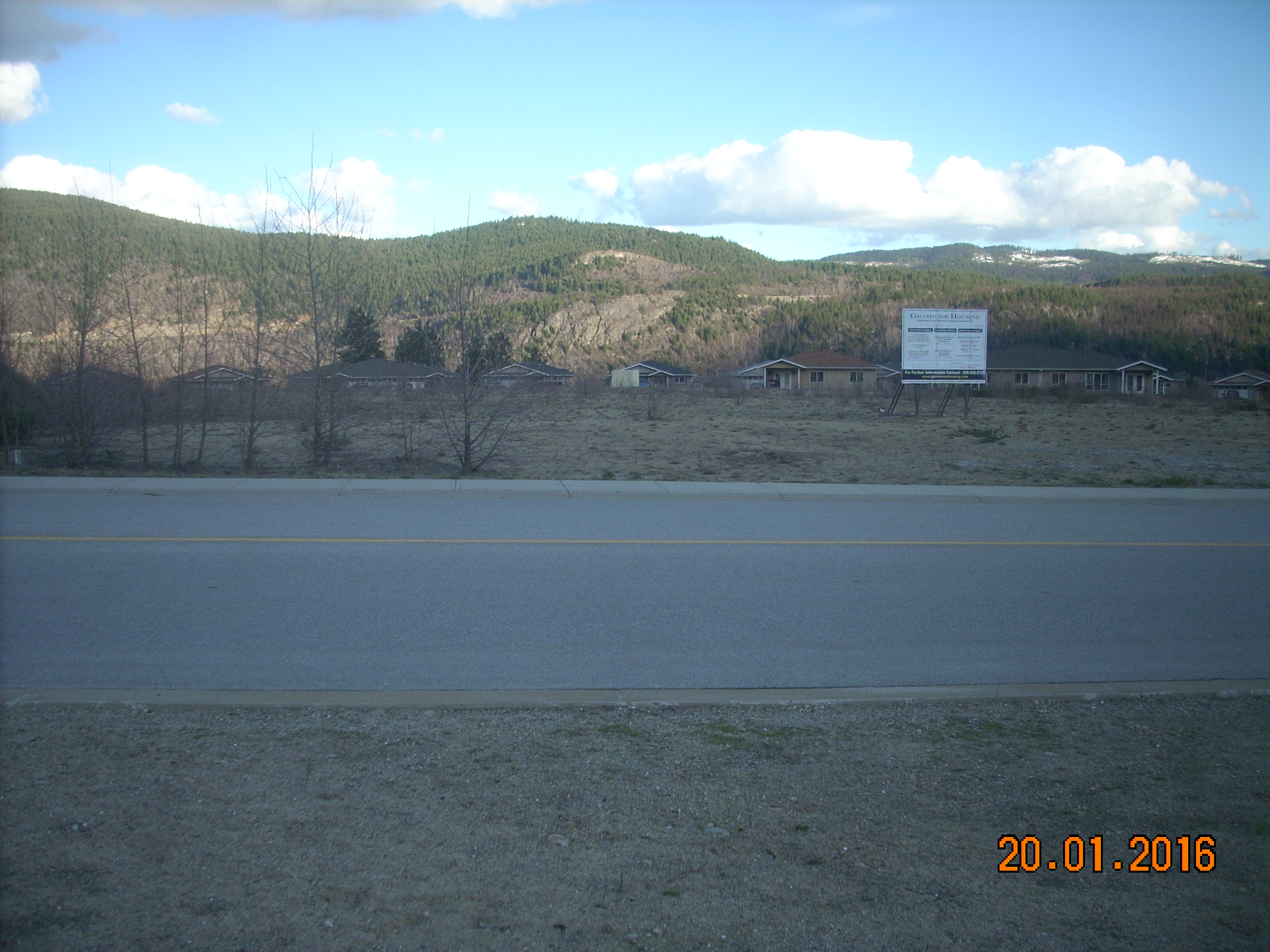
Grandview Drive Travelling Nortrh

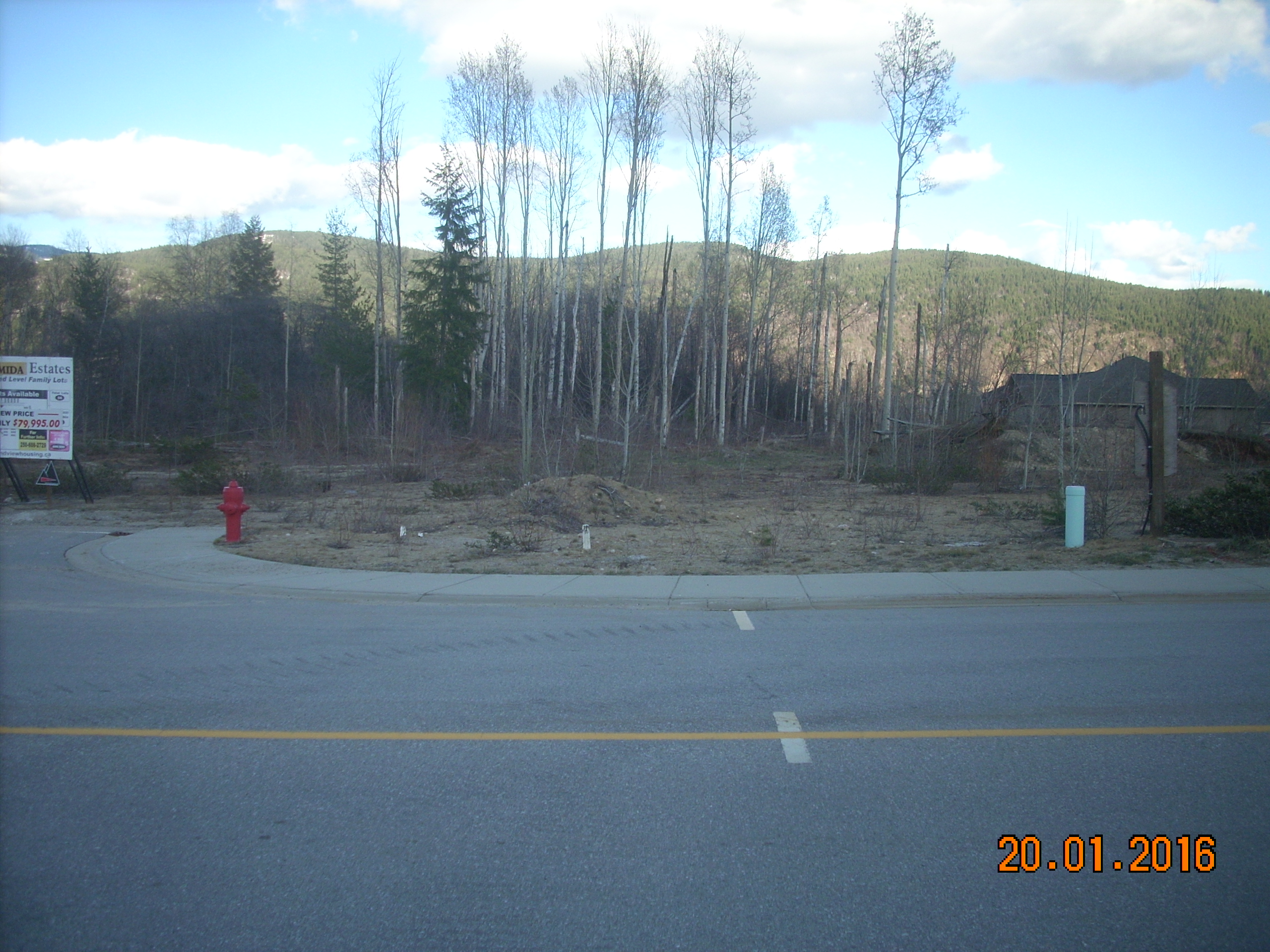
This all takes place on location bounded by 16th Avenue and 4200 Grandview Drive, Castlegar, British Columbia, Canada.

There are many opinions and conclusions as to what caused the failure of a beautiful seniors housing dream conceived by a group of seniors in Castlegar, B.C.

The intent of this blog entry is to provide information for anyone who may be researching cooperative movements with the purpose of designing and delivering seniors housing. This could also assist those groups who may be researching a housing project to become better prepared for the hurdles that may arise in their path to a successful project.

The various levels of government might take time to consider removing hurdles that encumber development by “grass roots” community groups who try to be part of a seniors housing solution. This could contribute to a decrease in the current seniors housing crisis

This action is designed to provide the reader with a background so that an independent opinion can be developed.

  1. The Idea
    1. Members of the Doukhobor Cultural Association (DCA) were aging
    2. The DCA was involved with completion of several successful community seniors projects
    3. Parkside Villa (26 units) in Grand Forks, B.C.
    4. Rosewood Manor (10 units) in Castlegar, B.C.
    5. White Birch Manor (48 units) in Delta, B.C.
    6. Why not a seniors project where the DCA could be participants and share with the public?
    7. In 2002, a two (2) day retreat at Blue Lake Centre ended with all members present agreeing that a feasibility study should take place in Castlegar, B.C.
    8. The main objectives would include:
      1. Affordability
      2. Access to seniors care with fewer restrictions that currently exist with Interior Health Authority
      3. Optimum design for seniors health and mobility
      4. Possibility to utilize project development profits that would lower costs of delivering care when that need would arise
      5. Benefits from the project to be shared with friends and neighbour


  2. Preliminary Feasibility Study No. 1
    1. A Committee of five (5) members was formed
    2. The Committee asked one of its members, a Professional Engineer, to report as Consultant
    3. Twenty (20) sites were investigated
    4. Site basic characteristics and requirements:
      1. Must be adjacent to all municipal services
      2. Design suitable to a campus style seniors complex consisting of Supportive/Assisted Living and Residential Care
      3. Recommended economic total size must be in the range of 160 to 250 units as established by successful private developments e.g., Hawthorne Park, in Kelowna, B,C.
      4. This ideal design would require five (5) acres minimum size
      5. Likely initial need for “seniors friendly” independent units as a starter project that would assist in financing the large basic infrastructure costs
      6. Recommended that housing lots be available for sale to the public which would also assist in financing the infrastructure
      7. It was then agreed that a preferred site size must be at least ten (10) acres
    5. Three (3) sites were short-listed:
      1. Centennial Park at the junction of the Kootenay and Columbia Rivers was the recommendation by Consultant and Committee
        1. Undeveloped park area exceeded thirty (30) acres
        2. Met all basic other criteria
        3. City Council recommended that the site be reconsidered as:
          1. Zoning from park to a higher zoning not usually successful
          2. Too many legal easements and site restrictions by external agencies including BC Hydro, First Nations, etc.
          3. Consultant and Committee recommended against further study on this site
      2. The Ferraro property in South Castlegar (the Grandview Project now) was second choice
        1. Property met basic criteria
        2. The forty (40) acre size exceeded the basic requirements
        3. Additional property could add to the revenues from additional development
        4. Purchase price at $10,000 per acre was very acceptable
        5. Consultant and Committee recommended further study on this site
      3. The ball park adjacent to the Castlegar Recreation Complex was suggested by the City of Castlegar CAO
        1. Closer to centre of town and services than the Ferraro site
        2. Size did not meet basic committee requirements
        3. Recreation Committee would not likely agree to compromise a site designated as recreation that would continue with future City growth
        4. Consultant and Committee recommended against further study on this site
  3. The Project Name
    1. British Columbia Housing Manager responsible for the Kootenay Region recommended that the DCA look at a successful seniors housing project in Kamloops that used a cooperative model where the seniors financed their own units
    2. The cooperative was the North Kamloops Seniors Housing Cooperative (NKSHC)
    3. Twenty (20) members of the DCA visited the site of the project, Cottonwood, and met with the Founders
    4. The constitution, plans and operating budgets were copied by the Founders and “loaned” for KCSHC use
    5. The DCA decided that using a cooperative model would be recommended for the final feasibility study
    6. A naming contest took place and Kootenay Columbia Seniors Housing Cooperative (KCSHC) was the result
  4.  Concept Creation
    1. The DCA decided to formalize the project by preparing a concept
    2. The decision was to allocate a maximum of just under $50,000 to this effort
    3. Elmer Verigin, as Consultant, would continue to report to the Committee and develop a concept:
    4. Ferraro family agreed to a $1,000 deposit on the 40 acre parcel for $400,000 purchase price
      1. Subject to feasibility and financing
    5. Lubor Trubka, Architects from Vancouver were engaged to prepare a site plan that would meet the economic basic requirements specified in (item 2.4 see above)
    6. Marwest Contracting Ltd and WSA Engineering were contacted to prepare a preliminary cost estimate on a design/build basis for infrastructure
    7. Elmer Verigin prepared an overall project estimate and possible costing of individual lots to cover infrastructure as well as projected final housing costs
    8. The DCA proceeded to register the KCSHC along with the appropriate documentation with a lawyer from Kamloops recommended by the NKSHC who was familiar with cooperatives
    9. It was agreed that the individual unit memberships would have a fee of $250
    10. Seventeen (17) members of the DCA took out the first unit memberships
    11. Voting power would equal one vote per unit membership
    12. The project was ready for public presentation
  5.  Society Acceptance
    1. A public meeting was called in September 2005 with the Architect and others available to answer basic questions
    2. About 100 people attended
    3. Memberships were sold and membership rose to just under 50 units.
    4. Subsequent meetings established an elected Board and Committees from the rising membership which included:
      1. Board of Directors
      2. Building Committee
      3. Rules and Regulations Committee
      4. Chateau Grandview (originally Grandview Manor) Committee
      5. Grants and Finance Committee
      6. Landscape Committee
      7. Governance Rules were established
      8. Committees responsible in each area must report their recommendations to the Board. Minutes are to be recorded at each meeting
      9. The Board then makes a recommendation to the membership
      10. All members are to be invited to monthly membership meetings consider each Board recommendation with a final decision taking place
      11. Minutes are recorded at each meeting and distributed to the membership
      12. Committee then takes action
      13. All financial transactions must be approved by the Board
      14. The Treasurer and one signing officer to sign all cheques
      15. Each membership meeting is to receive a financial report
      16. Maximum individual expenditure (within approved budget) that can be approved by the Board is $50,000. All other expenses to be approved by membership
  6. Decision on Land Purchase Phase I (40 acres)
    1. Option to Purchase had a time limit of May 2006
    2. Search for project financing included:
      1. Local credit unions
      2. BC Housing
      3. Columbia Basin Trust
    3. All refused to loan and/or fund the land portion without prior consideration of the total project
      1. Using seniors RRSPs and similar investments was not acceptable collateral for a loan
    4. A membership meeting was called to consider action to be taken
    5. The Consultant recommended that the project be abandoned due to financing challenges
    6. Members discussed action and considered that members put up cash to purchase land
    7. The Consultant advised that a total of $450,000 would have to be raised for Land Title and legal fees
      1. Further advice included no final project feasibility at this time
      2. KCSHC had no formal plan on how to proceed to project completion
    8. The membership decided to proceed against the Consultant’s advice
    9. 15 members volunteered to raise funds at $30,000 each
      1. Security would be by a Loan Agreement as a First Mortgage on the land
      2. See Loan Agreement 12.1.2
    10. The Consultant proceeded with the membership directive to secure the land purchase
  7. A Castlegar Market Study
    1. Prepared by Kate Mancer, a respected consultant in this field, of InSite Housing, Hospitality, and Health Services Inc. The following excerpt is taken from the formal report dated June 02, 2006: 
      1. The KCSHC should focus on housing for independent seniors as Phase One of its planned development for the following reasons:
      2. “…..Executive Summary…..Conclusions and Recommendations
        1. The primary target market for independent seniors housing is seniors between the ages of 55 and 74; the primary target market for supportive housing projects is non-family households over the age of 75, and the primary target market for residential care facilities is non-family households over the agre of 85.
        2. The greatest growth among senior’s population in Castlegar market area over the next 15 years will be the younger age groups – 55 to 74. That group will increase by 966 people between now and 2021 while the 75+ group will increase by 406 people
        3. Although seniors as a whole prefer to stay where they are, younger seniors are about 50% more mobile than older seniors.
        4. Non-family owner households over the age of 75 in the market area have relatively low incomes – an average of $19,305. Even after the sale of a house these households would face affordability challenges vis-a-vis the cost of supportive housing. The current rent for a studio apartment with one meal is over $1,400 per month.
        5. Although Castlewood is full and has a waiting list, the depth of the market for supportive housing is worrisome in light of standard saturation analysis and in light of low incomes of the primary target market
        6. Younger households have significantly higher incomes. One family owner households with a head between the ages of 55 ND 64 and 65 to 74 have an average incomes of $66,753 and $43,961 respectively, before the sale of houses.
          1. Escalating construction costs will result in higher rents and selling prices for all types of senior’s housing and health care projects, meaning the impact for the unsubsidized supportive market.
          2. Until Grandview Heights becomes a more established community and services develop around the project, its location will be more appropriate for younger and more independent seniors than older frailer seniors.
          3. The campus nature of Grandview Heights becomes will attract younger senior who might otherwise decide not to move until much later in their lives. Seniors younger than 75 or 80 are more likely to move to a housing project that is part of a campus than to a free-standing project.
          4. Research indicates that younger seniors prefer to own rather than rent. A life lease or equity coop arrangement for Grandview Heights make sense not only from marketing and administrative (control over occupancy) points of view but also from a viability point of view (i.e. access to capital) Because of general unfamiliarity with these tenure types, communication with future residents needs to be carefully planned and should begin as soon as possible. We are assuming that consumers in Castlegar will respond positively to a development of this nature but there is really no way of knowing for sure until the consumers are approached directly. It is our experience with the life lease concept that once consumers understand it, they like it.
        7. Golden Life Management has been very aggressive and very successful in the Kootenays; however, a project sponsored by KCSHC would have a marketing advantage relative to the Golden Life projects because of its campus nature, its non-profit nature, and (potentially at least) its tenure arrangements.
        8. he addition of a supportive housing / assisted living component in 10 years (more or less, depending on circumstances) would be the next logical development followed by a licensed care facility…….”
  8. Based on the above recommendations the KCSHC continued with:
    1. The developing and marketing of 55 Grandview Heights units and 56 residential lots to raise the capital necessary to fund the infrastructure
    2. Starting a process to develop 61 units of Supportive Living in the Chateau Grandview
  9. Establish Mission Statement
    1. The KCSHC membership created the following:
      1. Identity: “The Kootenay Columbia Seniors Housing Cooperative (KCSHC) is a Not-For-Profit Housing development catering to seniors seeking to live the rest of their lives in a self-governed community”
      2. KCSHC Backyard Social Function
      3. Vision: “Seniors living for life in a cooperative, supportive housing community”
      4. KCSHC Boston Tea Party
      5. Mission: “Our mission is to satisfy the needs of each individual member by creating homes where they will live independently and by establishing a campus-style health facility where our members may choose to live in an environment which sustains quality living.
    2. The cooperative will use prudent business practices to ensure our members receive the best possible housing and quality care services for the best possible price with a Life Lease Model”
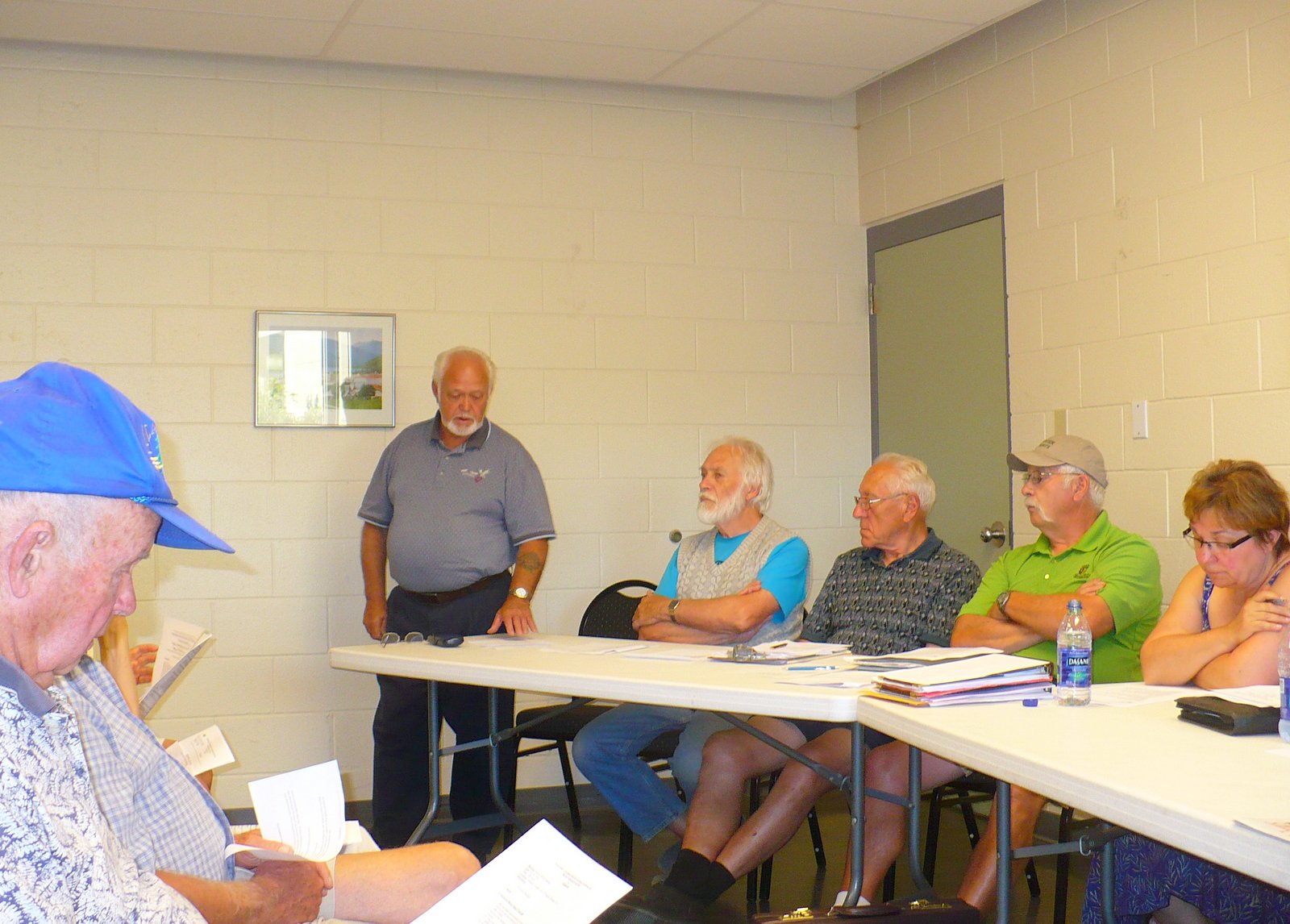
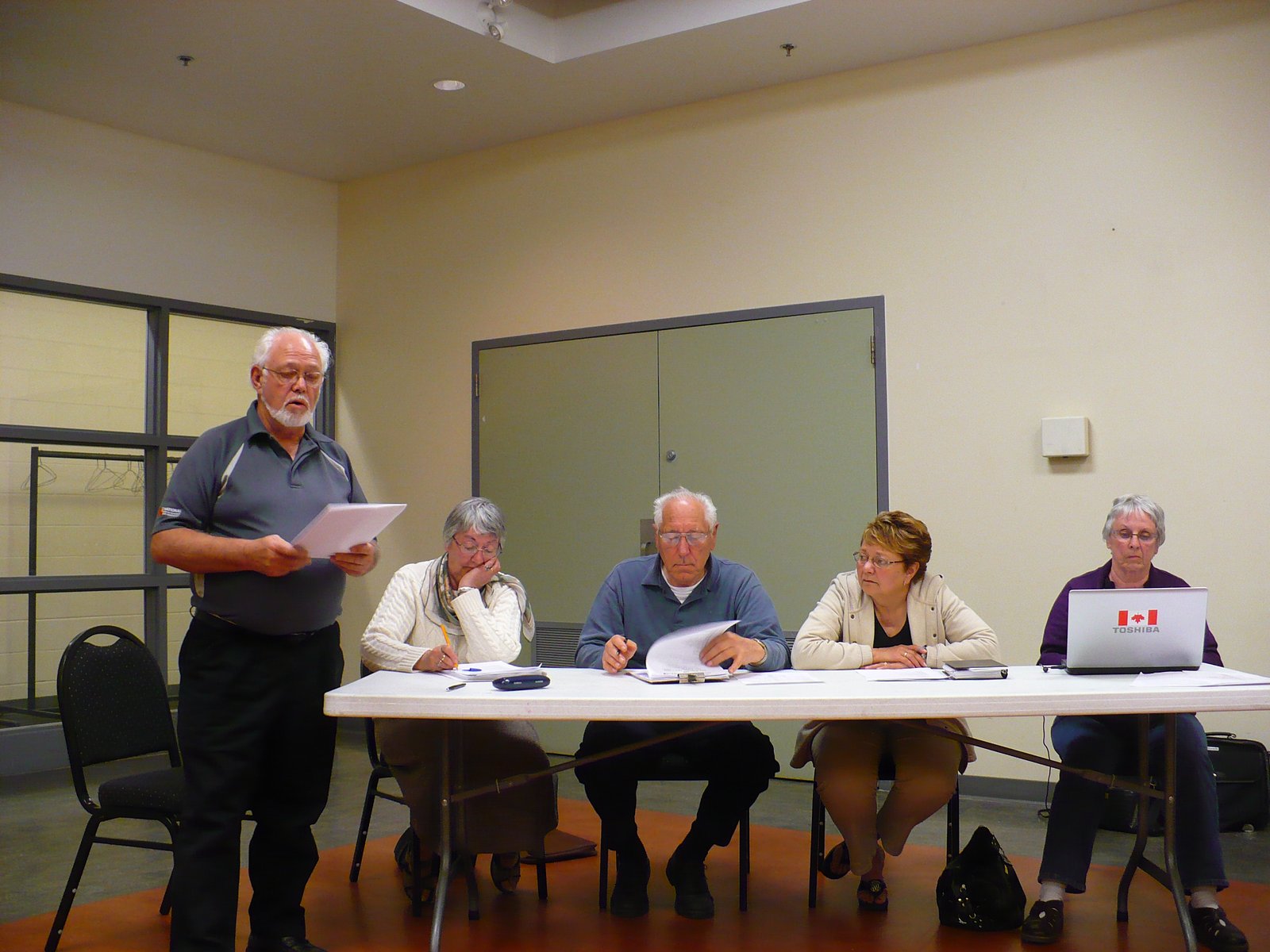
    3. KCSHC Directors Called Meetings and Some Members Came
  10. Search for Public Financing Support
    1. Columbia Basin Trust (CBT)
      1. Initial meetings indicated that there was a willingness to participate with the Grandview Manor (Campus Seniors) portion under submission of specific project,
      2. Quotation from CBT letter dated December 20, 2005 “Funding of seniors Care Complex…
        1. “CBT would be pleased to review a more comprehensive proposal to participate as an equitable partner in the construction of a 117 unit care facility…..”
      3. At a subsequent meeting with the Mayor, MLA and MP present the following is an excerpt from the notes taken by Elaine Whitehead, Assistant to Katrina Conroy MLA and dated February 21, 2008:“… Comments by CBT: 
        1. Good concept and a great idea but CBT can’t get involved other than to assist with getting more grant money for up to 10K inadvertently through the RDCK that CBT actually gives them……….made it clear they cannot get involved. Went through explaining how trust works and what their investment mean. Their lawyers would perceive this is a conflict of interest because they have invested in Castlewood and Grandview would be in competition. They cannot invest in a facility that would compete with one of their investments and their lawyers would be sure to inform them as such……”
        2. No CBT support was available
    2. Canada Mortgage and Housing Corporation (CMHC)
      1. CMHC website indicated support for cooperative housing projects
      2. Feasibility funding could be available as a loan / grant
      3. Support would come as a guarantee of a financing loan
      4. Upon actual application to guarantee interim financing for Chateau Grandview by:
        1. Bank of Montreal
        2. Royal Bank
        3. Western Canadian Bank
      5. Refused to interim finance unless loan was a final for a rental project
      6. No support was available
    3. British Columbia Housing (BCH)
      1. Requirements of BCH had changed from DCA previous project experience
      2. Project must have a significant municipal financial involvement
        1. City of Castlegar was not interested
      3. As a result no support would be available
  11. Search for Grants and other external funding
    1. DCA Initial Funding $50,000
      1. (See 4.b)
    2. Columbia Basin Trust
      1. Grant of $30,000 was provided in July 2008
        1. Money was used for feasibility study for Chateau Grandview
        2. Derek Murphy was engaged to do the study
      2. Grant of $3,930 was provided June 10, 2010
        1. Money was used for Geotesting for Chateau Grandview
    3. Real Estate Foundation (REF)
      1. A grant application was submitted
      2. Was recommended by the Executive Director
      3. Refused by the REF Board
    4. Kootenay Savings Foundation
      1. Grant of $30,000 was provided December 14, 2009
      2. Money was used for Chateau Grandview development purposes
    5. Heritage Savings Foundation
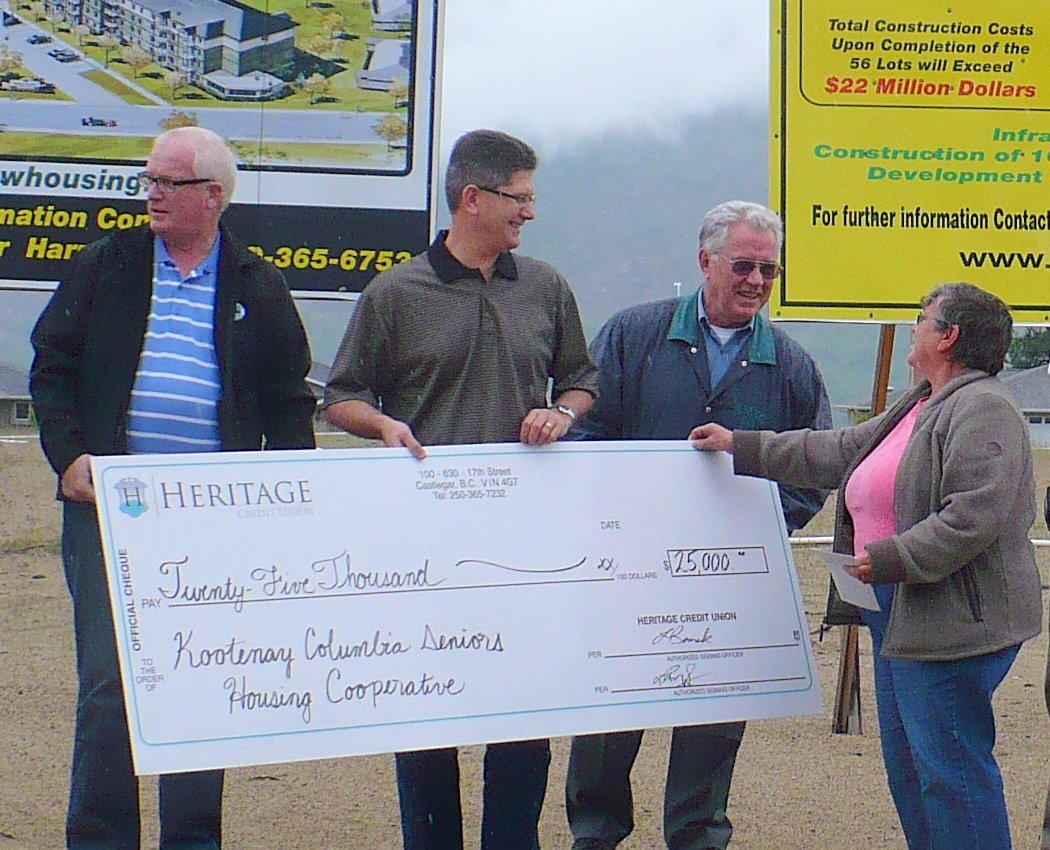
      1. Grant of $25,000 was provided January 26, 2010
      2. KCSHC HCU Donation
      3. Money was used for Chateau Grandview development purposes
    6. Canada Mortgage and Housing Corporation
      1. Grant of $50,000 was provided in 2008
      2. Grant of $15,000 was provided September 06, 2011
      3. Money was used to develop three (3) Contractor formal design/build proposals for Chateau Grandview
    7. Cooperatives Group Limited
      1. Grant of $15,000 was provided May 24, 2011
      2. Grant was used for advertising campaign for Chateau Grandview
    8. Mining gravel deposits on Lot 59
      1. The future site of Phase II Residential Lots was sited over a very deep overburden of clean gravel that could reach about 30 meters
      2. KCSHC had considered mining this gravel in advance of development to raise funds for infrastructure costs
      3. The Building Committee and Directors opted to develop the site over existing grades balancing cuts and fills to current levels
        1. Perhaps delaying the project and operate a gravel mining project may have been a viable option???
        2. A rough calculation would yield some $6.5 million at $1.50 per m3 but that would take many years as no local Purchaser / User could store that much aggregate economically
        3. The final conclusion was that this may not be a viable plan
      4. After the Phase I infrastructure was completed, it became obvious that site grading of Lot 59 would uncover a substantial amount of gravel
      5. The decision was made to market this gravel and about $50,000 was raised for operating expenses
  12. Membership Loans Financing
    1. This came unsolicited as a result of a motion made and passed at that meeting (see 6.9 above)
    2. Loans Agreements were prepared by KCSHC Legal Counsel
      1. Loan agreement specifically covered that the signatory seek independent advice
      2. Initialing that clause was required
      3. Five (5) year term
      4. Interest rate noted
      5. Trustees (3) elected to ensure that security was placed
      6. More loans came in than required to fill the initial needs
    3. Ensuing Loans
      1. Used same model as in item 12.2 above
      2. Unsolicited but membership was aware that financing by members was the likely approach to the project success
      3. Members would call the Project Manager who received the applications
      4. Director signing officers executed the loans
      5. Members may opt to:
        1. Future purchase of a Residential Lot
        2. Future purchase of a Grandview Housing Lot
        3. Final security would be a registered legal title but interim security would be a first mortgage on the unsubdivided initial property
        4. Money to be used for land purchase or infrastructure construction
        5. Interest from the membership was very active at this time
    4. Loans for 16th Avenue Construction
      1. Estimated cost was $2 million
      2. Negotiations with the City of Castlegar
        1. CoC advised that there were still no DCC Funds available
        2. Excerpt from CoC Annual report December 31, 2007, page 24, Exhibit 3 lists “….Reserve Fund for Development Cost Charges amount $1,174,700……”
        3. Advice was that they would make a “special funding” of $1 million if KCSHC raised the rest
        4. KCSHC made an appeal to the membership to raise $1 million
          1. Members responded and full amount was raised as the members were desperate to have access to 34 Grandview Housing units under construction at that time
          2. The same loan agreement was used as before to secure loan-holders (see 12.2)
          3. The contingency plan was to repay this loan from the pending development of Chateau Grandview where the members would pay $30,000 per door for their share of infrastructure costs
            1. Phase I of 61 units x $30,000 would generate $1,830,000
          4. The KCSHC felt confident to proceed with the CoC partnership funding
          5. Note the following City bylaw was not enacted by Council:
            1. COC bylaw 695, TO IMPOSE DEVELOPMENT COST CHARGES passed in 1994 is quoted:“…AND WHEREAS the development costs charges may be imposed for the sole purpose of providing funds to assist the City in paying capital cost of providing, constructing, altering or expanding sewage, water, drainage and highway facilities and providing park land, ion order to serve, directly or indirectly, the development for which the charges are imposed…..” “…..14th Avenue South (now 16th avenue as it passes through Grandview)PROJECT DESCRIPTION a bypass collector connecting Highway #3 at upper bench and Highway #22 near Industrial Park
            2. COST ESTIMATE $4.600,000 
              1. FUNDING DCC, general taxation and contribution from frontage beneficiaries…..”
              2. PROPOSED CONSTRUCTION 2011 – 2014
              3. Clause 4.1.4 states…..”
            3. KCSHC understood that all of 16th Avenue as it would pass through Grandview would be the responsibility of KCSHC
            4. KCSHC requested that the portion of 16th Avenue that continued south to Minto Road be constructed by the CoC and expedite construction to 2009 from 2011 as per bylaw 695
          6. KCSHC had prepared construction drawings and cost estimates that suggested the total cost to be $2 million
            1. CoC stated that there were no DCC funds available to do this (see actual DCC Fund total in 12.4.2.)
          7. KCSHC considered the alternative to access north through Emerald Green which was developing a subdivision that would require construction of that portion of 16th Avenue and allow access to 37th Street and Highway #22
            1. Final proposal would require a traffic light at Highway #22 estimated at a cost of $500,000 to be shared by KCSHC
            2. The developer of Emerald Green decided to abandon plans for that subdivision and this access became unavailable in June of 2008
            3. The southern 16th Avenue option became the only practical option
          8. Negotiations with CoC started again in July 2008
            1. Membership became aware that Emerald Green would not proceed and access to Grandview would not be available from 37th Street via 16th Avenue North (originally 14th Ave)
            2. Alternative was building 16th Avenue South
  13. Infrastructure Design Process
    1. Negotiations took place with WSA Engineering who had already provided initial cost estimates and advice
      1. Contract for the infrastructure design was signed with fees traded for the value of two (2) residential lots
      2. This reduced financing costs and reduced cash outlay
      3. Final result was that WSAE was provided with title to 2 residential lots of their choice in full exchange for the value of the infrastructure design fees
      4. (Note overdesign policy by CoC and AO as outlined in 28.iii through to vi inclusive increased design costs but were absorbed by WSAE)
  14. Feasibility Study No. 2
    1. With preliminary design drawings, the process to establish an overall cost estimate was possible
    2. The Project Manager (PM) had worked with Marwest Industries Ltd (MIL) on a large subdivision in Warfield. This type of contract work is based on unit prices. These unit prices can easily be compared to projects in surrounding municipalities that were derived by competitive tendering.
    3. Unit prices were established in this fashion
    4. These unit prices were used in final designs of the infrastructure by WSAE
    5. Due to the lack of available cash it was negotiated with MIL that they work closely with WSAE
    6. Agreed that final payment on contract will be the equivalent of four (4) residential lots as part of the future infrastructure construction contract
    7. MIL also found two associates that made loans to KCSHC for future value of four (4) additional lots
    8. The legal land surveyor agreed to provide surveying in a partial exchange for one (1) residential lot
    9. The PM agreed that fees for work on the infrastructure would be paid in exchange for the value of one (1) residential lot
    10. These negotiated exchange of services for future land was conducted on the basis of trust that the firms involved had with the Consultant
    11. The membership was advised of these negotiations and soon the members started offering loans for future:
      1. Residential Lots
      2. Grandview Heights Strata Lots
      3. Others offered loans as there was a philosophical belief in the cooperative process
      4. All transactions were based on the approved loan agreement system already established
      5. Upon subdivision registration, choice of lots would be based on initial dates of loan agreements
      6. All loans to be utilized for land purchases and development costs
  15. Decision on Land Purchase phase 2 (additional 20 acres)
    1. City of Castlegar officials advised in 2006 that the CoC was not able to proceed with construction of 16th Avenue (14th Avenue at the time of the bylaw 695) even though a bylaw that legislated construction of 16th Avenue was to be constructed by 2011
    2. Funding was to come from accumulated Development Cost Charges (DCCs)
    3. Although the KCSHC request was earlier than 2011, the officials advised that there were no DCCs in the Fund at that time
      1. Excerpt from CoC Annual report December 31, 2007, page 24, Exhibit 3 lists Reserve Fund for Development Cost Charges amount $1,174,700
    4. Construction of 16th Avenue South was estimated at $2 million in 2006
    5. Without CoC support, KCSHC could not afford this full cost in its economic development of Grandview
    6. Emerald Green was proceeding with an extension to their subdivision that included construction of 16th Avenue within that development
    7. An alternative access to Grandview would be to connect to that portion of northern 16th Avenue
    8. Property between Emerald Green and Grandview was owned by Ferraros
    9. A $300,000 price tag would allow a connecting 16th Avenue construction to be economically funded by development of residential Grandview lots on both sides
    10. The decision was made to purchase this land and extend the planned residential lot subdivision (see 10.c.viii)
    11. Revenues from development of 18 additional residential lots would pay for this purchase with future revenues possibility from a future Phase II residential subdivision
    12. This increased the financial development funding required as now the development was much larger than originally planned
  16. Develop Initial Project Cost Estimates
    1. Knowledge of construction costs of local subdivisions
    2. WSAE and MIL were actively involved in these projects
    3. Unit costs for installation of sanitary and storm sewer, water, power, telephone and cable was current
    4. Levelling and grading amounts were estimated from preliminary drawings
    5. Budgets were thus developed to an accuracy suitable for feasibility purposes
  17. Confirm Serious Purchaser Intent
    1. Membership interest continued to rise that was now approaching 200 member units
    2. Loan offers continued to come into the KCSHC coffers
    3. Preliminary site clearing had taken place so that members could visualize the design of the subdivision
    4. An appeal went out to the membership to determine their interest in the winter of 2008, this was the approximate status:
      1. Residential Lots 34
      2. Grandview Heights Strata Lots 52
    5. Based on preliminary projections of lot market prices the following funds were raised:
      1. Residential lots 34 x an average of $70,000 = $2,380,000
      2. Grandview Heights strata lots
        1. Serious 34 x $40,000 = $1,360,000
        2. Deposits 18 x $20,000 average = $360,000
        3. Total $4,100,000
      3. Note that these amounts were changing with time but this provides a reasonable estimate of the status at that time
      4. Based on the projection of total infrastructure, land, survey, design and other costs projection of $7,000,000, about $3,000,000 in financing would be required
  18. Project Appraisal
    1. Phase I Residential Lots (58) appraisal value $6,160,000 dated May 01, 2008Strand and Godfrey Appraisals Ltd
    2. Chateau Grandview Site appraisal $960,000 dated May 01, 2008
    3. Grandview Heights Strata Lots (59) appraisal based on KCHC sales price of $40,000 per unit $2,360,000 dated May 01, 2008 (note by Appraiser that, alternatively, fee simple gross sales proceeds is $7,300,000 or $124,000 average lot price)
    4. Uncompleted remainder of 23 acres $517,000 dated May 01, 2008
    5. Phase II uncompleted Residential Lots (36) appraisal $1,700.000 dated May 20, 2008
    6. Total value of the 60 acre site appraised $11,797,000 dated May 20, 2008
  19. Marketing Projections by KCSHC
    1. Residential Lots revenues 58 x $110,000 = $6,380.000
    2. Strata Lots (Grandview Heights) 55 x $40,000 = $2,220,000
    3. Supportive Living Phase 1 (Chateau Grandview) 63 x $30,000 = $1,890.000
    4. Total initial development revenues $10,340,000
    5. Revenues from developing the balance (208 units zoning maximum) of Chateau Grandview or 145 units @ $30,000 (original plans) for $4,350,000
    6. Revenues from developing Phase II Residential Lots $1,400,000
    7. Revenues to assist future care needs appeared very possible
  20.  Search for Infrastructure Financing
    1. Self-financing intent
    2. Many of the founding members were loathe to borrow funds
    3. The fundamental principle was to raise all the required funding from members
    4. A need for financing was becoming a necessity
    5. Time was a factor
    6. Waiting to find enough members serious to fund the entire $7 million infrastructure budget, may mean that others could not tolerate the wait and lose interest
    7. The decision was made to investigate if financing could be available
    8. Financing should be easier now that
    9. Members had raised over $4.1 million (see 17.5)
    10. Loan amount would be less than 50% of total infrastructure cost or under $3 million (see 17.5.4)
    11. Sources considered
      1. Banks
        1. Calls to the Bank of Montreal did not suggest any real interest
      2. Columbia Basin Trust
        1. Already established inability to fund due to legal barriers
        2. (see meeting with CBT 10.1.3.2)
      3. Kootenay Savings Credit Union (KSCU)
        1. A meeting with KSCU indicated that a loan would be considered with a 100% mortgage would be the necessary security on all lands held by KCSHC
        2. The Consultant suggested that the security requested was not in keeping with the equity available
      4. Heritage Credit Union (HCU)
        1. A meeting with HCU indicated that a loan could be possible and security could be on legal portions of the project representing sufficient security when subdivision would take place
        2. The Consultant recommended this source of financing be pursued (see 20.10)
        3. Financing Package selected for presentation to the membership was as follows:
        4. Grandview Heights Strata Lots would not have any financing as members would fund this portion from apparent sales
        5. Residential Lots would have 75% mortgage ($1,815,000) to appraised value on residential lots
        6. Phase II Residential Lots, Lot 59 (potential 36 lots) would have a $500,000 mortgage
        7. Chateau Grandview, Lot 53, would have a mortgage of $448,700
        8. A formal offer from HCU (dated March 11, 2008) along with a first mortgage requirement was received from HCU and presented to membership meeting #3900 on March 16, 2008 (see 21.1) 
  21. Infrastructure Final Financing Package Approval
    1. At a membership Meeting #3900, dated March 16, 2008, the membership reviewed the detailed terms and conditions of the Heritage Credit Union (HCU) Offer to Finance dated March 11, 2008 with 50 members present (from attendance list) from 186 members total
      1. “…….Agenda item 3915 Heritage Credit Union “Bridge Financing” recommendation from Directors:
      2. See hard copy of proposal
    2. Motion to support financing proposal
    3. Motion by Cliff Paluck/Joe Nazaroff for directors to carry on with this proposal. Vote all in favour, no opposed, no abstentions. Carried unanimously
    4. Report on Appraisal of properties proposal
    5. Other action if required……….”Financing approved was as follows:
      1. Residential Lots (58) mortgage amount of $1,815,000 at 3.5256 % interest
        1. Dated progression of this loan administration
          1. During a review of loans in early 2012 for Canadian Western Bank that was considering interim financing Chateau Grandview Supportive Living construction, it was found that $275,000 was never funded in this registered mortgage. Several audited financial statements failed to report this as well
          2. HCU Manager at first was surprised at this but later advised that he could not fund this remaining outstanding amount due to the decrease of current residential lot values
          3. The Consultant advised the Directors that this not a per agreement
          4. The Directors decided not to proceed to any remedy
          5. This was a serious reduction in funds to pay out infrastructure costs to two contractors
      2. Lot 53 (Chateau Grandview site) mortgage amount of $448,700 at interest rate 1/2% over prime
      3. Lot 59 (Phase II Residential Lots) mortgage amount of $500,000 at interest rate 1/2% over prime
  22. Decision on Infrastructure Construction Start
    1. Following General Meeting #3900, action taken was as follows
      1. Contracts with MIL were executed
      2. Construction started
      3. Final utility designs were completed and contracts let for utilities and contractor for that work not included in base utility scope
  23. Subdivision Registration
    1. It was fundamental that a registered subdivision be filed with Land Titles Offices in Kamloops
    2. KCSHC Site Plan C06001-004_28072009-Site Plan
    3. Needed to have HCU register individual mortgages over those lots to be mortgaged rather than over entire property
    4. Provide clear titles to members purchasing residential lots and Grandview Housing strata lots who in turn would release their loan agreements with KCSHC
    5. The difficulties to achieve this were:
    6. Approving Officer (AO) for the City of Castlegar cannot approve a legal survey drawing until all the infrastructure is complete
    7. Option is that a financial security is posted for 1.25 times the estimated incomplete work
    8. This unique issue was discussed with the HCU Manager with the result
      1. Deposits were up to $7 million in the HCU by members who were funding their bungalows and duplexes in Grandview Heights
      2. The Manager suggested that he could temporarily use this as collateral for the short time it would take to register the subdivision
      3. Certified cheques were delivered to the CoC AO in June 2009
      4. Subdivision was registered
      5. HCU was very helpful and cooperative in achieving this major step forward
    9. Letters of Credit were eventually removed by the City of Castlegar as the infrastructure work was completed
  24. Marketing
    1. Serious marketing was undertaken now to generate sufficient sales to pay HCU loan
    2. KCSHC Marketing Displays in Malls
    3. Residential Lot interest continued and members signed loans where they would advance funds as a percentage of completion of Infrastructure
    4. Grandview Heights interest was encouraged
      1. 34 members signed agreements that they would consummate a final agreement to purchase a full bungalow or duplex and find external funding for same
      2. 18 to 20 members who had loans for potential purchase decided not to proceed. All became members of Loan-holders Group #1
    5. Other new members became interested
    6. Interest in Chateau Grandview was in excess of 40 members
    7. Initial marketing contact person was the PM as the KCSHC had no staff
    8. Later, a member of KCSHC, Jim Laktin, was hired at $2,000 per month plus expenses and reported to the Promotions Committee
  25. Grandview Heights Construction Process
    1. Ultimately Loan Agreement translated to Bungalow or Duplex
    2. KCSHC Backyard Social Function
    3. Accrued interest on loan agreements was paid as part of the final lot value
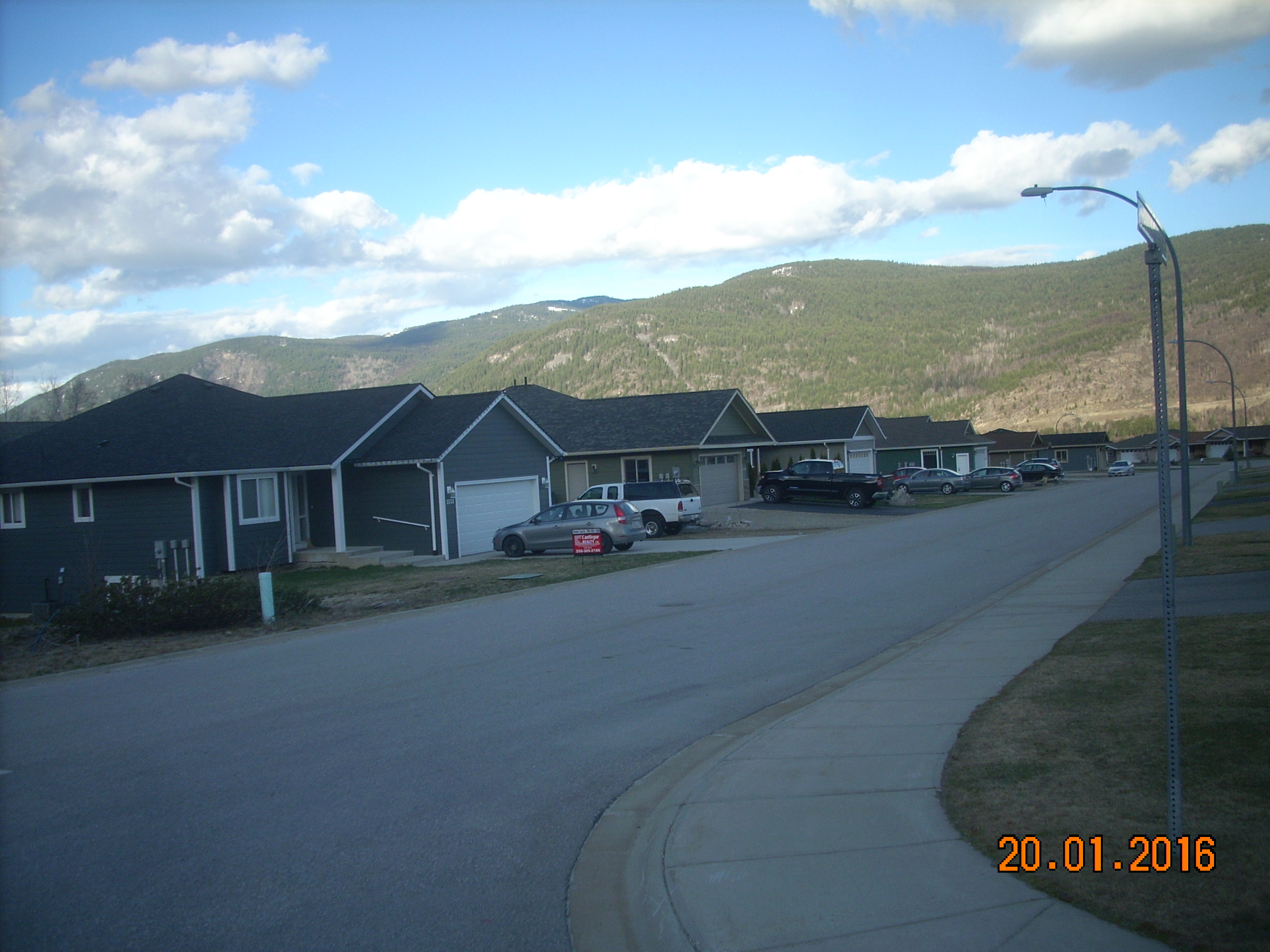
    4. Calamida Heights along Calamida Lane Looking East
    5. Successful in 47 deals
  26. Residential Lot Construction Process
    1. Ultimately Loan Agreement translated to a Residential Lot
    2. Accrued interest on loan agreements was paid as part of the final lot value
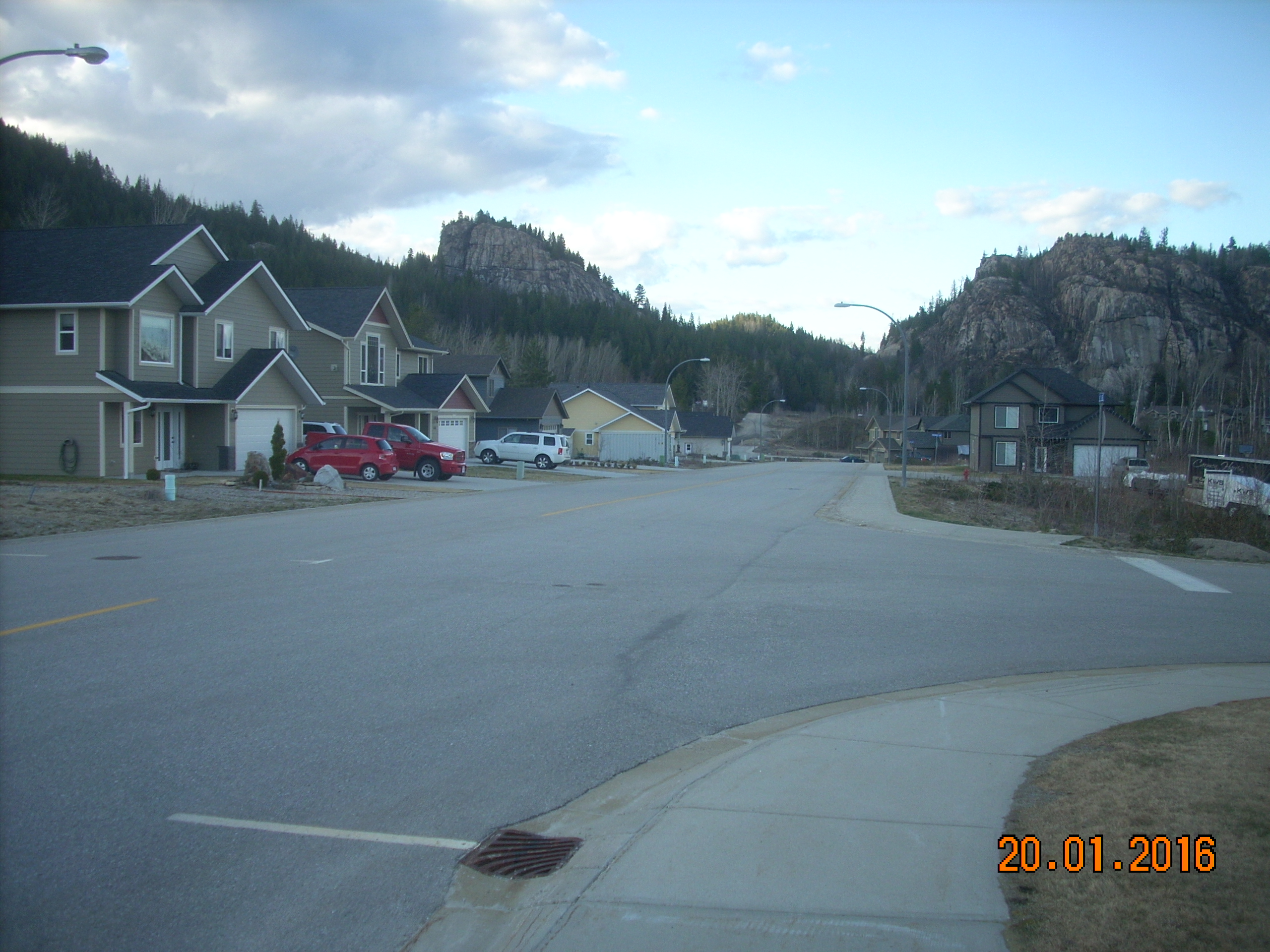
    3. Rosewood Lane Calamida Heights Development Looking East
    4. Successful in 34 deals
  27. Chateau Grandview Development Process (Lot 53) (Note This was Lot 52 in original Survey)
    1. A Chateau Grandview Committee took responsibility for this portion of the project
    2. The Committee knew how important success was in this portion of the project to the overall financial success now that the 16th Avenue development agreement with the CoC required $1 million from KCSHC
    3. Time was of the essence.
    4. The process included:
      1. Soliciting design concept proposals from architectural firms for a campus style project with
      2. Supportive living
      3. Assisted living
      4. Residential care
    5. Maximum zoning was available for 208 units on upper portion of Lot 53
    6. Developing a construction budget from an experienced general contractor for 64 supportive living units
    7. Budget was used from the Derek Murphy business plan
      1. Engaging Derek Murphy to conduct a business plan dated June 30th 2009
      2. Results in Executive Summary:Cooperative is proposing to build independent living residence (Grandview Manor) for seniors in its Grandview sub-division, which also includes 55 bungalows. The project will be built in phases, with the first phase to consist of 61 units. Future phases of Grandview Manor will likely include a complex care component. This business plan provides evidence to the effect that:
        1. “….The Kootenay Columbia Seniors Housing
        2. Grandview Manor is a desirable housing option with a clearly defined product that will meet a growing demand in the West Kootenay / Boundary area.
        3. There is sufficient evidence of future unmet demand for independent living projects like Grandview Manor to justify commencement of construction, once a critical mass of pre-sales have been achieved
        4. The capital and operating cost structures for Grandview Manor are sound and will provide quality residential and hospitality services at a very competitive price
        5. The Kootenay Columbia Seniors Cooperative has the organizational and financial capacity to successfully develop and manage Grandview Manor…..”
  28. Based on this Business Plan, the KCSHC continued with plans to develop Chateau Grandview
    1. Members signed intent to purchase units in Chateau Grandview
    2. Over 30 member units deposited $1,000 into trust to confirm interest
    3. HHTCS submitted an offer to become financially involved in the Assisted Living and Residential Care portion phase for a 49% interest with payment of $2 million when those phases became viable
      1. This is estimated to have an approximate value of $25,000 per door for the projected 80 planned units
      2. This closely compares to the initial appraisal on Phase I (Supportive Living) provided by Adrian Rizzo of Kent Macpherson Appraisals at $28,196.72 per door (See 28.6)
    4. HHTCS was familiar with ELIM, a project that their church sponsored in Surrey, B.C., and strongly suggested that the KCSHC visit the project as it had distinct similarities to Grandview in scope and philosophy
      1. Located at 160th Street and 90th Avenue, Surrey, B.C.
      2. The project is a “Campus Style” design with independent condos followed by Supportive and Assisted Living units which flow into Residential Care
      3. Funds accumulated from real estate sales are invested into the project to assist members financially
      4. This was part of the Grandview dream
      5. About 6 members of the Chateau Grandview Committee attended and received all types of information
      6. This was filed for future reference when Chateau Grandview and the rest of Grandview would reach a substantial level of completion
  29. Search for Mortgage Guarantors
    1. Sources:
      1. Columbia Basin Trust
      2. Canada Mortgage and Housing
      3. City of Castlegar and Regional District
    2. All were unable to provide the required guarantee
    3. Financing was not achieved
  30. Confirm Chateau Grandview Development Estimates
    1. A design/build invitation to contractors in April 2010, resulted in five proposals
      1. A review followed with three (3) selected for a final submission
        1. Tri-City Contracting Ltd (TCCL)
        2. Vic Van Isle Construction Ltd
        3. Maple Reinders Contracting Ltd
    2. All final submissions to have definitive preliminary design drawings and bonded tenders for a fee of $20,000 each
    3. In the industry, preliminary architectural designs are valued at about 1.75% of Construction Cost
      1. Based on the successful tender from TCCL of approximately ($10,897,00) or rounded to $11,000,000, the cost would have been about $200,000 for one design
        1. Three separate designs were submitted at a total cost of $60,000
        2. Tenders were received June 30, 2010
    4. TCCL was investigated thoroughly and became the recommended contractor
      1. Tender compared favorably with estimates prepared by the general contract  (See 27.6)
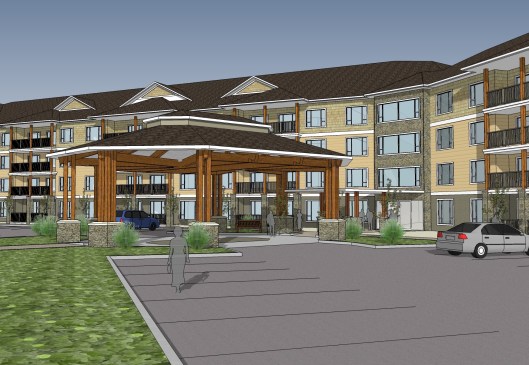
      2. KCSHC Chateau Grandview Rendering-Oct 1 2010
      3. Design concept as proposed by TCCL above
      4. During the investigation of TCCL‘s successful projects, H & H Total Care Services Ltd (HHTCS), the owner, was interviewed in two (2) projects now in operation in Kamloops and Penticton
    5. HHTCS became interested in the Chateau Grandview Project as an operator
    6. TCCL continues as an interested design/build contractor to this time
    7. Adrian Rizzo of Kent-Macpherson Appraisals in Kelowna, conducted an appraisal on June 04, 2010 for 61 marketable Supportive Living Units
      1. Appraised land value for 61 marketable units was $1.720,000 or $28,196.72 per door
      2. Appraised value for entire 61 completed units was $14,390,000
    8. The Mortgage Centre, a mortgage broker in Kelowna, was engaged
      1. To receive formal interim financing proposals from:
        1. Royal Bank of Canada
        2. Bank of Montreal
        3. Canadian Western Bank
      2. All the above proposals required a mortgage guarantee
    9. KCSHC as a cooperative needed substantial support
  31. KCSHC Challenges
    1. Members gossip spilled over into the community
      1. Support for the project started to deteriorate as a result
    2. The Twin Rivers subdivision, located across Highway 22 from the Grandview site, went on the market at about the same time as Grandview
      1. Their lots increased in sales price due to increasing infrastructure costs
      2. The result was a failure in potential sales
      3. Kootenay Savings Credit Union (KSCU) was the financing credit union and forced the developer to market the units to reduce indebtedness
      4. A large number of lots were sold to developers for $60,000 which set the market price for Castlegar lot prices thus undercutting Grandview pricesTwin Rivers Subdivision Competition
      5. This essentially stopped sales on residential lots at Grandview for a few years
    3. Administration Fee
      1. The KCSHC recognized from the outset that all transactions would simply pass through member loans, through to strata unit, residential lot or Chateau Grandview unit and so an administration fee was necessary to pay the minimal overhead costs
      2. The first 34 strata units passed a motion that $1,000 be paid on all transactions to June of 2008. Any others would be $5,000
      3. Chateau Grandview future fees were set at $3,000
      4. Ensuing transactions were challenged by 3 members (who purchased constructed units) who refused to pay the $5,000 administration fee after receiving advice from a notary public
      5. This was not legally challenged by the Directors due to shortage of funds
    4. 2008 Real Estate Crash/Global Financial Crisis
      1. The external economic pressures from a national housing market crash reduced values on all real estate
      2. This was a negative factor in the KCSHC activity
    5. Membership criticism
      1. Total membership totalled 285 member units at the height of the KCSHC,
      2. Unfortunately, attendance at membership meetings varied from 30 to a maximum of 50 members
      3. Also, most did not read the minutes distributed to all the members
      4. Others were influenced by misinformed gossip
      5. Unfounded criticism circulated about the Committees and Directors
      6. One member filed a complaint with the RCMP in Castlegar
        1. Complaint was that the Directors and the Project Manager (PM) did not handle KCSHC funds appropriately
        2. RCMP called the Project Manager for an interview which took 1 1/2 hours
        3. Constable could not reveal name of complainant
        4. PM applied to Freedom of Information (FoI)
          1. FoI advised that the complaint was that the PM took “kick-backs” from two of the major contractors and that improper contract awards process was used
        5. RCMP advised after the interview that they had no reason to keep the file open from this time forward
        6. No further action has taken place
      7. Another member spread rumours that the PM absconded with $3 million in funds from the Grandview project
  32.  KCSHC 2013 Plan of Action
    1. Action Plan Proposal to Membership by Directors
    2. After much research and meetings with affected firms a Plan of Action was developed as follows:
      1. All Shareholders Loans total about $1,400,000 without accrued interest
      2. Trade Lot 53 (Chateau Grandview site) to Loan-holders who held a 2nd mortgage
        1. Value of Lot 53 (See 28.3.2)
        2. Chateau Grandview Upper Bench Looking East
        3. Loan-holders would find a process to remove 1st mortgage of $448,700 and taxes
      3. Market eight (8) remaining Grandview Heights lots to create funds that would remove HCU “hold” on $275,000 operating loan
      4. Trade Lot 59 (Phase II Residential Lots) for contractor accounts/payable (A/P) to Marwest and Martech of $500,000
      5. Future Residental Lot Subdivision Lot 59
        1. Contractors would pay 1st mortgage of $500,000
      6. Unsold Residential Lots would be released to HCU
        1. KCSHC would continue to market them
        2. All net proceeds to HCU
        3. This would exceed the remaining mortgage amount
      7. Grandview Heights strata lots
        1. Remaining eight (8) strata owners that leased from KCSHC would register their strata and KCSHC would cease to be Landlord
    3. Meetings with Loan-holders
      1. After several meetings, agreement by secret ballot on above was above 95%
      2. KCSHC Directors Meeting
    4. Action Plan was initiated
      1. Eight (8) Grandview Housing Lots were sold to TCCL for about $275,000
      2. TCCL swapped completed duplex unit in lieu of cash and KCSHC gained ownership
      3. KCSHC sold duplex for about $275,000
      4. Directors held these funds in the Notary Public trust account pending distribution to HCU
      5. Cash to fund $275,000 “hold” by HCU on Operating Account was ready to transact
      6. This claim would precede any other
    5. Action taken by some members
      1. Although over 95% of the Loan holders were in agreement with the Plan of Action several took the initiative of filing a small debts claim against KCSHC
      2. These Claims came before a Small Claims Judge:
        1. Judge warned claimants their current protection was a 2nd mortgage
        2. That KCSHC did owe money
        3. Judgement against KCSHC would change loan into an A/P with no security
        4. Judgement for the claimants would bankrupt the KCSHC who had no cash
      3. Claimants responded that causing KCSHC bankruptcy was not their intent other than collecting monies owed to them but continued anyway
    6. Members filed a claim against monies held by Notary Public
    7. Small Debts Court seized $40,000 from the Notary Public Trust Account as a result.
  33. Bankrupcy
    1. The Directors had no cash as the repayment of the HCU Operating Loan would have released operating funds
      1. This could not happen now and they declared bankruptcy
    2. Bankruptcy Receiver filed a claim against the $40,000 in court and money was held pending proof of claim
    3. Current Status:
      1. The Court released $40,000 to the Bankruptcy Receiver
      2. Bankruptcy Receiver was finally confirmed by Court, October 29, 2015
  34. List of Possible Causes for KCSHC Collapse (not necessarily in priority)
    1. HCU shortfall of $275,000 in funding mortgage of $1,815,000 on Residential Lots (see 19.c.i)
      1. HCU freezing of operating account left KCSHC with no cash flow
      2. HCU short funded a registered mortgage
    2. City of Castlegar (CoC)
      1. KWL Engineering Report indicated that a self-draining ancient river bed would require no storm sewer
        1. “….new development should include provision for stormwater detention / retention ponds to minimize the impact of minor…..storms…”
        2. “5.2….Castlegar watersheds have a high infiltration capacity because they are predominantely comprised of sands and gravels into which rainwater and snowmelt can easily be absorbed. This why soakaway manholes have proven to be effective within the city…..”
      2. WSAE designed a storm retention pond (value $80,000)
      3. CoC requirement was a costly overflow channel to Scoffield Creek (over $350,000)
      4. This was not anticipated in the KCSHC development budgets
      5. Initial barrier to the infrastructure design process was that the CoC noted that a south sanitary sewer trunk line downstream from the intended project through Columbia Avenue was known to have a partial collapse
        1. This possible constriction had to be evaluated
        2. KCSHC was advised that it was their obligation to determine whether the sewer line would be adequate
        3. KCSHC protested that this is an existing infrastructure
        4. End result was that an engineering firm would be hired to evaluate
        5. KCSHC finally agreed to a 50/50 split of costs on the understanding that it would be a competitive tender process
        6. CoC selected a firm without KCSHC consultation and advised on November 29, 2005 that the total fee would be $15,800 and that KCSHC needed to forward the agreed 50%
      6. Legislated construction of 14th Avenue (now 16th Ave) scheduled in CoC bylaw 695 for 2011 – 2014 long before KCSHC came into being.
        1. CoC was to allocate Development Cost Charges (DCCs) into a fund since 1979 to fund projects such as these. (See 12.4.4.5)
        2. CoC advised that there were no funds
        3. How was this possible?
        4. KCSHC forced to pay a cost sharing with CoC of 50% of $2,000,000 cost
        5. This was not anticipated in the KCSHC budgets
      7. Increase design criteria of water pump house
        1. Basic level is to ensure pressure maintained at 43 psi
        2. This would have required a pump and pressure control mechanism as designed by WSAE for about $80,000
        3. Final design requested by CoC had 4 pumps in sequence at a cost of over $350,000
        4. This was not anticipated in the KCSHC development budgets
      8. Increase redesign criteria of storm reservoir designs than those recommended by Kerr Wood Leidel (KWL) Engineering Storm Sewer Report for South Castlegar dated February 1993
      9. Basic Design of Sanitary, Water lines became oversized
        1. Initial request was to install oversize lines with CoC paying the difference
        2. Urban Systems Ltd (USL) review came back with oversize piping over the WSAE designs
        3. WSAE had to purchase a computer design system to prove that USL request was over designed
        4. Time spent and additional expense to KCSHC was unwarranted
        5. This appears to be an irregular action by CoC
        6. CoC relented in the debate and permitted the WSAE designs to go forward
      10. Water Loop requirement to Emerald Green held as a barrier to development of Chateau Grandview
        1. CoC position was that “looping” to Emerald Green was an Interior Health requirement
        2. KCSHC had to pursue a long debate to prove that this is not a requirement by Municipal Code
        3. This appears to be an irregular action by CoC
      11. Bylaw 695 Development Cost Charges practice on adjacent lands
        1. Adjacent property owners should contribute to cost of adjacent streets and municipal services
        2. A large property owner adjacent to 16th Avenue was assessed $5,000 in the future, by the CoC AO, toward the $2 million 16th Avenue construction although the property is within City limits
        3. Was this fair?
      12. Another large adjacent property was subdivided by its owners (3) at that time and were not assessed any costs because they were in the RDCK and not within City limits
        1. This appears to be an injustice
      13. Offer by BC Housing (BCH) to fund 50 to 60 factory built housing units in April 2009:
        1. Government funding became available (Federal/Provincial) offered by BCH
        2. Two executives came from BCH Head Office in Burnaby to Castlegar to meet with the CoC and KCSHC
        3. Manfred Gerschak and Danna Locke met with
        4. President Jim Mullen and Director Harry Jukes of KCSHC
        5. No representative came from CoC
        6. Suggested site was original Calamida Stadium in Lot 53
        7. KCSHC was prepared to donate land to meet BCH criteria
        8. BCH required CoC to become involved
        9. BCH suggested access road to 16th Avenue as acceptable criteria
        10. CoC would not meet with BCH and KCSHC
        11. Minutes from Directors Meeting May 06, 2009
          1. “….Subsidized Housing was handled by Jim and Harry as they met with Manfred and Danna. The representatives were impressed with the site. There had been hope that the City of Castlegar would be involved and although a formal letter had been written to Council and the Mayor, it was learned that it had not been formally presented to Council. Elmer, however heard from John Malcolm who seems to favor another area closer to the Medical Center for this purpose. Malcolm contacted BC Housing personally……”
        12. The opportunity to build 50 to 60 housing units was lost because this offer was for a limited time only from the Federal Government that was offering a stimulus to the Manufactured Homes Industry
    3. Canada Mortgage and Housing
      1. KCSHC plan was that seniors would purchase units so that no rent would have to be paid in the Chateau Grandview project
      2. This plan was supported by the fact that over 30 members had placed deposits of $1,000 for a unit
      3. Since the system was used successfully to develop units in Grandview Heights where seniors purchased 47 units from their own resources, this would apply favorably in this instance
      4. It was further supported in that those members living in Grandview Heights would sell their units and progress to Chateau Grandview
      5. This system was already working well in the ELIM project in Surrey (see 25.v)
      6. CMHC would not mortgage guarantee Chateau Grandview loan offers from
        1. Royal Bank
        2. Bank of Montreal
        3. Canadian Western Bank
      7. Reasons given to the Mortgage Centre were that:
        1. Loans were interim financing with intent to purchase units by seniors
        2. CMHC would consider a guarantee if the project was a rental proposal
        3. The KCSHC as a cooperative and owner was also a negative factor
        4. Project could not proceed unless a change in ownership plan was instituted
      8. This plan was in progress (see 31.2) with the Loan-Holders becoming a developer rather than the KCSHC
        1. The plan then would be to initiate a rental project if necessary
    4. Alto Construction Ltd (ACL) (Phase I Grandview housing contractor)
      1. ACL was the low tender recommended by the Building Committee
      2. During site preparation various debates occurred regarding site conditions and ACL would not accept the Clerk of Works (COW), Project Manager (PM) nor the Chair of the Building Committee (CoBC) but requested to meet with the Building Committee and the Board to allow them to hear his complaints
      3. The joint recommendation of the PM, CoW and the CoBC was that ACL be removed from the site as the future would not be conducive to a good construction project
      4. The Board and BC directed the PM, CoW and CoBC to negotiate an acceptable agreement which was achieved
      5. The project became a difficult course of construction with challenges in the design/build process for the entire duration
      6. Additional costs and delays were the result
    5. Columbia Basin Trust
      1. This public agency became private competition to not-for-profit societies
      2. It was admitted by a CBT Official to a meeting attended by CoC, MLA, MP and members of KCSHC that CBT could not assist KCSHC. This could be a possible liability claim by a local operating care provider who is treated with exclusivity by CBT (see 10.1.3)
      3. Would not approve Chateau Grandview interim financing
        1. Stated that Chateau Grandview could not meet minimal financing requirements
        2. This is in contrast with formal offers by:
          1. Royal Bank
          2. Bank of Montreal
          3. Canadian Western Bank
        3. Was CBT continuing with dated reasoning ? (see 10.1.3)
    6. Ministry of Transportation and Highways (MoTH)
      1. The request came from the AO of the CoC that the MoTH needed another traffic study in 2012
      2. KCSHC representatives met with CoC and MoTH represenatives at City Hall
      3. MoTH advised that the intersection of Minto Road to Highway 22 has become unsafe requiring another traffic study
      4. KCSHC advised that a traffic study had been conducted in 2006 and that the subdivision had the approval of the CoC AO and was registered at Land Titles Office and this was an irregular request
      5. CoC and MoTH insisted and also advised that the traffic study would need to be paid for by the KCSHC
      6. The PM continued to protest this action and the MoTH engineer finally invited the PM to outline a historic process in the development of Grandview
      7. The result was an eight (8) page review submitted to the AO of CoC
      8. MoTH relented and the $1.8 million intersection was built and financed by MoTH a year later
  35. An Overview
    1. The Kootenay Columbia Seniors Housing Cooperative’s intention was to build affordable seniors housing and the seniors of Grandview can’t understand why they were subjected to the challenges that have been outlined above
    2. The Reader has an opportunity to review and digest all that has been stated above to advance his own conclusions.
    3. The future ????
    4. KCSHC Rainbows Come From Heaven

Written from documents and observations from the viewpoint of a Project Manager, drafted and dated December 11, 2015, by Elmer Verigin

  • Elmer met with Elaine Whitehead, Administrative Assistant to MLA Katrine Conroy on November 03, 2015 to obtain a copy of her notes on the referenced CBT meeting. She advised that she had no difficulty in the use of this information
  • Elmer met with Dan Sahlstrom P.Eng., of WSA Engineering on November 03, 2015. He reviewed the accuracy of the references to WSAE in a draught of this document. He had no difficulty with having his name published in this document
  • Elmer consulted with former members of the KCSHC that still live at Grandview, all of whom had held various levels of committee position in KCSHC for assistance in preparing this paper
    1. Alden Bigsby, Fred Houghton and Monique Huchet, former members of Board of Directors, Promotions Committee and Chateau Grandview Committee
    2. Peter Morgenthaler served on the Chateau Grandview Committee and Board of Directors
    3. Consulted with Bill Enstedt who served on the Board of Directors and Promotions Committee
    4. Consulted with Nora Jukes who was on the Landscape, Promotions and Rules & Regulations Committees
    5. Consulted with Marilyn Verigin who had served on the Chateau Grandview Committee
    6. Thanks for some pictures provided by Nora Jukes
    7. Posted by E. Verigin to blog March 25, 2016.

Reflections on Nick Plotnikoff (Deceased February 16, 2016)

It is always sad to hear when someone’s spirit has left his body. For me, in reflection, it is now possible to communicate with that spirit, by Quantum Physics, and share the many events that confirmed the beauty of a friendship that we had enjoyed when the body was whole. This is where Scientists and Christians agree and now unite in exploring the ultimate.

Nick and I became involved in organizing a Contractor’s Association that was necessary when the government of the day, in the early 1970s, passed legislation that we could not offer our services on any building project that was financed with public taxation. When I called Nick to discuss this new threat to our businesses, he, in turn, called many of his fellow local firms in Creston and Cranbrook to attend a meeting of Contractors that was being organized in Trail shortly thereafter.

These small business owners all agreed that something needed to be done and selected five (5) of us to arrange a meeting with the then Labor Minister, Bill King, in Victoria. People say that the ordinary person cannot have any effect on big government. Well this is an example of where three Kootenay delegates along with Nick and I were challenged to disprove that statement. This legislation had to be removed as it was “unfair”.

We met with Labor Minister for over 2 1/2 hours. Bill suggested that this “grass roots opinion” needed an organization to talk to government so that such a situation such as this would not happen again without proper consultation as he was unaware that there were that many small businesses out there that would be negatively affected by his legislation.

I can vouch for the fact that Nick was a convincing debater at that meeting. We followed up by forming the Independent Contractors and Businesses of British Columbia (ICBA) that now has over 2,000 member firms.

Bill King, in turn, was true to his word and caused that Act to be essentially repealed.

When I contacted some of these founding members of ICBA on Friday and informed them of Nick’s passing, here are some of the condolences that were forwarded to me:

“………Thanks for passing this sad information to us. Yes, we all remember Nick well. All you guys from the Kootenays are an unforgettable bunch and the real roots and foundation of the ICBA!!
Its difficult to see all these old-timers leaving us one by one. Please do pass on my condolences to family and friends.
All the best to you both!

Bill Kerkoff…..”

“…..We are very sorry to hear this news. I liked him a lot. Never shy about his principles. A hero to our cause and to the work force of B.C whether union man or non-union employee.

Len Remple….”

“…..I remember him well. It is sad to know he has left our presence.
May he rest in peace.

Please extend my sympathy’s to the family.

Ken Funk…..”

“….Thank you for informing us about Nick’s passing. We are sad to hear about his passing,

Christina and Hermann Koechl……”

“……Thank you Elmer for the information
I know how much Ed , and I also , appreciated NICK
Please give my condolences to his family from
Ed and myself

Myrtle Anne and Ed Rempel……”

Our friendship continued over the years thereafter and when a bunch of us decided to build Whatshan Lake Retreat, Nick called me and asked if we needed any help. So it unfolded that Nick packed up his tools and came to Whatshan and contributed three (3) days of his excellent finish carpentry skills to provide the touch that is part of his special skill. In the end of his contribution, he sat down with me and imparted his satisfaction of assisting in this project and wished it well to service humanity. He advised that, unfortunately, he would not be able to return again. We hugged each other and his pickup full of tools left to return to Creston.

While all this took place, Nick never lost contact with his Doukhobor roots. Those principles of his faith became part of his actions.

Then there was the humorous side of Nick. He was part of a duet with another Creston Contractor, in their interpretation of Huey and Louey, Donald Duck’s nephews. No matter how disparaging a situation would be, a “break” would entail these two in a discussion in “duck language”. Those of you who have not experienced this act have missed perhaps the best entertainment that even Red Skeleton could duplicate.

I believe that I have imparted to all of you that my tribute here today, is to confirm that when Nick made a commitment to something, he became part of a solution. He stood beside you all the time and never wavered when the going got tough. He was still there when it was all resolved satisfactorily.

Thank you Nick. It was a pleasure being on those journeys together.

1. Nell Sookro, Nick’s sister called me on Friday morning, February 19, 2016, to advise on Nick’s passing the previous day.
2. I made email contact with many of Nick and my contemporaries to advise them of this sad event. Their comments are noted within these reflections
Written on February 20, 2016 in my Office at 145 – 4200 Grandview Drive, Castlegar, B.C. 1130 hours by Elmer Verigin

THE FEARLESS FOURSOME (TFF)

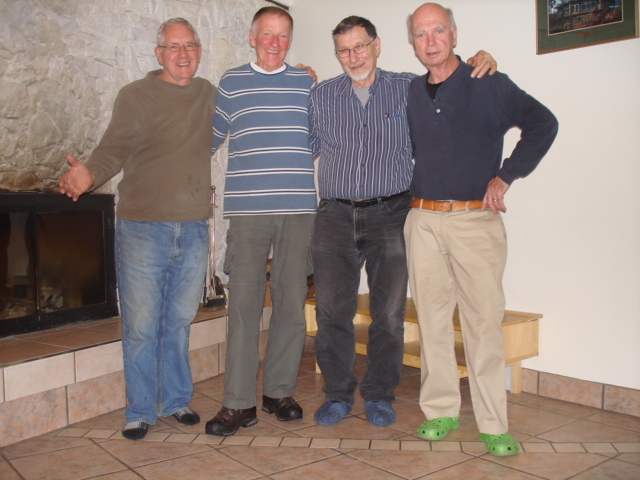
This story will cover a reunion of four friends on February 07 through 10, 2016 at Whatshan Lake Retreat. We originally met in May 1963 and separated in May 1965 with limited contact in between.

We were all selected in our graduate year by a Hiring Committee from Columbia Cellulose Co., Ltd., a company operating near a Sulfite Pulp Mill  (now shut down) in Prince Rupert, B.C., from four prairie Provinces.

  • Robert G. Miller, a Mechanical Engineering graduate from the University of Manitoba
  • Ronald G. Ross, an Electrical Engineering graduate from the University of Alberta
  • James B. Holloway, a Civil Engineering graduate from the University of British Columbia
  • Elmer W. Verigin, a Civil Engineering graduate from the University of Saskatchewan
Slightly Older Curlers Feb 2016

Photo taken at Whatshan Retreat February 09, 2016. Left to Right:

  1. James (Jim) Holloway (the camera technician)
  2. Robert (Bob) Miller
  3. Elmer Verigin
  4. Ronald (Ron) Ross

We did meet in the early 1990s when Robert was diagnosed with Follicular Lymphoma. He was able to research and develop diets and life style to add to Chemo and Radiation so that the stage 3 Cancer has been in remission for 27 years since.

Ron has survived a “Whipple” operation on his Pancreas but less that two years later he has now to overcome Liver Cancer and is being treated with Chemo. It is this occasion that has brought us together again at Whatshan Lake Retreat.

This part of the blog will concentrate on the happenings and recollections of somewhat “dulled” memories but still very refreshing and special time at the Retreat.

Ron and I got together on Saturday, February 06, 2016 to purchase all the “supplies” as we interpreted the various emails from The Fearless Foursome (TFF) that exchanged over the previous several weeks during the planning process for this event.

We left Castlegar on Ron’s pickup at 1000 hours, Sunday, and arrived at Whatshan at 1500 hours. The Rental Coordinator had asked us to prepare for a group of 11 that was to arrive at 1200 midnight.

This was Ron’s first visit to Whatshan, although he had prepared all the Electrical designs for the project to date. He acted like a pro and immediately assigned himself as follows:

  1. Turn up thermostats to 20 degrees
  2. Build fires in the cabin wood stoves
  3. Build a fire in the Retreat Fireplace

It just seemed that he was within his own environment and was having a great time.

I got busy putting all the stuff away and dealing with bedding. Most interesting was that, between two Engineers, neither of us knew how to ignite the pilots on the “automatic ignite” propane range. We were saved by the Caterer that just happened to come by and protect us from embarrassment.

We had a great opportunity to chat with Ron and shared our experiences with volunteering in the community. I was very impressed with Ron and Elaine in their International Rotary participation with assisting unprivileged children and single women in Honduras. A great personal contribution internationally and locally with Rotary projects in the community.

The arrival of guests started about 2000 hours that evening as they slowly drifted into the Retreat to enjoy the fireplace and chats that went on to midnight. We were requested to advance the Monday breakfast t6o 0600 from 0700.

Ron and I discovered that neither of us had an alarm clock and so after a fitful sleep I arose at 0400 with Ron in tow. We got a “farmer’s breakfast” menu prepared and welcomed a group of:

  • Aerospece  Engineers from Seattle along
  • Chenical Engineers
  • Structural Engineers
  • Others
  • A female cook

That were to meet a helicopter at Burton that would take them to a “hut” at the tree-line and then transport them back and forth from bottom of the mountain to the top as they enjoyed skiig in the pristine wilderness.

All were impressed with Whatshan and suggested that perhaps a better arrangement would be to just land the helicopter near the cabins at Whatshan. We will see the results!

Meanwhile Bob was meeting Jim at the Vancouver airport for their flight to Kelowna. There they would take a rental car to Whatshan. We expected them at 1700 that evening.

While waiting, we prepared the wood Barb-B-Q for steaks and whipped up a salad so that we could enjoy our welcom0ing celebrations with distraction.

The boys were on schedule and we hugged tightly but no kissing on the lips. We just started talking non-stop as there was so much to catch up on and there was a continuous flow of stories and past experiences along with laughter and joy.

What was interesting is that no one smoked and our desire for alcohol had mellowed with the years. We also had no time for card playing, nor shuffle board, that used to be part of our past times. We finally managed only one game on the shuffle board which had Bob and Ron totally wipe out poor Jim and Elmer.

So here is a list of some discussion topics that we covered:

  1. The Pulp Mill and the experiences with Engineering in a facility that just seemed doomed by a compromised management.
  2. Fishing at Terrace in the Skeena River for Spring Salmon right off the bank and the 55 and 45 pounders landed
  3. Fishing in the Copper River for Steelhead
  4. Fishing in the Lake Else River unsuccessfully only to get a better “bite” in the Lake Else Hotel in Terrace. Stopping at the First Nations house and buying Sockeye Salmon for $2.00 a fish so that our wives would not be disappointed in their fearless “Providers”
  5. Curling in the Smithers and Kitimat Bonspiels
  6. Winning the Grand Aggregate at the Marine Bonspiel in Prince Rupert and enjoying the glorious Seafood Banquet that matched no other.
  7. Drinking beer in the hotels within “Moccassin Square Gardens” at Prince Rupert
  8. Sliding down the back of Ron’s 1961 Valiant after a night in the Legion and not noticing that an RCMP vehicle was parked alongside. Ron answered the Officer’s question as to “whose car is it?” with a response “mine”. Next question “do you mind these guys climbing all over your car?” with “absolutely not as they are my buddies!”
  9. Digging for clams and then, as Prairie boys, having to look up in a cook book as to how to prepare them to eat
  10. Buying Shrimp off the boats at Point Edward at $2.00 a bucket and then asking Ron Wright how to prepare them. His instructions are not admissible for print here.
  11. Accepting Steam Engineer Syd Corbett’s  frequent invitations to go out in the Harbour in his 22′  Yacht for fishing and Crab Trapping. Then building a fire from driftwood on a deserted island to cook the crab. We also took a dangerous sortie at night to an island for deer hunting. No we were not successful.
  12. Hunting moose in Telkwa and then getting two of them back to Prince Rupert for sharing amongst six “white hunters”
  13. Because it rained all the time, there was a strong need for social engagements. We had a shower when our wives got pregnant, another when birth took place, and then a baby shower. This was just the guys.
  14. Sleeping in a tent in Grizzly country on the way to the abandoned native city of Kitsikiss. Casey scared the wits out of us we mistook his snoring for a Grizzly sniffing the tent
  15. We also enjoyed our work where we constantly challenged with a Pulp Mill that had serious maintenance issues
  16. After two years we all left at the same time.
  17. As you can see we had a great of discussion about our “suffering years”.
  18. Then we started with the possible Ice Age in 2030 as predicted by the Siberia Climatologists
  19. The proposed Mars Settlement proposed in 2030
  20. Spacex achievements
  21. Biosphere, what is it?
  22. Donald Trump and where that could go
  23. Justin’s experimenting new ways for Canada at our expense
  24. Cancer and its scientific search for treatments which was dear to our hearts. Bob explained his website Lymphobia
  25. Depression
  26. Agorphobia

On Tuesday we enjoyed a long walk around the area. We also enjoyed Shishliki from Ron’s son Jim farm fresh lamb. Oh yes, we had four delicious pies that Karen and Judy prepared for us.

We all slept in one cabin just like old times when all we had was one tent. There were hints of flatuations but nobody admitted responsibility.

Jim and Bob left at 0900 hours on Wednedsay, February 10, 2016. It was a difficult parting as we all wished Ron well in his greatest challenge to date.

Here are Jim’s comments a day after our get-together:

“…….It has been a long time since I enjoyed brain bending with such
a diverse and opinionated male group.

Although I find females even more opinionated….
I have recently come to realize that they have other virtues as well.

Bob, I actually enjoyed your attempt to set me straight on oily Curcuma. I’ve
fed my bottle of dried tablets to the dogs, who are now sleeping fitfully with the cat.
Judy has gone shopping.

Elmer, I remain in awe of your tenacity and spirit, and please digest this:
I know no other individual who comes even close to matching your selfless
contribution to the welfare of others…..I sense it is time to begin to let go of your focus on
those who disparaged your reputation. They are not worth any more energy.

Elmer, every once in a while remember and relish the feeling shared
between us old time companions who totally respect and love you.
I will be holding these few days in my memory until Bob’s snake oil stops working.

Once again you pulled us all together in brotherhood.

Ron, I don’t have anyone in my life who cherishes books like you do.
This was a revelation to me. I’d like to continue to receive your
recommendations and thoughts for as long as we can. This morning
I reached into my library drawer beside the toilet, and it flashed (not flushed)
back to me that you also read from the throne. Three books on the go all the way.
I’ll be in touch.

Jim………”

Followed by these comments by Bob:

“……Hi Elmer, Ron and Jim:

Yeah, there are times in life when something special comes along. Our “reunion” was certainly one of those. The hours we enjoyed conversing eagerly with ease on a range of topics too numerous for even Elmer to record will lead to an amusing smile or two and give us memories to last forever.

Thanks Elmer for your hospitality and to you and Ron for getting all the “goods”. I hope you guys made it back safe and sound. Thanks Jim for the photos. It’s great to hear about your enjoyable daily activities, so important at our time in life leading to ongoing “contentment”.

Here’s some info, Elmer, that you asked me to send re vitamin D. Marilyn, your daughters…you too if you wish…can ask your family doctor to requisition the 25-hydroxy Vitamin D3 test (not the 1,25 test or the test for vitamin D2). It can be included along with other items in a standard blood test, or done on its own. The cost (currently in BC) will not be covered but should be only about $65. The result should be in the range of 100 nmol/L (40 ng/ml) . Labs vary in their “target ranges”, but generally a value of less than 50 nmol/L is considered “deficient” with 50~75 being “insufficient”. The best time to test is about now at the end of the winter season, up until April 1. If supplementation is required, upwards of 5000 IU/day is safe. This amount will usually be needed to raise the level up to optimum of about 100. There is no need to exceed 150. Toxicity is of no concern at less than 200.

If a supplement is justified…and for most of us it is…get the supplement in an oil base, not dry tablets. These are available in all health food stores and most drug stores at minimal cost. There’s lots of data re the significance of vitamin D and breast cancer, indeed all cancers, on google and elsewhere. Hope this is helpful. Say hi to Marilyn. My best wishes to all.

And Ron, as confirmed several times, my best wishes to you in the months and years ahead. You look GREAT for what you’ve been through which bodes very well for the long haul.

Take care, guys. Looking forward to staying in touch.

~ Bob……”

And these from Ron:

“……Hello All

When we got home to Castlegar, Elmer sat in my truck and did soduko (or is it Sudoku?) while I got my blood tests done. He gave me a lesson while we waited for the ferry.

When I got home I left a phone message for Rachel and she happily stopped to pick up the pies. She wouldn’t take the left over Shishlick, but Elaine was happy to take it and we had it for dinner.

AND I washed it down with Scandals, Bob’s special beer. If you haven’t had your leftover Scandals beer, Elmer it’s quite good.

Today Dr. Malpass scheduled my next catscan for March 7th, which is 5 days before I head for La Penita. Then after I get back we decide whether to keep with the current chemotherapy, or up the ante. I told him about my friend who has been successfully battling Lymphoma for 27 years. He was impressed.

Bob, current therapy is Oxalaplatin & Leucovorin for 2 hours, then Flourouracil infused for 46 hours. Upping the ante would be Irinotecan which sounds nasty.

I bought some Vitamin D today Bob, so will add that to my regimen. Tomorrow is Chemo so no skiing for a few days.

At Rotary this morning I put in “Happy Bucks” for our time at Whatshan.

Elaine sends her love.

Ron……………”

And this is the story of The Fearless Friends (TFF) to this date.

Written by Elmer Verigin February 12, 2016

Testaments by Ron, Bob and Jim are unedited.

Here are additional dated comments since the original posting:

“….Thanks. I’m still talking about our time at Whatshan.

 Ron…….”

“…..February 26, 2015…..Hi Elmer and Ron: Yeah, Jim and I made it back fine. I’m presently in SoCal grinding away on website stuff and in between grindin’ away on local mountain trails. Hot here, up to 90 many days. It’s two months ahead of normal. Looks like El Nino rains were a bust…more drought forecast at least for LA south. Where’s that 2013 mini ice age when we really need it?! Hope all’s going well Ron. It was nice speaking with you on the phone. Email me any time if you think I might be able to help. I can call from here. And thanks for the photos. “Little Nona” sure has grown since the summer of 1963! …fond memories of Whatshan>> ~ Bob….”

WRITER’S REVIEW OF 2015 FROM HIS PERSPECTIVE

I kept getting scattered thoughts that preoccupied my daily life during these last few days of 2015. I have dreamed of many people that I have been associated with over the years. Some of these dreams may be trying to provide messages which I have not yet interpreted. All in all, today, I decided to put into print my understanding of the events in 2015 that have affected my life and those around me, perhaps even more than myself.

The other day, I was providing advice to some of my grandchildren who are actively considering Engineering as a career. They were enamored with the ring on the little finger on my right hand (working hand). “That is what I want to wear”, they both declared. “I want to be the ‘Groom’ and not the ‘Best Man’ ,” they repeated my definition of the difference between a Technologist and an Engineer. I was merely suggesting that all Technologists report to an Engineer in most firms using both professions.

“You must be aware that an Engineer, taking his education, will endure 44 hours a week of classes and laboratories,” I explained. “The ‘rule of thumb’ requires an equal amount of study and written work after class. This equates to 88 hours in a week where 148 hours are available. Medical professionals recommend 8 hours a night of sleep for 56 hours. So there is a 4 hour per week “window” for recreation. At no time is there any pay cheque but at all times there are expenses that require funds for room and board as well as tuition and books. This is a four year sacrifice and commitment from your young life.”

I continued, “A voracious appetite for Mathematics is an accepted perquisite and senior matriculation grades in the A’s will be required for entrance in most universities.”

“We love Math and our marks are up there,” they responded. “We are ready for the challenge!”

I looked in their eyes and I could see that they were not to be denied were searching for approval from their “Gramps” which I was proud to provide with emotion and pride.

In reviewing my business career that covered development and construction projects throughout Western Canada, I kept recollecting my 35 year years as a Rotarian with Clubs in Trail, Castlegar, Vancouver, North Delta as well as New Westminster, all in British Columbia. The emphasis on regular and punctual attendance at the weekly meetings was underlined with volunteering in the community where it was needed most. One of the most successful Rotary International achievements was the eradication of Polio in the World. A gigantic undertaking that required exceptional organization of all the Rotary Clubs in the World.

When I think about the Rotary these various mottos constitute the Rotarian:

1. “You come to this Earth and rent space. Check from time to time to ensure that your rent is paid”
2. The Four Way Test:
a. “Is it the truth?”
b. “Is it fair to all concerned?’
c. “Will it build goodwill and better friendship?”
d. “Will it be beneficial to all concerned?”
3. “Service above self”
4. And many more

The ability to socialize with everyone in the Club by their first name and extending that in every Club that would be attended when travelling.

My thoughts became sentimental when I recalled all the Rotarians that I knew, that are now passed on. I know that I miss Rotary but I know that I am not able to serve to a standard that I would find acceptable and so that will have to stay as it is.

I marvel at all the many fantastic relationships that I have been honored to enjoy. Yes there are some that could have been a better experience. How would I know quality of friendship if sometimes lesser levels did take place?

It is with these people that we were able to create projects for the benefit of many people such as:

• Seniors Housing Projects
• Whatshan Lake Retreat
• Doukhobor Museum
• Youth Drug & Alcohol Treatment under Freedom Quest
• Other Projects

Yes, there was sacrifices by all involved but the results are significant and most of the work was performed without fanfare but as “service above self”. All of us obtained this satisfaction.

I am enjoying my “twilight years” with Marilyn. These times are celebrated with our family that has chosen to live near us in the Kootenays of British Columbia. I realize now that financial riches are not equivalent to family love. I am indeed very fortunate!

It seems that Marilyn and I have left a legacy of investments in friendships that covers all of Western Canada. No matter where we travel, there is someone in almost every community that we should visit. Unfortunately, we are usually too “uni-destined” to enjoy the spare time tie to visit everyone. It is the usual comment “next time we will need to appropriate more time to visit”. Yes I know, we are running short of time in many ways.

One of the greatest events that has taken place for s recently, is our trips to Kelowna Hospital, January 04, 2016. Marilyn has suffered several medical emergencies over the past three (3) years and it was time to obtain an Angiogram to determine if there were compromises of any sort in her heart. Not always do patients receive good news after such an examination. In our particular instance, Marilyn was advised that she had no blockages surrounding her heart.

It is with this great news, that Marilyn is determined to live the rest of her live to the fullest. That means an unrestricted participation in Garage Sales and Flea Markets for the “best deals”. Yes, I am joking but this blessing from God has been seriously accepted by both us.

I was able to finally complete a detailed factual account of the Grandview Project with a group of members of the Kootenay Columbia Seniors Housing Cooperative. It was an achievement to document it all in a professional manner. This project had encountered some difficulties that are being studied for resolution. Hopefully, that will take place soon so the project may achieve completion.

This blog entry was not intended to be a full article but it simply a reflection of the Writer’s thoughts at this date.

1. I started this as musings on January 02, 2016 in my Office at 145 – 4200 Grandview Drive, Castlegar, B.C. 1845 hours by Elmer Verigin
2. I continued on January 22, 2016 as distractions and organized thoughts come to me.
Posting of this blog took place January 24, 2016

SYRIAN REFUGEES IN CASTLEGAR, B.C. ??

My nephew, Darrell Verigin, came to visit me the afternoon of January 14, 2016. The visit was much appreciated and he was very excited about something. He dropped the latest edition of the Castlegar News (January 14, 2016) on the Dining Room table and directed Marilyn and I to read a page 4 headline:

“Castlegar Refugee Project (CRP) preparing to sponsor family”

This newly organized group in October of 2015, the article outlined, has the objective of sponsoring a Syrian Refugee family and requires $18,000 before they can submit their application for sponsorship to the Federal Government. The ultimate fund raising goal will require $20,000 to $30,000 to cover the costs of sponsorship in collaboration with the Government.

“I immediately went to the Heritage Credit Union (HCU) and donated $100,” Darrell emphatically stated. (The HCU was accepting donations on behalf of CRP and matching all donations up to $2,500).

“When I thought about this,” Darrell continued, “I immediately thought of my ancestors, the Doukhobors, and how they were so graciously accepted into Canada in 1899. If they had not been sponsored, without any reservation, by the Quakers and Lev Tolstoy in their plight with the Russian Government and religious persecution, it is unlikely that I would not be here to talk about this today.”

It is with his urging and enthusiasm, that I write this blog entry and encourage all of you to support this campaign initiated by the CRP. A call to Rosemary Manarin, chair of CRP, at (250) 365 6470 will inform you of the many other methods that you can participate such as:

• Positive outlook to the project
• Gifts
• Furniture
• Housing
• Doctor and Dentist treatment
• Housing
• In-kind support
• Clothing
• Other essentials to a family that will arrive with nothing

The CRP is a recognized constituent group, under the auspices of the Anglican Diocese in the sponsorship agreement holder with Immigration Canada. The Committee already has ten (10) members and thirty (30)volunteers.

Obviously, it is up to each and every one of us to participate in which ever manner we can.

1. As requested by Darrell Verigin on January14, 2016
Written on January 24, 2016 in my Office at 145 – 4200 Grandview Drive, Castlegar, B.C. 1845 hours by Elmer Verigin

Failure is a Resource??

My son-in-law, Rick Woodhouse, and daughter Lori, lent me on June 13, 2015, a pamphlet, “YOU 2” written by Price Pritchett. I am recovering from depression and they were realizing that I needed therapy of a positive nature, to have me continue to a save recovery from this dehabilitating conditions.

You 2 is a high-velocity formula for multiplying your personal effectiveness in Quantum Leaps.

Probably, the largest contributer to my condition was the result of the stoppage in completing the seniors housing project, Grandview, at Castlegar, B.C. In my role as Project Manager, I felt that not being able to complete Chateau Grandview, the campus style complex was a direct reflection on my personal limitation. I realize now that, the contributing elements were beyond my control.

This excerpt from You 2, page 25, is worthy to quote as follows:

“……Seek failure……

Quantum leaps demand a willingness to make mistakes.

You cannot leap up to a safe zone of behavior where you have beaten the odds of failing. An unwillingness to encounter defeat or run into problems outlaws quantum leaps. Unless you allow yourself to make mistakes, to fail, you will never have the opportunity to set limits of what you truly are capable of accomplishing.

You must realize that if you’re experiencing no difficulties, problems, or pain, you probably have aimed too low. You leveled off your growth and achievement. You probably are far from reaching your limits.
So think of problems or pain or slippage in performance as a positive sign. A performance lag ordinarily occurs at the very outset when you are making a quantum leap. It’s the pause during which you poise for the jump, the temporary loss of momentum that occurs in the process of “changing gears”.

You deliberately destabilize yourself when you break out the habit patterns that represent the status quo. You create some inner chaos for yourself. So be prepared for the possibility of confusion, anxiety, and failure. That’s part of opening yourself up to new methodology that has the potential to deliver exponential performance gains.

So often in life, it seems things first get worse on the way toward getting better. Be prepared for that sort of development. Problems belong in the process. They are part of the equation that produces you2. They are not proof that your ambitions are futile or that you should give up.

As someone has said, “Everything looks like failure in the middle.” You can’t bake a cake without getting the kitchen messy. Halfway through surgery it looks like there’s ben a murder in the operating room. If you send a rocket toward the moon, about ninety percent of the time it is off course – it “fails” its way to the moon by continually making mistakes and correcting them.

At the outset you may feel high because going for the quantum leap is heady stuff. But then the hard reality of “problems” may slap you in the face. Progress often masquerade3s as trouble.

It’s easy to lose faith, because other people may withdraw their support and be critical of your efforts. That, plus your own anxieties and uncertainties, can tempt you to turn on yourself.

This is then crucial point in the process – don’t give up! Failure belongs here. It’s a sign of progress!

The stress will seduce you toward retreat to the “safety” of the status quo, the trap of familiar. Just remember this. Failure does not mean you’re defeated.

Actually, the struggle gives you strength. It’s like tempering the steel, or the soreness involved in developing muscle. The difficulties are just evidence that you’re learning and progressing.

So go looking for failure….and the use it. Don’t interpret problems or breakdowns as proof that yu should quit, but instead take them as evidence of your growth and improvement.

Failure is a resource. It helps you find an edge of your capacities……”

I am taking this article as a thrust for me to9 go forward and complete what has been started.

Written on January 21, 2016 in my Office at 145 – 4200 Grandview Drive, Castlegar, B.C. 1030 hours by Elmer Verigin, and quoted from a pamphlet YOU2 by Price Pritchett

VERIGIN 2015 CHRISTMAS STORY

FROM ELMER & MARILYN VERIGIN
Marilyn and Elmer awake suddenly and we are now a three quarter century old. Really! Did any of you get older?
Now an update as best I can remember (Hoooh, I am 75 you know)
• Let us start with Marilyn. We had challenges this year in Saskatoon but with the excellent Care that Saskatchewan has, she is still with us. I was able to retain my job as chauffeur with a 100% increase in pay. Those Cabbies in Toronto do not know how to negotiate!
• Of course we travelled to Saskatchewan. Involuntarily in February to bid adieu to our friend Keith Tarasoff. We just had too many happy times to recall but parting was still difficult.
• We went back in September to celebrate 60 years of the Saskatoon Doukhobor Prayer Home. Marilyn and I locked eyes at this Hall in 1958 and remain mesmerized ever since. It was great to meet those of the Saskatoon Doukhobor Youth that were able to make it with much hugging and just trying to recognize each other. Where did all those years go?
• We also spent time n Benito visiting with sister Mary and family on that trip in September. We followed this up with visiting all our friends and relatives in the Saskatoon area. Alex Derkachenko fries the best potatoes and Mitch drinks the best Scotch. We are still looking for Donna Hunchak’s chicken receipe.
• Whatshan Lake Retreat remains our most active volunteer passion. This year many younger members are undertaking a feasibility study to launch programs and events into a new dimension along with retaining the site for much of the former programming. Go to http://www.Whatshan.com and have a look. We did lose our most faithful fan,
• Aunty Flo Markin passed on in late October. Not to be forgotten she booked 3 cabins, for her family outing, as usual, on the 2nd week of July 2016. She expects to attend in spirit. What a lady and my last Aunt!
• The Doukhobor Cultural Association has completed its objective to distribute all its assets and now exists as a social club that recalls the 45 years of working together.
• We are still struggling to get our Grandview project back on track and at this time there is little to report. Watch Elmer’s blog for an update on status.
• Marilyn is very much into her Grandview Ladies Circle and Hospice Organizations. Oh yes, there is the “occasional” Flea Market and Garage Sale and at times the slot machines command her attention.
• Elmer is still in the Kootenay Mens Choir and desperately trying to learn how to Curl with this stupid stick that throws the rocks off line. He is still trying to gather more stories for his blog.
• In retirement, Marilyn and I have slowed down a great deal as I will demonstrate in this one month from the end of October to the last week in November
o Attend Aunt Flo’s funeral in Calgary
o Spend a work weekend in Whatshan dealing with dangerous trees and “bucking” them into firewood
o Attending Tamara’s Master’s graduation in Victoria
o Visiting with Marilyn’s brother Allan and wife Leah in Nanaimo. Witnessing Allan taking his cat for a walk was well worth the trip
o Taking my appointment with a Hearing Surgeon for a possible implant in Vancouver. He was very encouraging and said that my chances for success are the same as a “Hail Mary” in Football.
o Visiting with Peter and Elsie Rezansoff and enjoying their hospitality
o Attending a 40 year celebration of the Independent Contractors and Businesses Association (ICBA) at the River Rock in Richmond
o Yes we ached for a week or so after returning.
Our children and their partners are enjoying their professional careers in many disciplines. All are happy, healthy and well fed.
We are really enjoying our grandchildren along with their partners. The group is now expanding with our second great grandson. Did I say “great grandsons”? That is definitely our wealth! Our grandchildren are tallied as 3 College and Diploma Grads; 4 attending College; 2 in High School and 1 pursuing a professional Golf Career, There is no quetsion marilyn and I are very proud of them.
As for their parents, grandparents and great grandparents, it is interesting that we lost all three phones for days at a time. Do not despair when we do not answer the phone right away, as we are still looking for them.
Do come and see us! We love you all!
Merry Xmas and a healthy New Year in 2016 and beyond!
Elmer and Marilyn – December 18, 2015

A QUOTATION FROM THE CHANCELLOR OF ROYAL ROADS UNIVERSITY

I was a very fortunate parent and privileged to attend the graduation exercises at Royal Roads University in Victoria, B.C., this past November 10, 2015. It was the occasion of my daughter Tamara Louise Verigin-Burk’s graduation with a Master’s degree in Leadership.

The ceremony was awesome and very significant in the life of our daughter but along with the process we were able to personally meet the Chancellor of Royal Roads, Dr. Strandlund. He just casually walked up to our family group and started chatting. It was later in the conversation that he introduced himself after asking Tamara questions as to how she found the professors and the Royal Roads education system. He was very interested in her responses. We were impressed with his simplicity and humility.

It was with great interest, on my part, when I inspected the “tiny” ticket that we were provided with to enter the theatre, when I read the “fine print” to appreciate the message thereon:

AVOID     PRACTICE   WORKS OF MERCY

Anger       Patience       Feed the hungry
Greed       Generosity   Give drink to the thirsty
Gluttony  Moderation Clothe the naked
Jealousy   Confidence  Shelter strangers
Laziness   Diligence     Solace the sick
Lust           Dignity         Minister to prisoners
Pride          Humility      Bury the dead

On the reverse of this ticket is this message:

VIRTUES         PERILS TO HUMANITY

Courage           Commerce without Morality
Justice              Knowledge without character
Prudence         Measure without Conscience
Temperance   Politics without Principle
Faith                 Science without Humanity
Hope                 Wealth without Work
Charity             Worship without Sacrifice

This message was printed on a 7.5 cm x 3.5 cm surface.

My take on this is that the Chancellor had a purpose in so doing as many people have a quick look at a ticket of this nature and find that it is a certain color and usually has little or no message. Once a curious person starts reading this coupon, one realizes that there is a real message. I for one was impressed!

Thank you Chancellor Strandlund!

1. Taken from a “ticket” to the Royal Roads University graduation ceremonies held at the Victoria, B.C., Theatre where my daughter Tamara Verigin-Burk received her Masters Degree in Leadership, November 10, 2015.
Transcribed on December 03, 2015 in my Office at 145 – 4200 Grandview Drive, Castlegar, B.C. 0915 hours by Elmer Verigin

An Experience with the Saskatoon Doukhobor Youth (SDY), September 05 and 06, 2015

Notices for a sixty (60) year anniversary for the construction of the Saskatoon Doukhobor Prayer Home were sent out by a volunteer Committee who planned this event since the Spring of 2015.

A suggestion by Paul Shukin to Mitch Ozeroff at the seventy (70) anniversary since construction of the Lundbreck Hall during Peter’s Day on June 28, 2015, created the idea of encouraging the original Saskatoon Doukhobor Youth to come to the Home on Saturday, September 05, 2015 from 1900 to 2100 hours. Since most members would likely attend the scheduled anniversary the next day, Sunday, September 06, 2015, this made sense.

So it was that contacts were made with those members where information could be obtained and so some members received two notices of the event. Unfortunately, many of the approximate 175 former Choir Members could not be contacted at all due to lack of contact information.

Marilyn and I arrived in Saskatoon September 01, 2015 and visited many relatives and came to Mitch and Dorthy’s place in Langham on Thursday, September 03, 2015 to find that Jack and Jan Tarasoff from Calgary were already there. So you might say that the festivities were already in session.

Dorthy was distracted and upon questioning, she admitted that she was concerned how the food and other items would come together with emphasis on volunteers coming to help. The challenge was five (5) canners of borsch for the indicated 150 responses of people coming to the Sunday event. She decided that she would do this in two (2) stages creating three (3) canners on Friday leaving the remaining two (2) for Saturday.

Marilyn agreed to assist and so we arrived about 1000 hours on Friday to find the basement kitchen abuzz with ladies and some men. The well organized team had specialists from cabbage shredders, carrot cutters to mixers and a total of over thirty (30) volunteers were busy swapping stories as they performed their tasks. I had to quickly move aside to avoid being run over by a smiling Doukhobor carrying quart sealers of completed borsch to the Cooler.

So the group convinced Dorthy that all five (5) canners could be completed in that same day and early in the afternoon the deed was done!

So now to Saturday evening, September 05, 2015, and the anticipation as to see who would show up from the original SDY. By the time 7:00 P.M. came, there were 47 registrants. It was exciting as many could only be recognized by their name tags followed by hugs and at times, tears, Where were the young smiling faces of 57 years ago?

Mitch welcomed everyone and suggested we go around the room to have everyone introduce themselves and a bit about what they had done and where they were now. This was followed by singing three hymns and two songs from a repertoire of the former SDY. Amazing, it sounded good as the majority even though many had not sung in a choir since leaving the SDY.

Too soon the scheduled two hours passed by and the “formal” session adjourned only to continue with visiting and keeping a tally on just how many children everyone had and where they were. It was sad to note that some had passed on but the overwhelming friendship and Doukhobor love prevailed until, reluctantly all went home so that preparations to attend the Sunday Moleniya could start.

Yes, we had to arrive early to get a good seat as 150 people were expected and there was just enough chairs to seat all of them.

The Sunday morning started with a Moleniya conducted by Mae Popoff and ended in time for the meal catered by all the volunteers. The space in the lower floor was not able to accommodate all the attendants and two settings were required. It was like the old days when small halls would require multiple settings. No one complained as the food was more than ample with the usual left-overs, typical of Doukhobor hospitality.

The afternoon program opened by June Bold, Chair of the Saskatoon Doukhobor Society with a welcome from a Saskatoon Councillor Ward 2, Pat Lorje. She under-lined the cultural mosiac of Saskatoon with the Doukhobors being a significant part of that rich culture and thanked them for their adherence to the principles of Peace and Community participation.

Michael Ozeroff made a presentation on the youth choir activities that took place in the Saskatoon Prayer Home with his text as follows:

“……..60 Year History of the Prayer Home

I think one of the most notable events to take place in this facility is the very beautiful singing and a cappela style of the Doukhobors.
Over the years many events have taken place from local choirs and groups to visiting choirs from outside of Saskatchewan and Canada. Let me give you an example thru the 1950’s and following years choirs have visited from B.C. both USCC members to a youth group who visited here
from Krestova, choir from Grand Forks, Kootenay choir with spokesperson Peter Samoykoff as well as the DCA, a smaller group with Elmer Verigin as the leader then.
In the mid 80’s a peace rally was held at Dana Sask which saw about thirty Molokans attend the peace rally, and performed at the evening program.
This area was very fortunate to have a large group of youth attend the singing practice for many years. This group was formed in the mid 50’s; in 1958 Peter Kalesnikoff became the choir director with help from Ella Boki. Following this year the Saskatoon youth choir kept expanding for the next decade.
Peter and Ella were with us for one season followed by Peter and Mary Ewachiw and this year, 1959 saw the first year of our annual variety nites were held. These programs lasted a total of ten years with groups coming to perform from other areas of Saskatchewan, Alberta, and from B.C. the farthest being 1963, a bus load from Grand Forks and the Kootenays preformed. The Sask youth attended many services here in this facility, over the many years it is estimated the youth had 200-250 members form the districts coming for further education at the U of S. Mitch Ozeroff was choir director for eight years, followed by Violet Woykin.
Many religious services were held over the years, Peter’s Day celebrations, Funerals before funeral homes came on the scene, a Doukhobor convention once called the union of Doukhobors in Canada with delegates from western Canada were present.
We saw a few of our youth married with this prayer home. We used this Dom for many years to prepare for folk feast in fact on separate occasions as our pavilion and as mentioned for bread baking preparations.
We’re seen on three occasions taping of three choirs in this building the first being Saskatoon Blaine Lake choir, Double Album, Peter Kalesnikoff Director, the taping of the Saskatoon Senior choir. Mae Popoff Director and taping of the Saskatchewan centennial choir, varies from many Saskatchewan Districts Mitch Ozeroff Director.
Members from the society, on various occasions went as choirs and groups to visit our friends in Saskatchewan and as well as outside of the province, to conferences, and appearances using the prayer home as home base.
We remember the many time parents of smaller children teaching Sunday school classes, teaching singing and a number of times having the children perform on a variety of Nites. Teaching Russian classes to children and adults were also held.
We must applaud the groups before, the trusties for their enthusiasm, for these visions to build this facility. As former youth we were treated with respect they helped us and we hope this will continue with the future.
Thank You
Spasibo

Alex Postnikoff presented a detailed history on the construction of the Saskatoon Prayer Home as follows:

“………………………THE EARLY DAYS

Thank you to the planning committee for arranging this celebration and for establishing some guidelines for the length of our presentations.
In my presentation, I will try to capture at least some of the impact the founding members have had on the local community, province, and even nationally! The original board members – Bill Sherstobitoff (intellectual), John K. Tarasoff, Alex Vereshagen, Alvin Meaken, and dad – Mike Postnikoff would not have anticipated, but that happened!
I knew each of these people personally, and while I didn’t as a 20 year old in 1955 know what motivated each of them, it’s clear that collectively they were moved to provide:
– a place of worship and a place to honour tradition
– a place to express their philosophical views particularly through the psalms and acapella singing.
The Doukhobors arrived in Canada in 1899. Our dad, like other Doukhobors, was born in the side of a hill, in the village of Petrofka, in the spring of 1900.
I have often stated that our dad’s humble beginnings made me an insignificant soul, irrespect of my station in life!
Born into limited means, having been a ferry operator on the North Sask. River at Petrofka over a 20 year period and later a farmer, shaped his thinking and contribution to the construction of this Prayer Home. Indeed, the experiences of his fellow board members would have done the same. We are all a product of whom we meet and what we experience.
Suffice it to say that each of these board members were good, unselfish and honourable people who wanted nothing more than the best motives for the preservation of the Doukhobor philosophy and way of life.
While some people might refer to Doukhoborism as a religion, many would refer to it as a philosophy or “a way of life”.
As a very young child attending the Prayer Home in Blaine Lake, I used to stare and wonder what the motto, “TOIL AND PEACEFUL LIFE” meant! Little did I realize that it was this motto that drove me in my professional life!
Prior to the construction of the Prayer Home in 1955 and ’56, our parents and grandparents gathered in private homes, usually on a weekly basis in less busy farm times, to enjoy their “SPEVKY”, and to provide them an opportunity to keep their “way of life” alive. The young children often tagged along. This in no small way helped me sniff out my life’s partner!
I know from our dad’s statement around the kitchen table that the board shared many common goals including that the Prayer Home should be a place of worship, a place of gathering for young and old, a place where all could promote the annual remembrance and motivation for St. Peter’s Day, a place to welcome special visitors and a place to acknowledge the invaluable contribution of the forefathers including Count Leo Tolstoy (who wrote “the spirit of God is in each person”) in bringing us to a land of religious freedom and opportunity.
We should never forget the contributions of the Quakers and Mennonites.
As time went on we had to be thankful for the help, acceptance and recognition of our friends and neighbours the Browns, McIntyres, Waldners, Spencers, Cionas, Thordarsons, Kichulas, and the thousands of others.
Not unlike any board in the broad general community, they had to address many questions. Among them were, where should we build, how much land should we purchase, how large should the Prayer Home be to accommodate the growing urbanization of the Doukhobors, what kinds of activities will be held in this structure, and what future needs can we anticipate?
In addition to the above considerations, the board wished the Prayer Home to be a place where young people could receive the blessing and acknowledgement of the congregation as they publicly exchanged their vows in marriage.
As providence would provide, Marlene and I were officially married in this Prayer Home on October 24, 1957. Others so blessed were:
-Jack and Florence Cheveldayoff (1962)
-Alfred and Betty Kabatoff (1963)
-Ned and Alex Reiben and their spouses, the dates for which I could not find confirmation.
Weddings in the early years were usually large and often catered to by the parents of the bride and groom. Our parents hosted 450 guests at the Avenue G Hall, next to the Dairy Queen on Twentieth Street in Saskatoon.
Some 35 years ago the Doukhobor Society of Saskatoon was placed on the national stage. Two major conventions, with delegates from across Canada came to Saskatoon.
-300 delegates attended the Canadian Association of School Administrators (CASA).
-1000 attended the Canadian Education Association (CEA).
The CASA convention centered around the theme “A Harvest of Ideas”. Our Saskatoon based committee of seven wanted something unique to the West and specifically Saskatchewan. Since these conventions were alternately staged in Eastern and Western Canada, they also reflected a bit of Canada, they also reflected a bit of friendly competitions between the two regions.
How about a threshing demonstration in the middle of September, in the heart of the “Prairie Bread Basket”.
How about fresh bread from the nearby Doukhobor ovens adjacent to the threshing demonstration? What a way to observe a threshing demonstration with a warm slice of bread, butter, jam, and coffee! Have you ever seen 300 smiling
adults on a beautiful sunny afternoon?
As I reflected on the early morning and rather cool temperature, it seemed almost impossible to get the required number of loaves to rise and be ready for the 4:00 p.m. demonstration. Skilled bakers like my in-laws, Annie and Bill Kabatoff, Dorothy and Mitch Ozeroff, Fred and Mabel Ozeroff, and my wife, Marlene, went to work with resolve and determination. For my in-laws and Mitch and Dorothy, this was the middle of harvest, and Canada applauded them for their effort. The threshing demo was a resounding success to say the least!!
At the evening banquet at the Western Development Museum, the Doukhobor Society of Saskatoon played a major role as well. On 38 tables, instead of flowers or pretzels, was featured a loaf of freshly baked bread, salt, and water – this was a committee decision! Delegates by provinces, were seated at tables of 8 and the 7 committee members spread themselves among the delegates. Unknown to the delegates at each table was a ribbon attached to one chair. Now you know why the ribbon. What a hit!!! Loaves of bread went from Victoria to St. John’s, NFLD and places in between.
I sat with 7 delegates from Nova Scotia. One of our table guests, perhaps naively asked, “What kind of people are the Doukhobors?”
I replied, “They’re a lot like you and me, in fact, you wouldn’t be able to recognize one by looking at one!” I added, “They’re just common folk!”
I told you this story about CASA not because of my role as a member of the planning committee, but rather because of the dream that our Doukhobors had for their children and future generations. They wanted our people to make a peaceful, constructive, positive contribution to Canadian society, and to spread their humanitarian tentacles throughout the country and the world!

The Doukhobor Society of Saskatoon is but one important vehicle. But you, the people, sitting before me, having served in your various capacities are and have been the messengers and deliverers of these dreams.
Your collective contributions have left their marks in agriculture, medicine, law, education, the arts, business, the trades, journalism, tourism, and virtually every human endeavour known to man!

Thank you, “TOIL AND PEACEFUL LIFE”.

Alec Postnikoff…………”

William Kalmakoff presented a history on the bread-baking which the Saskatoon Doukhobors instigated as a fundraiser:

“……DOUKHOBOR BREAD BAKING STORY

Today we celebrate 60 years since the Saskatoon Doukhobor Society was formed. We also celebrate 60 years since Doukhobor Bread Baking became a public event. Actually Public bread baking began even before the Prayer Home was built.
Let’s go back a few more years. It was in 1947 that the Western Development
Museum was established on 11th street in an old airplane hanger. Throughout the years numerous exhibits were collected including a steam engine, old threshing machines,
harnesses, blacksmith shop, and even a driving coach supposedly owned by Peter Verigin. The museum was open to visitors but interest did not appear to be great. In
1954 the Museum organized a Thresher men’s Reunion which was held from October 8- 11 on a Thanksgiving weekend. There was an astonishing response as over 5000 people
attended and was documented by the National Film Board and the Canadian Broadcasting Corporation. People were enthused about the old machinery in action, pioneers at work and progress that had been made.
The idea of Prairie Pioneers in action became the show that was labeled Piona
Era. 1955 was Saskatchewan’s Golden Jubilee year and the event was scheduled for July 4-9. On the WDM grounds was a clay oven build by a Ukrainian man from Choiceland. The Doukhobor Society was asked to participate in demonstrating bread baking and to sell the product. Under the direction of J.K.Tarasoff another outdoor bread baking clay oven was built close to the original one. Flour was donated by the Pool and taken to private homes where the ladies made the dough then the dough was taken to the WDM grounds to a trailer to be put into pans and then baked in the Clay oven.
The 1955 Piona Era Souvenir Program indicated that at 10 a.m on the first day of Piona Era there would be the first batch from an out door clay oven and near the front of the booklet was a picture of three Doukhobor women. Bread was sold for 5 cents a slice with loaf selling for 50 cents. Society minutes dated September 20, 1955 reported that 400 dollars was realized from bread baking at Piona Era.
In 1956 Members from the Saskatoon Doukhobor Society built a Pioneer Log
house as a sample of the dwelling used by early Doukhobor settlers on the praries.
The inside was set up as a pioneer home and was used during the day having women demonstrate carding wool, spinning and weaving. That year bread dough was mixed in the newly constructed Prayer Home. Men took the dough to the WDM and then the ladies rolled out the dough, put it in pans and baked it. They worked and sang till late at night and some even slept over night in the sod house. The second year of Bread Baking 1956 netted approximately $ 850 profit.
Unfortunately, that year, just before the end of Pion-Era, the wooden under structure beneath the portable clay oven caught on fire and rendered the whole structure
beyond repair. Because the Society members were enjoying the fellowship of bread making, the exposure to the general public and the very positive feedback they were getting because of the bread and the published newspaper articles they decided to continue. Plans were made to build a three unit oven enclosed under a roof , with an attached room for making the dough and setting out the pans and space for a sales area. From then on bread baking during Pion-Era would not be affected by the weather. The unit was completed and in 1957 the net profit increased to$ 1,760.
With a permanent enclosed area, participation in Piona-Era continued through out the years, with the profit going to the Society and enabling the Society in 1961 to raise the Prayer Home and construct a basement undeme th. The provision of free flour from the Wheat Pool (52 one hundred pound bags) and butter from the Dairy Pool, Co-op, and Palm helped with increasing the profit even though a concession fee of $225 was mentioned in records for 1960. In 1961 Pion-Era board promised up to $5000 to the Society for relocation expenses if necessary to ensure that the Bread Baking remained a permanent feature at Pion-Era. Minutes of the Society indicate that on May 30, 1965 it was decided that the Society protest against Pion-Era WDM relocation. Other dates include 1966 a motion made to pay volunteers one dollar per hour worked and in 1967 the sale of borsch was introduced. 1969 motion to rent or purchase a cash Register. However in 1972 the WDM was moved to Lome avenue. The Doukhobor clay ovens were also moved to the Exhibition grounds and the Society passed a motion allowing non members to work at the bread booth. Museum and exhibition event were
combined for Pioneer days called Saskatchimo days. By the 1980’s the WDM and the
Exhibition began to distance themselves from joint celebrations and by 1990 the WDM was no longer took a part in the Exhibition activities. The Doukhobor Society continued to bake bread during Exhibition days. In 1978 the old ovens were demolished and three new clay ovens were built on the same location. The ovens were built in such a way that they could be moved and a shelter was constructed. This was made possible with a grant of $7,000 obtained from the Canadian Secretary of State office. By 1984 the bread baking income had reached $20,000 a year.
Now let’s go back to the start of Bread baking at Pion-Era WDM in 1955,
Although Doukhobor Societies had existed in various parts of the province, their members were mainly farmers and little publicity was generated except news about Doukhobor resistance during the World wars. The organization of the Saskatoon Doukhobor Society and Bread Baking during Pion-Era, the public response and newspaper and radio broadcasts depicted the Doukhobors in a very positive cultural way. Doukhobor participants were shown to be dedicated, hard working, co-operative, and had peceul relationship with each other and the general public {Toil & Peaceful Life).
I have reviewed some of the major moments in the history of Doukhobor Bread

Baking. Now to present times. The clay brick ovens and temporary ?? Structures are
still on what was deemed to be a temporary location on the Exhibition grounds. There is no longer any connection with the WDM.
At the start of Bread Baking at the WDM it was a temporary service, but there was public acceptance, some meagre money gain, and means for member cooperation.
Bread baking has become a tradition, a public demand, a source of financial gain, means to unite Society members, to encourage and involve youth and to participate in a larger public community. Hopefully as we go about our tasks, we still maintain the belief that to be useful, productive, and successful individuals we still have to feed our body, our mind and our spirit. As evident by the Display of Bread (food for our body,) Salt symbolizing attainment of wisdom of the mind, water symbolizing the Spiritual development of Human life.

In summary the Key moments in Doukhobor Bread baking appear to be:
1. The original start at WDM grounds Pion-Era in 1955, the public acceptance, recognition and newspaper publicity.
2. The building of the log cabin and showing of more Doukhobor talents (spinning wool weaving.)
3 The construction of three ovens with a shelter and serving area.
4. Move to Exhibition area after WDM moved to present location on Lome avenue.
5. Motion to allow non members to work at Bread booth
6. Grant from Secretary of State to rebuild ovens.
7. Participation in Folkfest.
8. Stay with Exhibition Board rather than WDM
9. Still located at original site on Exhibition grounds and Doukhobor Bread still in demand by the general public.
!0. Today’s celebration part of Labour Day weekend .And Perhaps in the Baking of bread the Doukhobor Motto of Toil and Peaceful Life is still as important today as it has been in the past.

June Bold was able to complete the program at 3:30 P.M. with some closing remarks. After some visiting and lingering by many who just wanted to treasure the final moments.

Many thanks to all those that assisted in organizing this event along with all those who brought food to add to the delicious borsch.

Just another blog entry of a lasting memory of Saskatchewan and especially the wealth of Doukhobor hospitality.

The above article is strictly the observations by Elmer Verigin September 05 and 06, 2015 at the Saskatoon Doukhobor Prayer Home, 525 Avenue I, Saskatoon, Saskatchewan
1. Acknowledgments to the following Presenters:
a. Alex Postnikoff
b. Michael Ozeroff
c. Bill Kalmakoff
2. Thank you to the information provided by:
a. Edna Wright (Edna is intending to send me her comments on Doukhobor singing)
b. June Bold
3. Blog entry was drafted October 17, 2015
4. Emendments can be expected with time
5. Check my blog for Saskatoon Doukhobor Youth (a dated Society) for names and addresses of members